



Basketballexercises for u15
- Alternate between squatting and standing while dribbling.
- Dribble while sitting down and standing up again.
- Dribble while lying on your back; stand up while dribbling at the signal.
- Dribble while lying down and standing up again.
- 2 rows of which 1 row has the ball.
- Passes to the middle line from the middle line 1 vs 1.
- When passing, make sure the persons keep running straight and don't go sideways.
- free play on 1 or 2 baskets,
- depending on the number of players.
- NO dribbles only passing.
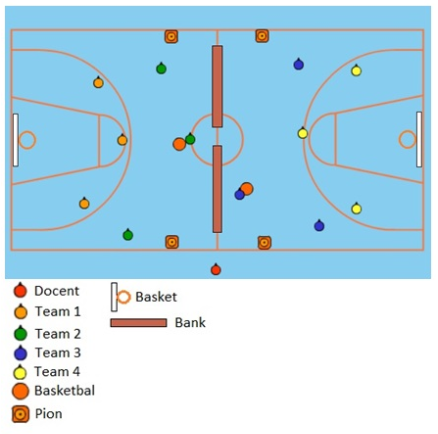
- The teacher divides the room into two squares by placing benches on the centerline of the room.
- Then the teacher makes 2 squares with pawns to catch up the right of attack.
- During this game the rulebook is used.
- See module basketball for this guide.
- The teacher divides the students into teams of 3, possibly with a substitute.
- See the tables at the bottom of the lesson preparation for the game schedules.
- The intention is that the team that has the ball (on the map team 2 & 3) try to score.
- To be able to score, the team must first get the right of attack.
- They get this right of attack when they arrive with the ball in the area of the pawns.
- From now on the team may score.
- They do this by shooting the ball into the basket.
- The other team must try to take the ball away from them.
- When this happens, the teams swap roles and the new team with the ball has to get the right of attack and try to score.
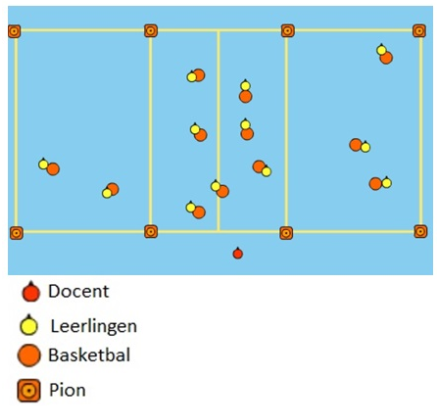
- The teacher sets out three areas of approximately equal size with pawns.
- It is best to use the volleyball lines (see map).
- There are three sections (see map):
- Left: barons square (losers square)
- Middle: princes section (neutral section)
- Right: king of the court (winner section)
- All students stand in the middle section.
- With a signal from the teacher the game starts.
- All pupils have to try to tap/strike the ball of another pupil out of the box.
- If you succeed you move one square to the right.
- If your ball is knocked away you move up one square to the left.
- If you hit/tap someone's ball out of the box on the right you score a point.
- If your ball is knocked out of the winner's box you lose all your points.
- If your ball is knocked out of the left box nothing happens and you stay standing.
- When the teacher gives the final signal the person with the most points is king of the court and he/she has won.
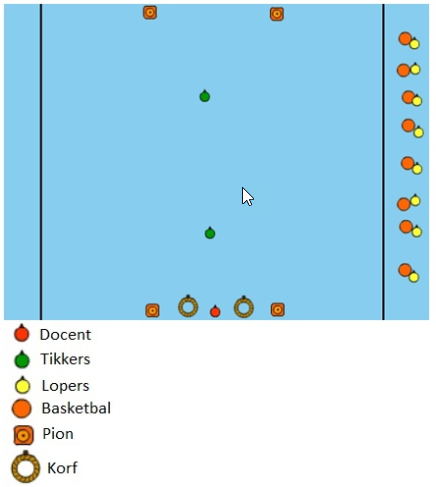
- The teacher chooses 2 tickers.
- They have to stay inside their box (inside the 4 pawns) and knock the basketballs away from the runners when they want to cross.
- The runners have to dribble to the other side without losing their basketball.
- If a runner doesn't have his basketball with him, he's out and he automatically becomes a ticker.
- A tip that you can give to the runners is that they should shield the ball with their body.
- This means staying between the ball and the opponent.
- The pupils may only cross again when everyone has been tagged or has reached the other side.
- In the end, as the game progresses, you get more and more tickers and less and less runners.
- The last remaining runner is the winner.
- We're gonna dribble!
- Dribble the ball from left to right.
- With feints in between. High. Low. Fast and slow.
- Look closely at the options you have.
- The planet Saturn is the planet with the rings.
- So can you guess how the Saturn exercise goes?
- Spin the ball around your left leg, your right leg and around both legs.
- There is no dribbling involved, but this exercise is very good for your hand-eye coordination.
- There are rows of players on both sidelines.
- The front player of each row has a basketball.
- These players dribble to the sideline on the other side and play the ball with a bounce pass to the second player in the row who is now automatically in front.
- The first player closes in behind and the second player now dribbles across.
- The players practise the overhead pass (with 2 hands, from above the head) and vary the distance
- Players stand in a circle with 1 player in the middle.
- One player starts and throws the ball with a chest pass to the player in the middle.
- Then the first player runs after the ball to the middle.
- The player in the middle throws the ball to the next player in the circle and then runs after them etc.
- The players stand in a circle and pass the ball to each other.
- They are free to choose who they throw to and which pass variant they use.
- To make the exercise more difficult more basketballs can be used.
- Divide the players into two groups.
- The group without the ball tries to tap the player in the other group with the ball.
- As soon as they have touched the player with the ball, the ball is theirs.
- The player with the ball therefore tries to pass the ball on to a teammate as quickly as possible.
- Touching someone with a ball gives a point. The team that scores ten points first wins.
- They are simple but fun basketball games for children with a number of advantages:
- The children get more ball feeling
- The children learn how to aim the basketball
- The children learn to dribble well
- The children develop team spirit and learn to work together
- The children move in the indoor gym or on the outdoor sports field
Ideal for training, lessons and fun activities.
- The children stand in a large circle.
- There are several basketballs in the game.
- The children with the ball bounce the ball as fast as possible to a classmate or group member, while calling his or her name.
- This is recommended for children's camps (great outdoors!) or sports days, where children can learn each other's names and learn to catch the ball.
- Players who do not bounce the ball well, do not catch the ball or call out the wrong name, step out of the circle and do not participate for a while.
- As fewer and fewer players remain, the remaining players bounce more and more balls.
- Continue, until only one or two players remain.
- They have won.
- Place a row of cones and give each child its own basketball.
- The children are challenged to dribble around the cones.
- They are not allowed to hit the cones and they are not allowed to lose their ball.
- The children follow each other quietly. The pace is gradually increased.
- When the children get more ball control, put another row of cones parallel to the first row.
- Let the children play a game: the first one who manages to dribble around the cones without a fault has won.
- Let the winners play against each other, until only one winner remains.
- A good basketball exercise for more ball control.