

Volleyballexercises for u15
- Code warm-up game.
- You make 2 or 3 groups.
- You come up with a code of about 8 numbers. {depending on the condition of the team}
- Say my code is 11325543.
- 1- 2 x run to the net and back.
- 2- 5x abs.
- 3- 5 times blocking.
- 4- 2 x dive.
- 5- 20 seconds in sitting position against the wall.
- The pair tries to decipher the code.
- They do 1 of the 5 exercises, then come to the trainer to see if the number is correct.
- If yes:
- May they try to guess the next one.
- If no:
- They have to choose another number to guess the code.
- Who deciphers the code first, wins.
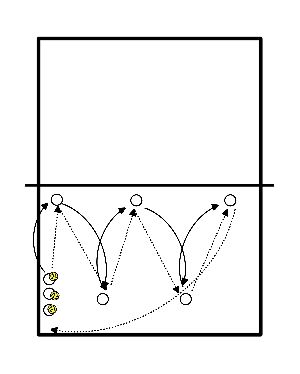
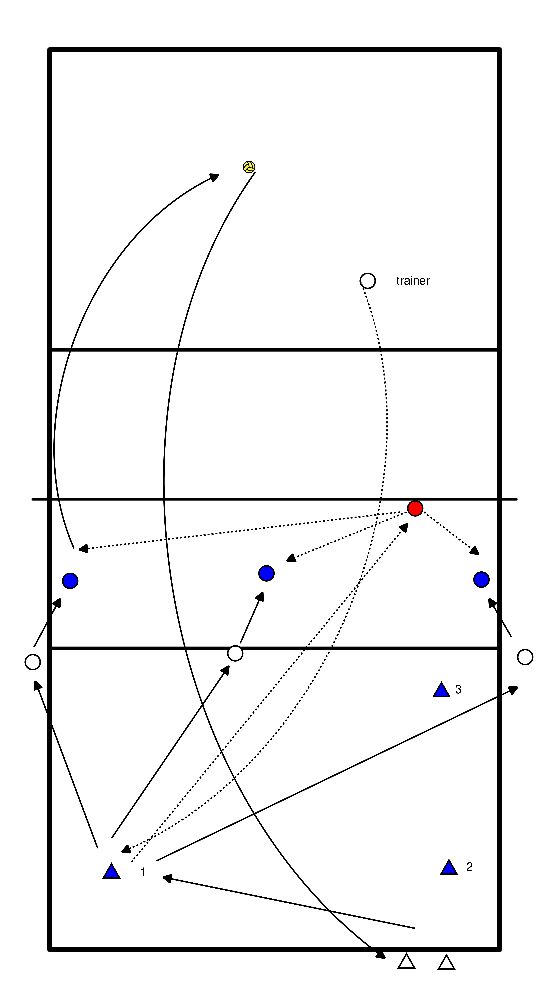
- Playmaker at the net.
- Two middle attackers, two outside and two diagonal.
- Other players line up to pass.
- Trainer puts ball in play from the other side of the net.
- Passer passes, playmaker chooses attacker and an attack is made.
- After the attack players get the ball and join the passers.
- After passing attack on your own position (or an empty position).
- Organization:
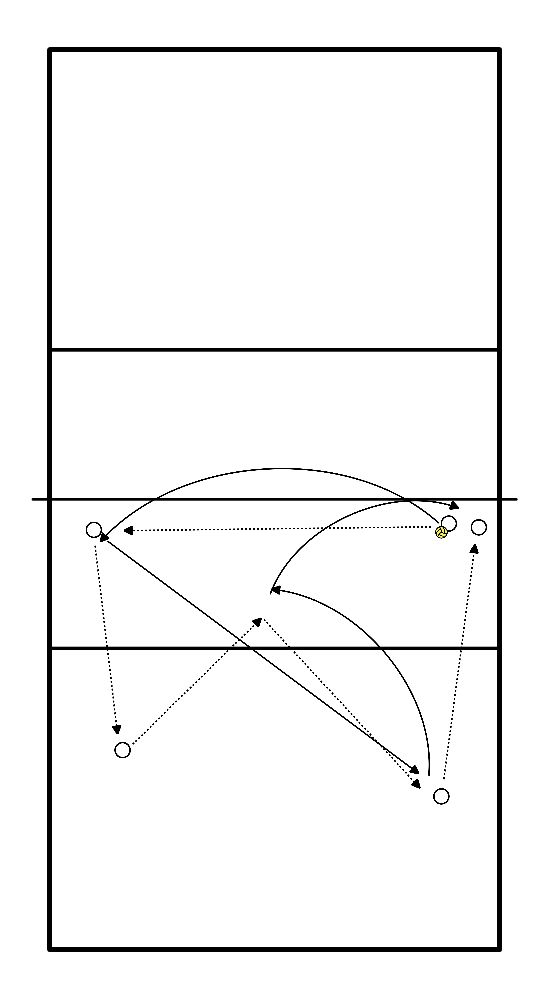
- Divide the group over the 2 fields.
- 2 players on pos 2 with 1 ball, 1 on 4, 1 on 5 and 1 on 1
- Execution:
- Ball is played from p2 BH to 4.
- On p4 the ball is hit technically to p1.
- The latter defends the ball at 3m p3 and at that moment the player on p5 comes and plays the ball Bh to p2.
- And it starts all over again.
- Walk:
- P2 to p4.
- P4 to p5.
- P5 to p1.
- P1 to p2.
- Explanation:
- 2 teams of 3 players
- Per team 3 volleyballs (different balls so you can tell the difference, 2 'baby' and 1 'normal' ball)
- The team must play the 'normal' ball over the net in 3 times and meanwhile the 'babies' are thrown over.
- Each player may only touch the 'normal' ball once!
- (When a player has played the 'regular' ball, he gets a 'baby' thrown to him)
- Starting positions:
- Mid-back has no ball. Mid-back has no ball (he passes the ball to the distributor).
- Distributor gives a set-up on the outside.
- 3rd player plays the ball over the net. (At first do not attack, only if it goes well!)
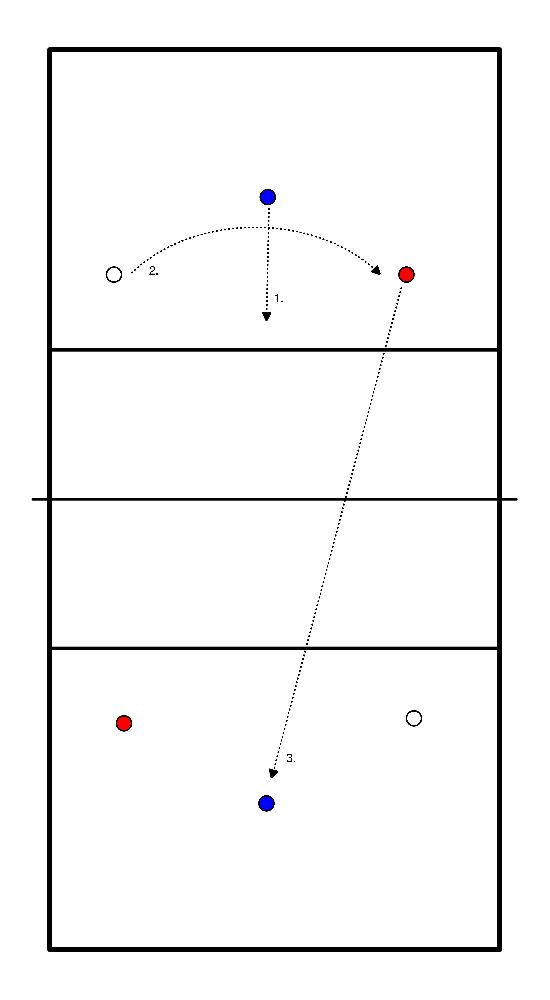
- The goal is to play the ball in threes. This requires the commitment of every player.
- So line up three players.
- They solve a thrown ball (by the trainer), by playing in threes.
- The first ball is passed to the upper-position.
- The 2nd player, who has the job of upper-player, runs to the upper-place.
- The 3rd player then prepares for the attack.
- At first keep the ball on one side of the net, by not actually hitting the 3rd ball, but catching it.
- Then 3 other players move in to do the same.
- On the other side of the net, the same is practiced with the other half of the team.
- After a while, when the ball is regularly played in threes, the ball is actually played to the other side.
- The team on the other side then plays the ball back in threes.
- And so on; play over as long as possible.
- No scoring, it's about playing in threes.
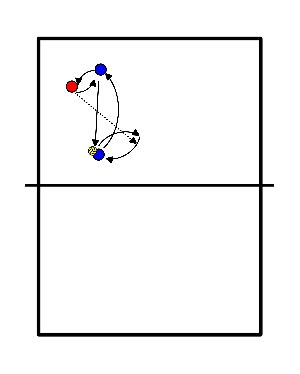
- Organisation: Make three teams with one ball.
- Execution:
- 2 players stand opposite each other at approx. 5m.
- The third player is "distributor" and stands to the right of the passer.
- Player 1 plays brace to 2nd player and he passes the ball to the right, where the Sv is standing.
- This gives player 2 a setup, which is attacked on player 1.
- Meanwhile, Sv runs to the right side of player 1 to receive the pass there.
- Organization:
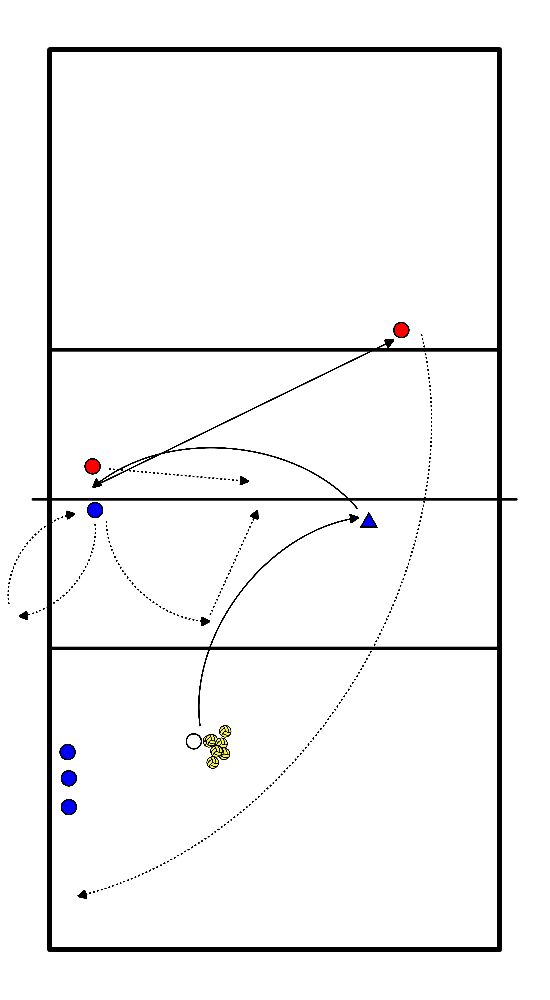
- Trainer throws to playmaker on p2/4 on field A.
- Every 5 setups the players are changed.
- On p4 an attacker stands at the net.
- On court B there is a blocker on p2 and a defender on p5.
- Execution:
- Trainer claps on the ball and throws to.
- The attacker walks back from the net at the moment of hit and attacks the setup on p4.
- She then runs back again and attacks a 2nd ball at p3.
- The block on field B moves with her to p3.
- Running directions:
- Attacker becomes block.
- Block becomes defense.
- Defense retrieves the balls and becomes attacker.
- Organization:
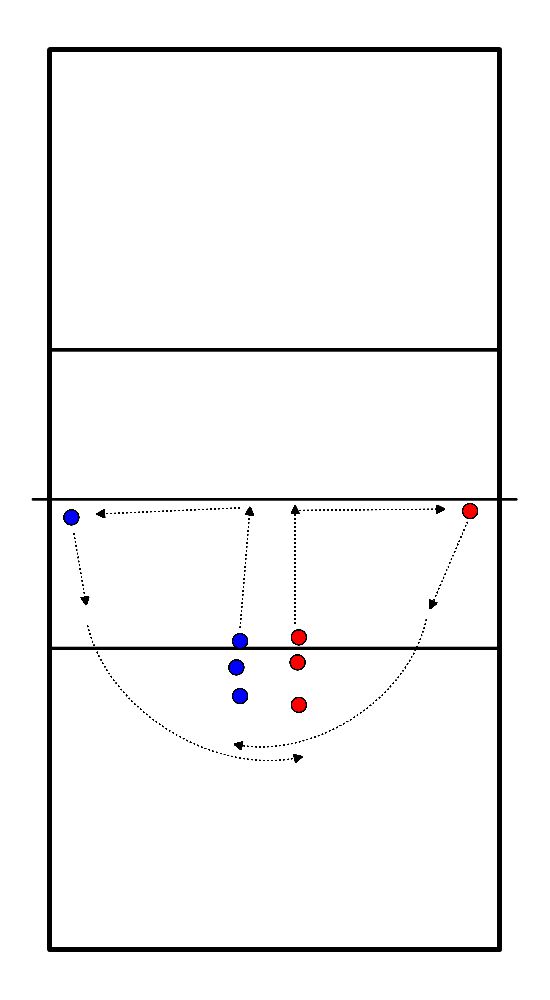
- Players on p2 and p4.
- Other players in 2 rows on 3m line p3.
- Execution:
- The first two players walk to the net and block together on p3.
- Then they sidestep or walk to p2 and p4 and block together with the player who is already there.
- The original player on p2 and p4 make a roll/dive and join the other row.
- Organization:
- Field A:
- Sv on p2.
- Attackers on 4 and start at the net.
- Trainer throws in balls.
- Field B:
- Block on p2 and Libero on 5.
- Explanation SBS6. (Stand still, Block Stroke arm to P6)
- Field A:
- Execution
- Tr throws on, setup and attack at 4.
- Block blocks the strike arm and the libero defends the attack if necessary.
- Block stays in place for 5 attacks.
- Expansion:
- Field B:
- Block on p3 connecting to attack on P2.
- If the block is gone before the setup is given, the Sv may play the ball over the net at p3.
- Field B:
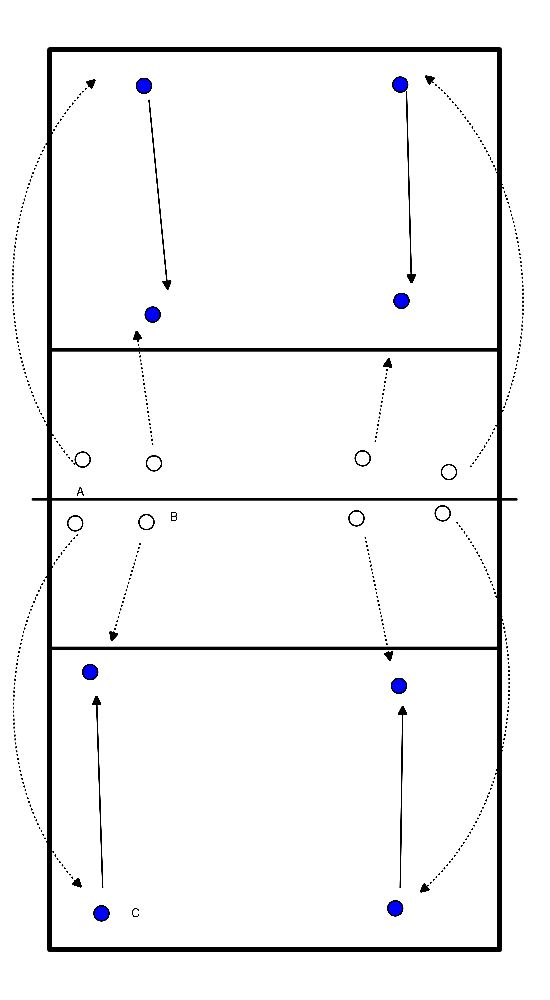
- Players form threesomes.
- Per trio two players at the net with a ball.
- Player A hits the ball (overhand) for a pass before the backline.
- Immediately after that B throws the ball on the three meter line.
- Player C makes a pancake and plays the ball back.
- After 10 times the players turn one spot (A becomes C, B becomes A, C becomes B).
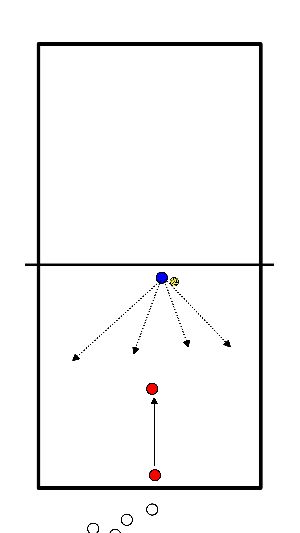
- This exercise trains the split step.
- Players line up behind the back line.
- Trainer or player stands at the net.
- One by one the players walk in from the back line.
- When the trainer hits the ball, the player makes a split step.
- Then he gets the ball on a random spot next to or in front of him.
- Player passes back and retrieves ball if necessary.
- After that the player closes in at the back.
- Organisation:
- 3 players on p2, p3 and p4.
- 2 players on p5/p6 and p6/p1.
- Other players with ball on p6.
- Execution:
- BH to p4 and follow ball, from p4 BH to p5/p6, follow ball backwards.
- From p5/p6 OH to p3 and follow through, etc.
- At p2 catch and connect to p6.