



Volleyballexercises for u15
- This exercise can be done in 3 or 4 teams.
- Minimum number of players is 6 and maximum 8 per available field.
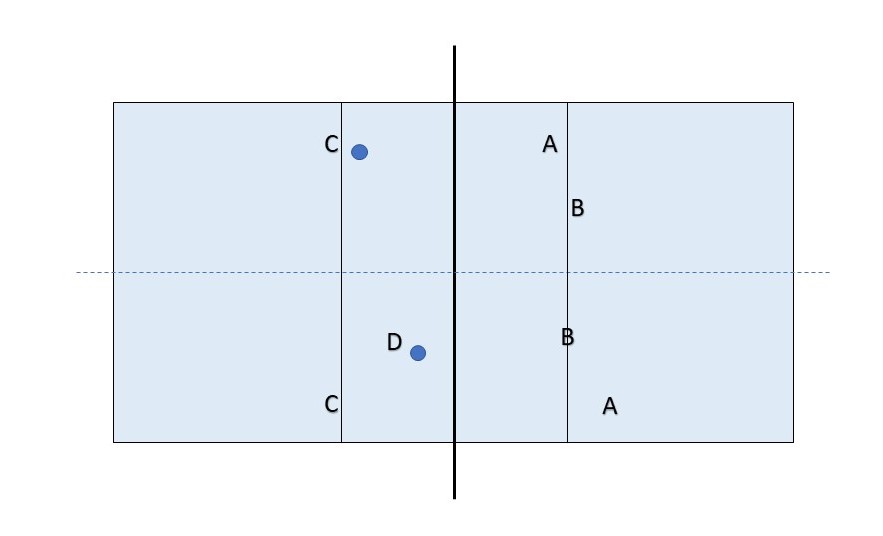
- In a 4-player team, two players on each side of the net.
- Use during the exercise half a net width per 3-4 team.
- In a 4-player team:
- 2 players on each side.
- The ball is thrown over the net at the start.
- Player A plays the ball for himself and at the 2nd contact he gives a set-up for player B.
- Player B tips the ball over the net with 1 hand.
- Player C plays the ball for himself and then gives a set-up for player D.
- D tips the ball over the net.
- After a team has played the ball over the net the players change places.
- In the case of a 3-player team:
- 2 players on one side of the net and the other player only on the other side.
- Player C has the ball and throws it over the net to the 2 team.
- Player A plays the ball for himself and at the 2nd contact he gives a set-up for player B.
- Immediately after giving the set-up, player A goes under the net.
- Player B tips the ball over the net with one hand.
- Player C plays the ball for himself and gives a set-up for player A.
- Player C goes to the other side of the net immediately after giving player A a set-up.
- Player A tips the ball over the net to player B.
- Player B plays the ball for himself and gives a set-up for player A.
- After giving the set-up player B goes under the net.
- Expansion:
- Possible mandatory blocking of tip ball by player not doing the passing.
- Possible mandatory blocking of tip ball by player not doing the passing.
- Goal:
- Technically good attacks.
- Need:
- 4/5 players, enough balls.
- 1 player stands on the distributor position (between position 2 and 3).
- 1 player stands on the other side of the net to return the ball.
- 2 or 3 attackers on outside position.
- SV plays the ball directly overhand to position 4.
- 1 attacker comes in and hits straight.
- Points of Attention:
- Getting ready:
- Attacker stands outside the sideline and behind the 3-metre line.
- Play:
- Waiting for ball to come out of hands of playmaker (SV).
- Then the attacking run:
- Small step left.
- Arms forward.
- Big step right.
- Arms backwards.
- Connect left.
- Feet parallel to the net.
- Arms forward/up.
- Come out of the knees.
- Jumping.
- Stroke arm backwards (like pitcher baseball).
- Other arm pointing in direction of where you are hitting.
- ROUTINE:
- Balls are hit over the net.
- Offender gets back in line with the attackers.
- Offender other side of the net makes sure SV has enough balls.
- After a few minutes turn through until everyone has been SV.
- Getting ready:
- Organization:
- 2 players on p2 with balls.
- 2 players in the backfield.
- 2 (or more) players out of the field.
- Implementation:
- During 1 minute, the players on the p2 are going to keep the field players busy with attacks, tip balls, etc.
- Let 1 player on p2 work and as soon as a ball is not defended, the 2nd player takes over.
- The players off the field take care of ball safety.
- After 1 minute the players on p2 become defenders, defenders go out of the field and 2 new ones on p2.
- Objective:
- Increase responsiveness.
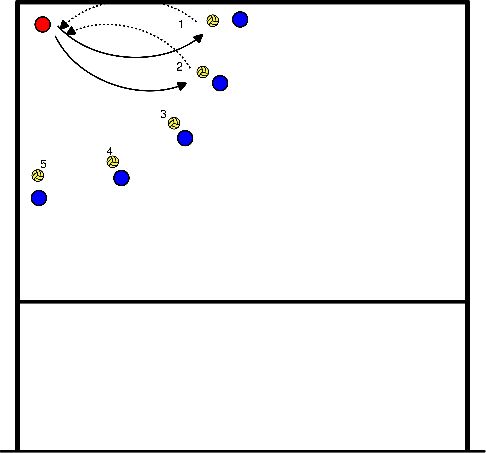
- Place one player in the corner of the field.
- Have at least 4 players stand around him in a quarter circle.
- Each player has his own ball.
- Throw the ball in tempo (tight) on the knees of the player in the corner to pass back underhand.
- After passing, immediately throw the ball to the next player in the quarter circle.
- Player in the corner so consecutive balls in underhand pass back:
- Important to stay low.
- Expect the ball.
- Respond regardless.
- About 5 rounds and then replace the player in the corner.
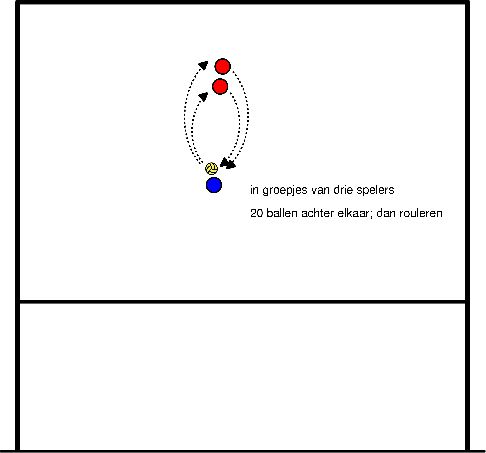
- Two players stand behind each other.
- About half a meter apart, facing the same way.
- Another player stands 3 or 4 meters away from them and has a ball and throws it to upper hand.
- The one who throws throws randomly on player 1 and 2.
- Player 1 or 2 calls loose if he thinks the ball is for him and plays overhand back.
- About 20 balls in a row.
- Then the group of 3 changes position until everyone has been there.
- After that again, but now without talking.
- All on the 3 meter line facing the net.
- If necessary divide in two halves.
- In slow motion synchronise the attacking pass. (right-handed)
- The next steps are in an arc towards the net; by doing this all at once in synchrony, they oblige each other to run in an arc:
- Left small step; take arms to the front; start of forward force
- Right big step; arms all the way back; deep in knees; accelerationof forward force
- Left foot in front of the right (close step), with the foot parallel to the net; forward force is slowed down
- Throw both arms up and push off with 2 feet up; forward force is converted into upward force
- Right arm backwards like baseball/arrow pitcher; left arm points in direction of desired ball path; strike ball and land through knees approx. 0.5m in front of the net
- Group on 5 and 6.
- 5 throws ball towards 3 and players on 6 set up from 3.
- Players on 5 attack on 4.
- 5 gets the ball and 6 passes to 5.
- Pay attention to high quality. Arms well up, straight up, high jumps.
- Ditto:
- But then from 6 and 1, attack on 2.
- Ditto:
- Fixed setter, players 6 play the ball BH to setter, players 5 attack on 4.
- Ditto:
- But then attack on 2, from 1.
- Variation diagonal/straight through.
- In preparation for service pass:
- Ball lane recognition.
- Organization
- 2 rows on back line on 1/6 and 6/5.
- Trainer with ball carrier on other court.
- Execution:
- Trainer serves OH alternately for one of both rows.
- Player comes in and catches the ball in the right position at navel height.
- If that goes well, reduce the escape time.
- Extension:
- Pass to receiver at 2/3.
- In preparation for attack on p3.
- Organisation:
- Player on 2/3.
- Trainer with ball pit on p5/6.
- Other players on 3m-line p3.
- Execution:
- Trainer throws ball and player on 2/3 gives a setup on3.
- Player on 3m-line runs in and catches ball and delivers it back to Tr.
- Have player on 2nd/3 set up 5 balls.
- Make sure the setup stays short on the p3 and not on the p3/4.
- Expansion:
- No more catching but attacking.
- Organisation:
- Trainer with ball pit on field B
- Field A: player on 2/3.
- Player on 3 and 4, both in the pass.
- Other players behind the backline.
- Execution:
- Trainer serves OH and from the pass is attacked.
- 1st choice is p3 otherwise to p4.
- Ball is attacked.
- Each player has a sit up ball - 9 different core-stability exercises
- The Grasshopper:
- To get the most benefit from this exercise, make sure your body is in a straight line from head to toe, your hips are square (parallel to the ground) and your abs are tucked in and braced.
- Your hips should not sink at all during the movement, especially when you return to full length from the knees inwards.
- Another important point is to make sure your shoulders fall over your hands at all times, so your body doesn't rock back and forth, largely losing the benefit of this stability ball exercise.
- If you have sensitive wrists, use a pair of dumbbells as a base for your hands, this will keep your wrists in a more neutral position and reduce their strain.
- Push ups:
- Keep your hands on the side of the ball so your wrists are more neutral and very slowly lower to the ball to make this a good challenge.
- Just before your torso hits the ball, explosively (yet controlled) push back up.
- Straight Leg Deadbug:
- To get the most out of this exercise, make sure your arms and legs are always pressed into the ball.
- Even if you extend one arm and leg to just above the ground, the leg and arm still holding the ball should be pressed into the ball.
- Back leg position:
- Place your arms to the side or under the lower back if more support is needed there.
- Start with your legs perpendicular to the ground and on either side of the ball.
- Then rotate your legs so that your right leg is in front of the ball (facing you), while your left leg is on the other side (facing away from you).
- Pause at the end of each turn and then turn again so that the legs are reversed.
- Hamstring Roll-Ins:
- The key is to keep your hips high the entire time, so that your body is in a straight diagonal line from your feet to your head.
- Dig your heels into the ball as you drag it back to your buttocks.
- Squeeze your hamstrings and return SLOWLY to your legs fully extended (remember to keep your hips up).
- Ball Sensitive Twists:
- Start with your hands on the ground, shoulders above your hands, abs braced, body in a straight line and feet on either side of the ball, activating your groins to keep your legs from slipping.
- This alone is a huge benefit.
- Next, slowly rotate your hips to the right so that your foot touches the ground.
- Use your obliques to pull your hips back square and then to the other side.
- Remember to keep your hips at shoulder height the entire time.
- Ball Planks:
- Here I want you to dig your forearms and especially your wrists into the ball.
- This alone will increase your core activation 10-fold.
- Tighten and brace your abs, keep your hips up, and glutes and quads contracted.
- Next, simply move the ball around in a small circular motion, moving only your arms.
- Your whole body should stay still like cemented concrete.
- Lateral Scratch Runs:
- The ball should be under your head and shoulders and feel like a pillow, while your arms are stretched out to the side and fully locked/contracted.
- As with all of these stability ball exercises, the key with this one is to make sure your hips are up and your body is in a straight line from your knees to your shoulders.
- Push-Ups:
- This is a pretty easy move as you go down and pull your knees towards your wrists.
- This, of course, also causes the ball to roll inward.
- But the real test begins when you push yourself out of this "tucked in" position. Try it and convince yourself.
- 3 players in the field and SV4.
- Trainer plays different ball in the field, 3 count must handle the balls and make sure SV4 can handle the ball.
- SV4 plays the ball to the trainer every time.
- After 10 balls, change 3 players.