View exercises
-
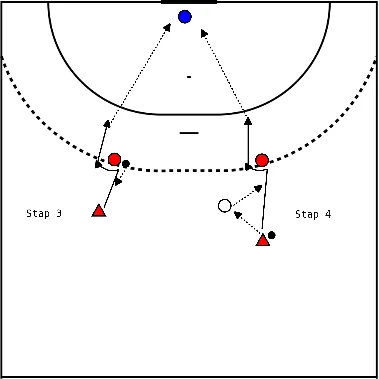
Execution
- The pivot player stands in the middle between the two defenders.
- The left attacker threatens to move inside, causing the right defender to step out.
- The defender of the pivot defends on the ball side.
- When the ball moves to the right, the right player threatens to move inside and the left defender steps out.
- The pivot defender continues to defend on the ball side.
- Back coverage is provided by the left or right defender.
- The centre back (CB) defends the pivot player.
- Switch after 1.5 minutes counterclockwise.
- Start slowly and increase the pace during the exercise to match game speed.
- Be alert to providing back coverage.
- The CB must continuously shield the pivot player towards the ball side.
-
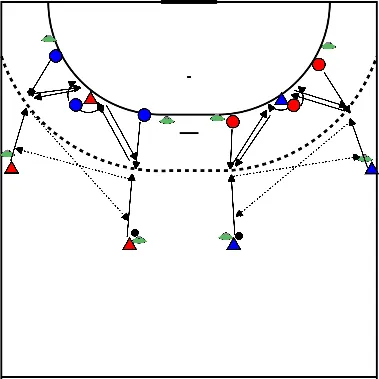
Execution
- Form two lines, one at the left backcourt (LB) position and one at the right backcourt (RB) position.
- Place two players at the centre backcourt (CB) position.
- LB and RB throw the ball to the CB while they start moving.
- The CB passes the ball back to LB or RB just before the free-throw line.
- LB and RB take two steps and perform a jump shot towards the goal.
- Both groups shoot at the goal, so ensure you quickly retrieve the ball and pay attention to where you shoot.
- Have the players shoot over a thick mat for an added challenge.
- Open up during the first pass.
- Keep the arm raised during the first pass.
- Jump high and not forward during the jump shot.
- Complete the shot fully.
- Land on the take-off leg.
-
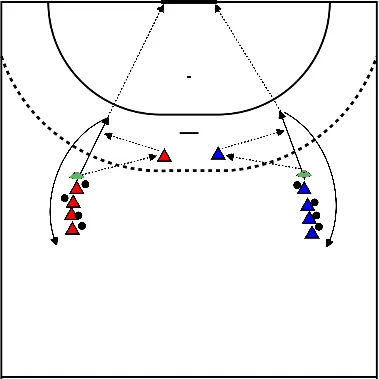
Setup
- Divide the field into a left and right half.
- Players work in pairs, each pair has one ball.
- The pairs position themselves in two groups along the back lines.
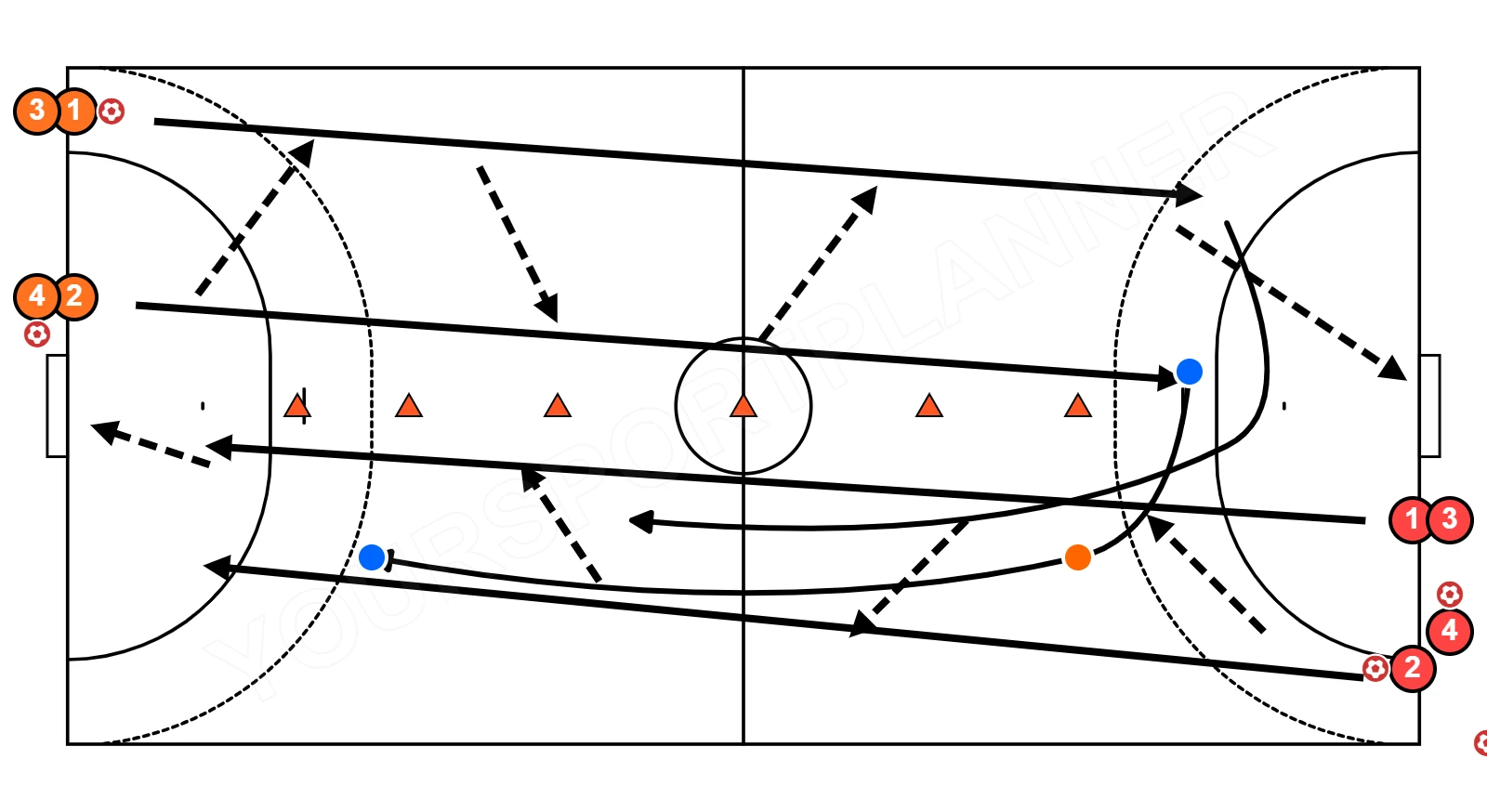
- A pair (for example, orange 1 and 2) starts by bringing up the ball and tries to take a shot.
- At the moment of the shot, the pair on the opposite side (for example, red 1 and 2) begins their attack on their side of the field.
- Orange 1 and 2 must switch immediately to defence after their shot and try to interrupt the attack of red 1 and 2.
- After the shot from red 1 and 2 or in case of ball loss, orange 3 and 4 begin their attack and red 1 and 2 defend.
- The game repeats with new pairs.
- Pay attention to the timely start of the attackers; it should not be too early or too late.
- If necessary, the start can occur on a signal from the coach.
- The exercise focuses on the fast counterattack and the transition from attack to defence.
-
Execution
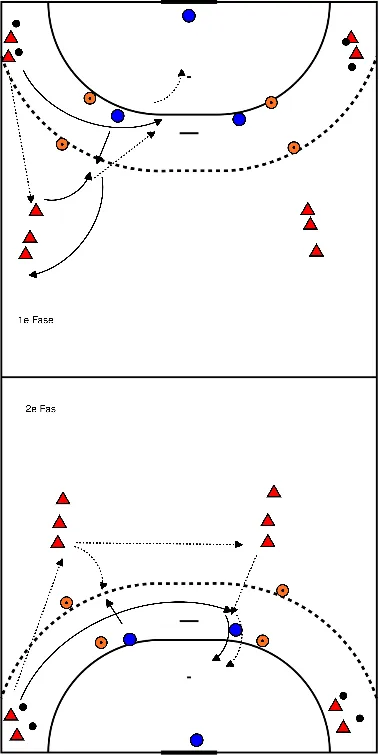
- First Phase: The wing player passes the ball to a backcourt player and receives it back immediately, after which the wing player shoots at the goal.
- Second Phase: The wing player passes to a backcourt player, who then passes to another backcourt player, after which the ball returns to the wing player who shoots at the goal.
-
Execution
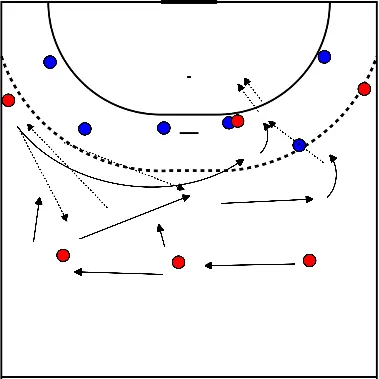
- The wing player initiates movement and collaborates with the backcourt player next to them. They move from the left backcourt/left wing position to the right side.
- The right backcourt and centre backcourt shift one position to the left.
- The pivot sets a block on the third defender.
- The left backcourt passes to the left wing cutting between positions 2 and 3.
- The other backcourt players move to act as decoys.
- Counter to the left backcourt or centre backcourt who has shifted.
- Passing
- Timing
- Blocking
-
Objective
- Learn and refine a new variant of passing movement: turning to the left (against the shooting arm).
Execution
- Place a defender (pole, dummy, player).
- Use a goal or cones as a target, with a goalkeeper in place.
- Work in groups of 2 or 3 players.
- Start first without a ball, then with a ball.
Rules
- After throwing, retrieve the ball yourself.
- You receive the ball in the jump so that your two-foot landing counts as a zero step.
Points of Attention
- Technical: Right-handed player: after the two-foot landing, turn backward with the right leg and place it down. Take one step with the left towards the goal. In the turn, already bring your arm into shooting position (so lift it up). Stay as upright as possible. Push off with your left leg and make your jump shot at the goal. A left-handed player does this exactly the opposite way.
- Tactical: Make your zero step as much as possible on the right side (right-handed player) of the defender.
- Physical/Mental: Optionally create a line for left-handed and right-handed players, continue one after the other.
Build Up the Exercise in Difficulty
- Step 1: Without a ball (defender is a pole).
- Step 2: With own ball dribbling (defender is a pole).
- Step 3: Receive the ball from the defender (defender is a player).
- Step 4: Receive the ball from a teammate.
- Step 5: Two lines opposite each other. You cross in the middle and after the passing movement, pass the ball to the front player of the line and join the back.
Extra Challenge
- Players who can already do this well can also practice turning towards the shooting arm. Right-handed player: after two-foot landing, turn away with the left leg and make the last step with the right towards the goal. Left-handed player: after two-foot landing, turn away with the right leg and make the last step with the left towards the goal.