

Basketballexercises for technique passing
- The players play the ball behind their backs towards each other.
- As with the pendulum throw, the body is slightly rotated (when thrown with the right, the left shoulder should be closest to the fellow player), keep the distances small in this exercise.
- The ball is caught with the left, passed to the right and thrown with the right.
- The ball will start to spin like a 'figure eight'.
- After 20 times catching with the right, transferring to the left and throwing with the left, the ball will start spinning.
- The players throw the ball alternately high, low, with a bounce or at chest height.
- Have the players stand a little closer together and throw up with a bounce.
- ...prepare for the ball to come.
- Eyes on the approaching ball.
- The arms are stretched out towards the ball;
- the wrists are slightly bent backwards;
- the fingers are spread and point upwards;
- The body reaches slightly forward.
- At the moment of ball contact, the fingertips touch the ball first;
- the thumbs and slightly the index fingers are behind the ball,
- so that the ball cannot shoot through.
- the speed of the ball is slowed down by bending the arms.
- The ball comes to rest in front of the diaphragm.
- Especially with 'hard' passes, it is useful to place one foot in front of the other while catching.
- The feet are in a small scissor or parallel position.
- Knees slightly bent; torso slightly forward.
- bodyweight above both feet.
- the ball is held at chest level with the fingertips; thumbs behind the ball.
- the elbows point backwards and are not too close to the body. eyes directed at the goal.
- By extending the arms and the back leg, the ball is pushed away and guided for as long as possible; the ball leaves the hands via the fingertips.
- At the end of the action, the palms point outwards and the thumbs downwards;
- this is caused by the forceful folding of the wrists.
- The body weight is transferred to the front foot through the entire action.
- The pass is often supported by a step with the front leg in the direction of the goal.
- The chest pass can also be performed in a sideways direction; pivoting in the direction of the goal is necessary for this.
- feet in parallel position; ball in both hands in front of chest.
- eyes focused on the goal.
- Step with the left foot in the direction of the pass,
- so that the left side of the body comes in front (turning in);
- At the same time, the ball is brought behind the head with both hands;
- the body weight rests on the back leg.
- The elbow is under the ball;
- the angle between the upper and lower arm is about 90 degrees;
- the fingers of the throwing hand are spread.
- next: turn your hips and trunk to the left;
- the left hand will lose contact with the ball and is held horizontally to protect the action;
- the elbow is bent.
- The right arm swings in a straight line past the head in the direction of the goal; the movement ends with the wrist being folded over.
- The right arm swings in a straight line along the head towards the target; the movement ends with the flick of the wrist; the ball is pointed after by the throwing arm,
- while the wrist hangs down in a relaxed position.
- During the action, the body weight is transferred to the front foot.
- free play on 1 or 2 baskets, depending on the number of players.
- PURPOSE: Quick passing, cutting, helpside, ballside, boxing-out.
- First team at 5.
- Loser push-ups 6.
- Depending on the number of balls.
- Pairs or alone.
- In singles.
- Start at your position, dribble to opposite side of basket.
- Set or jump shot from your position (guard, forward, center).
- Up to 8 hits.
- In pairs.
- Start from position, pass to opposite basket.
- Last pass must be good so that shooter in jumpshot is ready for his/her shot.
- Up to 4 touches per player!!!!!
- Losers, 1x back and forth slides in width.8 hoops/pawns for shooting positions.
- 2 rows of which 1 row has the ball.
- Passes to the middle line from the middle line 1 vs 1.
- When passing, make sure the persons keep running straight and don't go sideways.
- free play on 1 or 2 baskets,
- depending on the number of players.
- NO dribbles only passing.
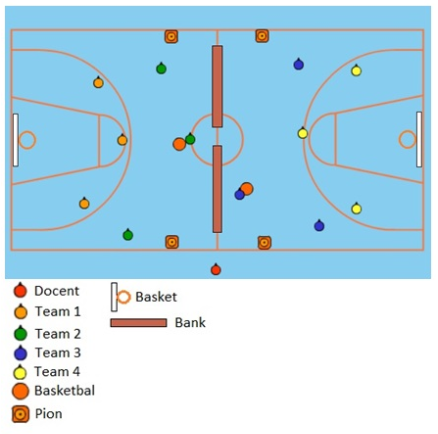
- The teacher divides the room into two squares by placing benches on the centerline of the room.
- Then the teacher makes 2 squares with pawns to catch up the right of attack.
- During this game the rulebook is used.
- See module basketball for this guide.
- The teacher divides the students into teams of 3, possibly with a substitute.
- See the tables at the bottom of the lesson preparation for the game schedules.
- The intention is that the team that has the ball (on the map team 2 & 3) try to score.
- To be able to score, the team must first get the right of attack.
- They get this right of attack when they arrive with the ball in the area of the pawns.
- From now on the team may score.
- They do this by shooting the ball into the basket.
- The other team must try to take the ball away from them.
- When this happens, the teams swap roles and the new team with the ball has to get the right of attack and try to score.