
Beachvolleyballexercises for technique pass / toetsen / onderhands

Formation
  • Two teams of a maximum of 4 people.
  • 1 ball.
  • On both sides, 2 people on the court, others behind the baseline.
Objective
  • Score in one attempt in the other court (within the lines).
Rules
  • Start with a simple underhand service.
  • We play underhand tennis, so over the net in one attempt.
  • A difficult ball may bounce once, but then the ball must be returned with one hand, a foot, or the head.
  • Made a mistake? Leave the court to the baseline, a new player takes over.
Focus
  • Variation in setup
  • Communication between the players
Starting Position
  • 4 players active, 2 on each side
  • 1 side with 2 balls
  • 4 players in reserve
Rotation
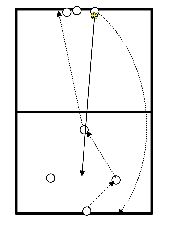
  • A+B -> G+H -> E+F -> C+D -> A+B
Basic
  • E throws over to A or B (for example, first to A)
  • A receives in zone 2, B provides setup high or low depending on A's instructions
  • E takes position close or far
  • B plays over with hard contact to the open space (E close -> ball far over and vice versa)
  • F throws over to B, B receives in zone 1, A provides setup high or low depending on B's instructions
  • F takes position close or far, A plays over with hard contact to the open space (F close -> ball far over and vice versa)
  • G and H retrieve the balls, C and D are ready
Simpler
  • First ball is caught for reception
  • Ball for setup can also be caught if necessary
  • Focus on playing high or low setup
Extension
  • Use serve instead of throwing over
  • Setter observes position E or F: close -> low setup, far -> high setup (or vice versa)
  • A and B must observe the other side and coach each other
Game Form
  • Ball within the cones: 1 point
  • High or low setup as requested: 1 bonus point
Possible Extension
  • Mark the corners of the court
  • 1 extra point for reaching the correct corner
Introduction
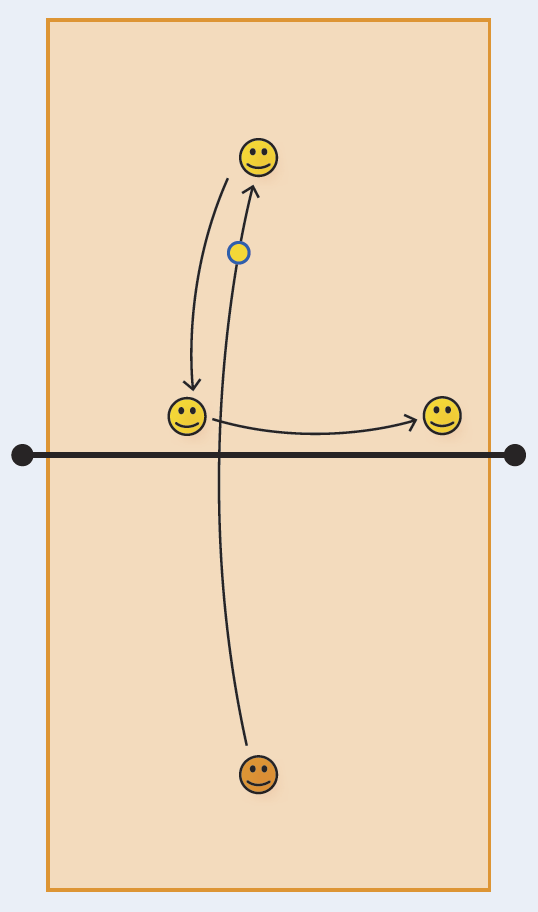
  • First, explain the theory of the pass.
  • Illustrate the situation in the sand.
Execution
  • Keep the ball on your own side and one metre from the net.
  • The other player runs a banana or crescent route.
  • The players stand together on the court and deliver a service pass.
  • The setter runs the discussed path and catches the ball.
Extension
  • Add a set and attack to make the exercise more challenging.
drawing Theory and execution of the pass
Execution
  • Two receivers receive a service. The pass is caught, and the roles rotate: the receiver becomes the catcher, the catcher becomes the server, and the server becomes the reserve.
  • Ensure that the pass remains on their own side and is at least one meter from the net.
Extension
  • The catcher provides a set-up which is then hit.
Variation
  • Two receivers receive a service again. After the service, the server quickly stands somewhere in the field.
  • After the pass is made, the passer looks where the server is standing. A set-up and attack follow, aimed at the server.
  • Roles rotate as follows: the server becomes the reserve receiver, the receiver who attacked becomes the setter, and the setter becomes the server.
drawing Service and pass rotation
Formation
  • 1 server
  • 1 receiver
  • 1 setter
  • 1 catcher
Execution
  • Visualize an inverted triangle between the receiver and the setter, with the top at the receiver and the bottom against the net.
  • Start with an easy serve.
  • The pass should be directed to the corner of the triangle, most centrally in the field.
  • The setter sets the ball to the other end, with a maximum distance of 2 meters.
  • Use a standing basket for more accuracy.
Continuation
  • The coach plays the ball back to the receiver, repeat and catch or optionally play out.
  • With 3 players: 1 receiver and 2 setters, coach serves.
  • With 5 players: 2 setters alternate.
  • With 6 players: divide into two groups and use both sides of the court.
Technique
  • Work on the correct technique – turn towards the post before giving the set.
  • Provide the set in a dynamic movement along the attacker's shoulder line.
  • Use a standing leg in a slight lunge position to initiate the setup.
Adjustments
  • Start with a very easy serve for consistent passes.
  • Increase passing pressure with a more difficult serve.
  • Let the setter start from a deeper point in the field.
  • Let the setter start from a blocking position.
  • Vary with set targets; increase or decrease the distance to the target, shift the target per set.
  • Aim for 5 perfect passes and setups in a row.
  • Engage the partner by providing feedback or by attacking the ball without jumping.

Goal

  • Acclimatize to passing on the sand.

Execution

  • Divide the court into two halves.
  • Player A throws the ball over the net to Player B.
  • Player B passes to Player C, who is already in the setter's position.
  • Ensure rotation to keep the exercise dynamic.
  • If this exercise goes well, serving can be introduced.
drawing Acclimatization to passing on sand
Execution
  • Player at the net hits the ball to the defender.
  • Defender controls the ball for themselves to the right place to provide a set-up.
  • Defender moves and gives a set-up to the net player.
  • Net player hits the ball to the next defender.
  • After the set-up, the player joins the line with the defenders.
  • Rotate after 10 balls.
Objective
  • Control over the defense and preparation for a set-up.
  • Ensure the set-up is high enough and on the correct "arm" for the attacker.
drawing Ball control and set-up training
Objective
  • The objective is to separate the elements and deliver quality. Pass the ball to the desired position. Then get into an attack position and execute the hitting technique. Here, preparation for the jump and reach height is essential.
Execution
  • Both sides of the net are used. Player 1 stands on one side of the net, tosses the ball, and hits it to Player 2, who is in a service-receive position. It is important to use the desired technique when hitting. Player 2 passes the ball to the trainer. Pay attention to passing to the desired set position. The trainer catches the ball and immediately throws it in a perfect setup (starting with a 1-meter set that includes a peak). Player 2 gets into position for the attack and attacks in a specific area (use cones as a target). After the attack, the player moves to the serving position. After Player 1 has hit the ball, they join the line of passers/attackers.
Adjustments
  • The attack direction is initially "only" right or left. As the exercise progresses, the target can be made smaller and more precise. The ball can also be tossed instead of hit by Player 1. Give Player 1 a more targeted assignment. Use a setter instead of the trainer who catches and throws the ball. Make attack zones smaller to increase the required precision. Build the attack from the serve and attack with a defense.
Setup
  • 1 coach and 3 players.
Execution
  • The coach serves the ball over the net.
  • One player passes, one player sets, and one player catches the ball.
  • After completing, players rotate positions.
Variations
  • Focus on passing, setting, and/or attacking.
  • Give players more tasks for a greater challenge.
  • Simplify by having players perform only one task.
Adjustments
  • Throw the ball instead of serving.
  • Serve from different positions.
  • Make serving more difficult.
  • Passer and setter run in from different sides.
  • Set the ball into a basket.
Pairs.
  • Player 1 hits controlled, easy, smash to fellow player.
  • Co-player passes the ball up the court.
  • Fellow player does a setup for himself.
  • Fellow player hits back again.
  • Pairs play the ball over with focus on technique.
  • First overhead.
  • Then underhand.
  • Then alternate.
  • Focus on height to gain time.
  • Two against two
  • Trainer brings in ball
  • Teams play rally against each other
  • The one who loses goes out
  • Substitutes come in
drawing Game: Whoever wins stays put