



Handballexercises for u9
- 2 Benches face each other, between 6 and 8 meters apart
- On every bench there are 4 to 6 pawns
- There are 2 teams who must try to knock off the pawns by throwing them over.
- Pawns that have fallen down can be taken to your own side
- The team that has all the pawns wins
Outdoors:
- Place the pawns in bicycle tires, where you are not allowed to stand inside.
Relay
- 2 Groups stand in a row next to each other
- Starting point and ending point are marked with a pawn
- The player in front of the group rolls the ball backwards between all legs.
- All players where the ball has passed, lie down as quickly as possible
- The player in the back jumps over the players, connects and rolls the ball backwards again
- Important: Every player who has jumped over gets up again
The first group to cross the line wins.
- You make 2 teams
- 1 team starts with the ball and tries to tap the other team with the ball.
- They have to pass and are not allowed to run
- The other team tries to intercept the ball
- When the ball is intercepted, they can continue playing immediately
- If you tap someone you get 1 point
Who has the most points at the end?
Relay
- 2 Groups line up next to each other
- The player in front rolls the ball backwards between all legs.
- The last player slaloms around the players to the front, joins in and rolls the ball backwards again.
Variation
- Players lie down after rolling the ball backwards.
- The player in the back takes the ball and jumps over the other players
- Each player who has jumped over gets up again
The first group to cross the line wins.
As a child, it is good to learn young how to jump up or what fast footwork is, in this exercise you can use both.
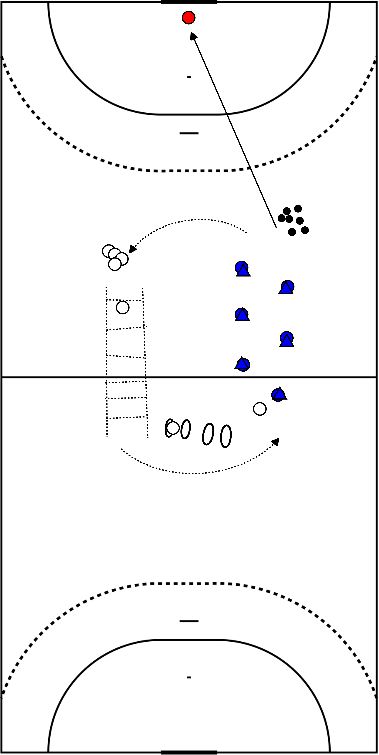
- A player starts at the running ladder,
- Here, he or she carries out the task which is explained.
- Then after the step ladder, the player continues to the next obstacle,
- Here, the player jumps over the jump with one or two legs at the same time.
- Then the next obstacle, the player continues to the pawns,
- Here, he or she goes sideways past the pawns.
- If there is a goalkeeper present, you can choose that the children, after moving the cones, take a ball and may throw it in a 1 against 1 with the goalkeeper.
- Then the ball is put back and they join in at the back.
There are different variations to think of for each obstacle, so it remains attractive and you can keep doing it for a reasonably long time.
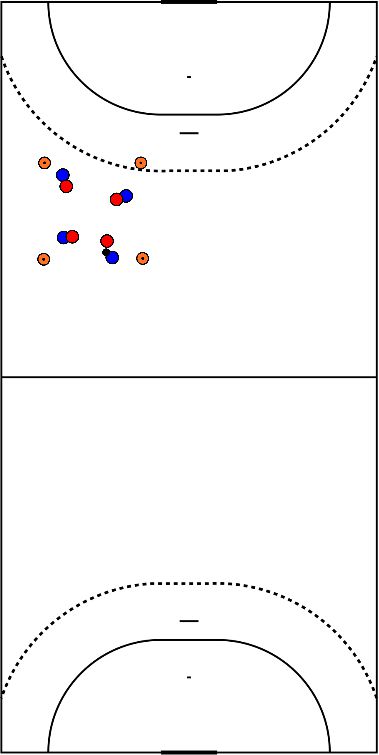
This game can be played as an end game but also during training and as a warm-up, which makes it appealing, especially since you can differentiate and change it well.
- Two teams are made in a square of about 10 by 10.
- One team starts with the ball, the goal of this team is to pass the ball to a teammate 10 times.
- The goal of the other team is to intercept and pass the ball 10 times.
This game comes in different situations.
Examples are:
- Larger/smaller field
- Different way of passing (MUST via bounce, MUST through the air).
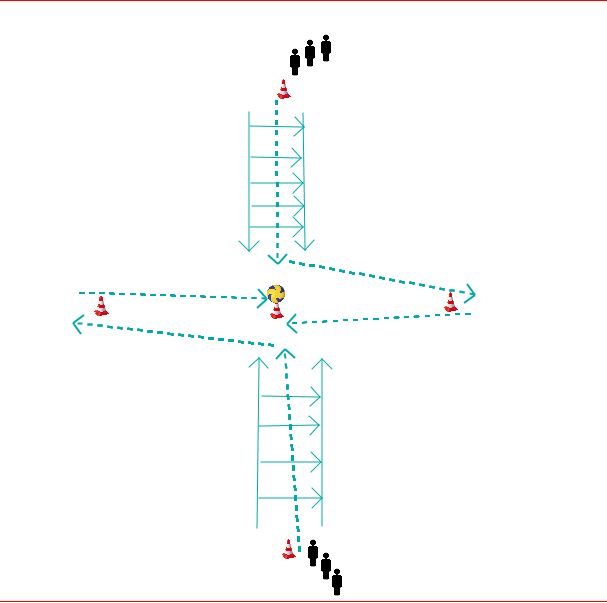
- 2 ladders opposite each other,
- 2 high cones in the middle (on the sides) between the running ladders,
- 1 pawn with a ball in the middle between the running ladders.
- From behind the ladders, 2 players start at the same time;
- Walk down the running ladder,
- Then move to the side around the pawn and back to the pawn in the middle,
- The one who catches the ball first wins.
- As soon as the jacket is taken, the next 2 players can start.
- Make a big circle with all players
- Start with two balls and pass to each other, always skipping 1 person in the circle.
- Always bring an extra ball into play.
- Attention:
- Good arm position,
- Stand on the front feet, right leg in front.
- Good catching with triangle behind the ball.
- Good fit.
- 2 groups line up behind a pylon
- Everyone has a ball
- One at a time Dribble out, 3 pass bounce back
Or:
- Dribble-slalom around pylons
- Behind the pylons throw on a rebounder,
- Dribble-slalom back
- Try to get a quartet with your team by getting 3 or 4 of the same objects (e.g. 4 cubes) in your box.
- Prevent another team from stealing objects from you by tapping them.
- Rules:
- In your own box you are free and cannot be tapped.
- If you are in another square you can be tapped.
- If you are tapped you walk around the outside back to your own square.
- If you are in an opponent's square without being tapped, you are free to return to your own square with the stolen object.
- You may only take one object at a time.
- A team has won if it has 4 same objects in its own box.
- Variations/adaptations:
- You can be tapped on the way back.
- Add extra quartets.
- All balls are placed one meter before the 9 meter.
- Two players are placed behind a pawn at the centre half way through one half.
- The players take turns trying to shoot at the goal with as much variety as possible in shots and positions in the goal.
- When the first player has shot at the goal, the other player can run up and take a ball to shoot at the goal.
- After the shot on goal, run back around the pawn before you can take another ball to shoot at the goal.
- The goal is to continue in one go without stopping until all the balls you have to shoot at the goal are gone.
- The other players spread out over the field and next to the goal to catch the balls and place them back at the position where all balls are.
- The other players also keep score.
- Who will get the most balls in the goal?
- After this you start again with two new players.
2 teams
- 1 shoot - 12 meter distance, dribble to line and shoot
- 1 keep - after each shot another
Which team will score the most goals?
- Repeat 3 times
- Watch the dribble
- Watch the shooting technique
- Watch movement, posture and focus goalkeeper