

Inline-skatingexercises for u18
Game Rules
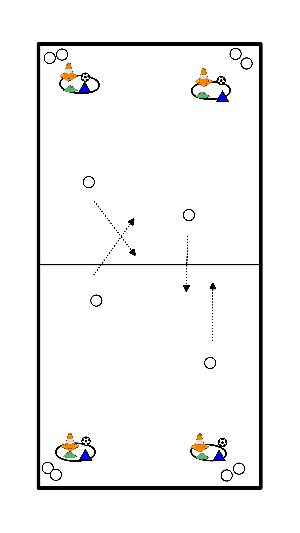
- All teams start with four different objects in their hoop.
- A player may steal one object from the other teams at a time.
- The goal is to collect four identical objects in your hoop.
- At that moment, you shout "QUARTET!"
- A tagger can be appointed if desired.
- Anyone who is tagged while holding an object must return it to the original hoop.
- A fifth object can be used, placed in the center of the field.
- These objects are worth more points but are guarded by a tagger.
Goal
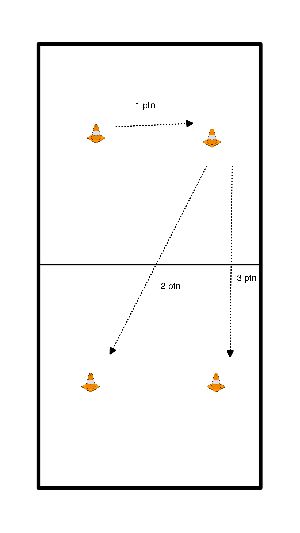
- Collect as many points as possible by skating different distances.
- All skaters start at one of the four cones.
- At the start signal, the skaters begin to skate.
- For each distance from cone to cone, they earn points:
- Short distance: 1 point
- Lateral distance: 2 points
- Diagonal: 3 points
- Skaters add up their points over 1-2 minutes.
- Optional: Tagging function, where tagged skaters lose their points and must start again.
Execution
- Skate around in a circle.
- At the whistle signal, the trainer calls out an instruction.
- Stop
- Accelerate
- Skate on one leg
- Crouch while skating
- Make fish movements
- Change direction
- Skate backwards
- Jump as high as possible
- One trainer calls out the instructions.
- Another trainer skates along and provides explanations if necessary.
Preparation
- Members stand on the designated line next to each other, with at least an arm's length between them.
- The trainer steps over the feet and gives instructions on which foot or movement should be performed during the crossover.
- Tip: Keep the arms in a cross position horizontally next to the body.
- Tip: When crossing another skater, the right has priority.
- Skaters move in a figure eight pattern.
- A tagger can be designated. Whoever is tagged within the square becomes the new tagger.
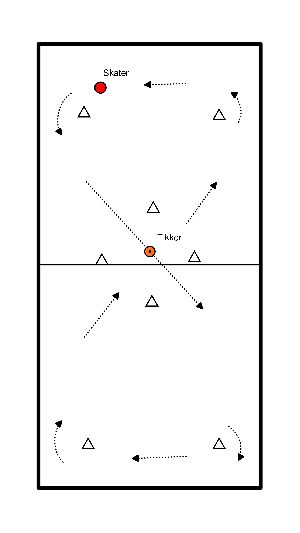
- Everyone starts with one cone.
- Music is playing.
- When the music stops everyone has to stand by a cone.
- After each round, one cone is taken away.
- Whoever does not have a cone goes out of the game.
- There are two teams.
- Each team has a cone at 25 meters in front of them.
- After the whistle, each person on that team walks diagonally to the cone facing the other team and puts it down.
- Then that person walks on to their own cone and straightens it and then skates back to their own team.
- The next one leaves and does the same.
- After a while one team is going to have a lead and from the moment you get to your own cone and it is still straight, then you have a point.
- Whoever has the most points has won.
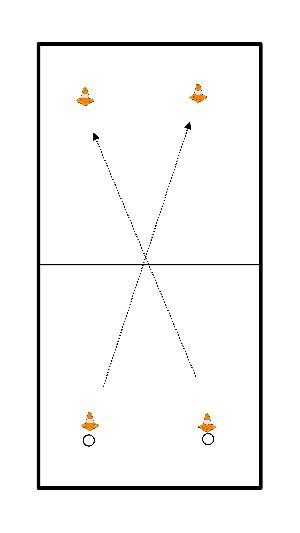
- Each person is given a vest that is tucked into their pants.
- The others try to take the vests.
- Whoever has the most vests at the end has won.
- People who no longer have a vest can continue to participate and share vests.
Several posts are scattered throughout the hall. The posts consist of different levels.
The members first divide themselves into the level they think they belong to.
The trainers skate around and give tips.
Examples of stations:
Station 1: There is a low obstacle,
e.g. field hockey stickWhat
do you do?
The members first divide themselves into the level they think they belong to.
The trainers skate around and give tips.
Examples of stations:
Station 1: There is a low obstacle,
e.g. field hockey stickWhat
do you do?
- You skate and stop just before the obstacle. Then you step over it. Possibly with someone holding your hand.
- You skate but don't stop in front of the obstacle. You step over it while riding.
- You skate and jump over the obstacle. You go through your knees and push off your feet at the same time.
Item 2: There is a low obstacle, slightly higher than potty 1
.E.g. Flat pots/ small conesWhat
do you do?
.E.g. Flat pots/ small conesWhat
do you do?
- You jump over the obstacle. If this is still not possible, you do the steps just like in item 2.
Next posts are higher and higher obstacles.
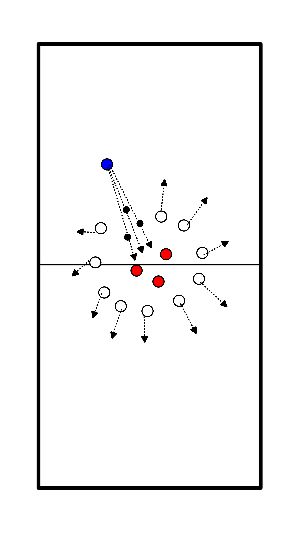
Members lie in prone position in a circle while the tickers (red - fluorescent jacket) stand up in the circle.
The moment the trainer (blue) - as many balls as tickers - rolls balls to the tickers all members may stand up and spread around the room.
Now hunter ball starts!
Whoever is tapped can:
The moment the trainer (blue) - as many balls as tickers - rolls balls to the tickers all members may stand up and spread around the room.
Now hunter ball starts!
Whoever is tapped can:
- put his arms to his side - socket
- spread his legs
- arm against the wall
- etc.
After a few minutes, the tappers pass on their fluorescent shirts.
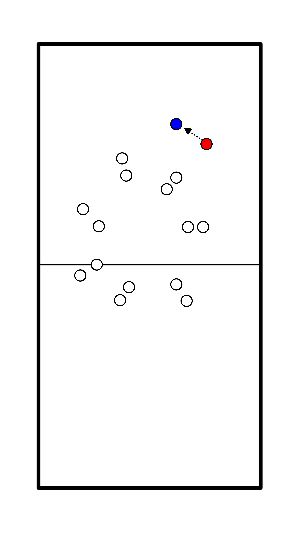
Hunter ball is played in 2 teams.
1 team wears a fluorescent jacket
Each player may hold the ball for up to 5 seconds.
Whoever is dead:
1 team wears a fluorescent jacket
Each player may hold the ball for up to 5 seconds.
Whoever is dead:
- opens the legs
- hands on your side
- arm against the wall
- stays on the side (every team has a 'dead side')
- Based on the cat and mouse game.
- Everyone stands in pairs of 2 behind each other, placed in a circle.
- There is further a tagger and a runner.
- The runner must get behind a group of 2 as quickly as possible to be safe.
- In this case, the first person of this new group of 3 becomes the ticker and runs after the other player. The roles are switched.
Gradation:
- 2 pairs of tickers and runners
- It is also allowed to sit in front of a group of 2. In this case, it is not the front person, but the back person who becomes a tagger. This keeps everyone thinking actively.
Variation:
- Not standing behind each other, but lying on top of each other.
Application:
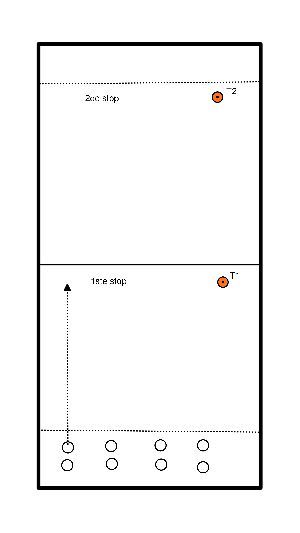
- penguin -stop
- fish --stop
- T-stop
- turn-stop
- field hockey -stop
Have everyone leave behind the starting line, in pairs of 2 in a row. This allows for a focused look at everyone's stop.
- Tip: Place a trainer on the center line and a trainer on the end line.
- Tip: Apply max. 3 stops per workout!
- + Pay attention to bending knees!