



Korfballexercises for technique attack / score
Last update: january 2026
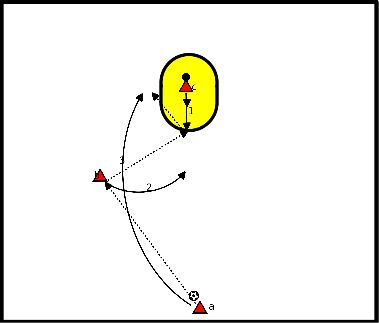
- Player A at the line passes to player B left or right in the box.
- Player B plays through to player C who comes to the tip of the circle.
- Player B moves inside and comes out right in front of the basket.
- Player A after playing through to B moves toward B and runs around behind B to the basket.
- Player A gets the ball and takes a through ball.
- Score 10 times after setting up in front on left
- score 10 times after setting up in front over right
- score 10 times after setting up from the side - out ball
- score 10 times after setting up from behind
- score 10 times after setting up in front over right
- score 10 times after setting up from the side - out ball
- score 10 times after setting up from behind
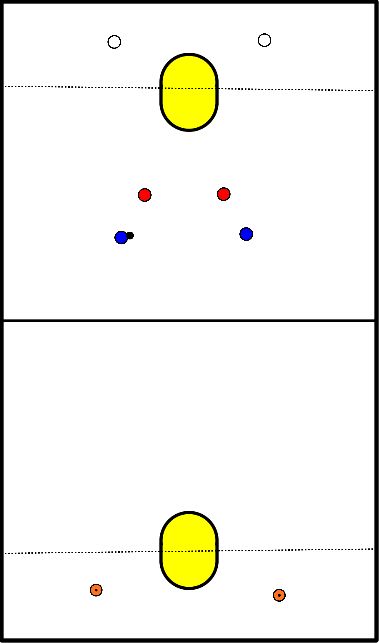
Games are played on a small korfball court, divided into two squares, with 1 ball and a total of 4 pairs per square.
- Team blue starts attacking and may not go behind the dotted line, which is in line with the post.
- Team red starts defending and may go anywhere in the box
- Team white may be used as a focal point for team blue and engage in the rebound duel with team red. They are not allowed to get past the dotted line. Caught balls are played back out to the attacking team.
- Team blue scores? Then the ball is played as quickly as possible to team orange, who have the same function as team white in the starting situation.
- Team blue switches places/functions with team white. Team white then becomes the offense in the other box and team red remains defense.
- Interception team red? Then the ball is played to team orange as quickly as possible. Team red becomes attack in the other box and team white defends.
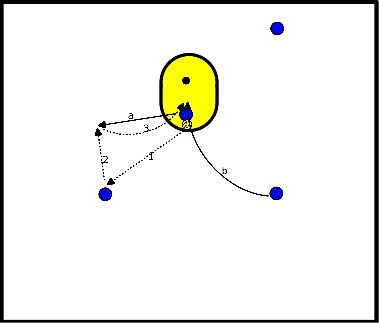
The ball is under the post in the support.
Two players in the front of the box.
The fourth player wanders somewhere in the back box.
Two players in the front of the box.
The fourth player wanders somewhere in the back box.
- The support throws the ball out to the left or right and runs in the direction it was thrown.
- The ball is played back to the out runner.
- The player on the other front is constantly moving and breaks through at the moment the ball is played back to the out runner.
- The out runner hands the ball over and this through ball is scored.
Score 20x over left and 20x over right.
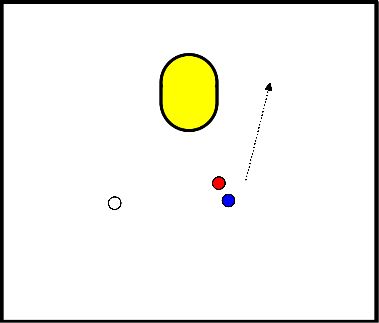
Per 3- or 4-team at a basket.
Step 1:
Step 1:
- Player Red defends Player Blue.
- Player Blue has the ball and then throws it to Player White and runs deep and shoots.
Step 2:
- Follow Step 1 and after Player Blue runs deep, Player White rushes in for a giveaway.
- Player Blue goes for a pass through Blue.
- Player Red continues to defend, but allows the through ball.
> Take the goal attempts as calmly as possible
> If by 4 put down a rebound.
> If by 4 put down a rebound.
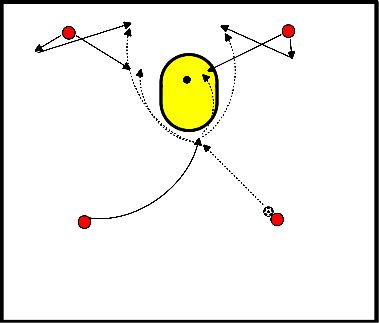
- The ball enters the box in a 4-0 formation.
- The player on the other side -for- cuts in for support.
- At the moment the ball is played to the diagonal player makes a breakthrough or lateral move, gets the ball played to him and gets to the shot.
- If no goal is scored, the support can shift attention to the other back, where breakthroughs or clearances can be made for the shot.
Note: The player on the side of the ball can also run in instead of the player in front. The action then comes from the other side of the box.
Exercise:
Exercise:
- Score 5 through balls over left and over right
- Score 5 clearance balls from the left and right.
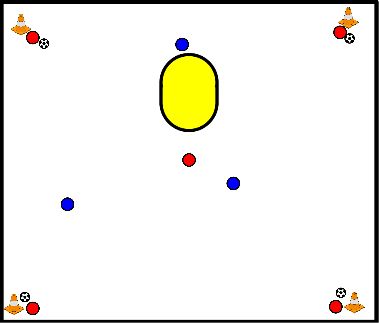
Explanation
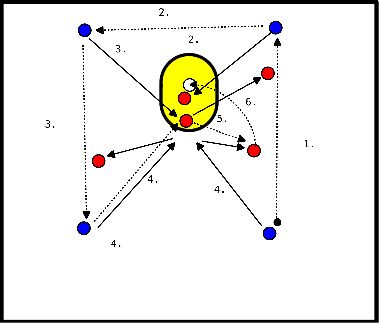
- Put a basket in each corner of the field.
- At each basket, one player stands with a ball.
- The remaining four players stand in the middle of the field.
- 1 player is attack, three players are defender.
- The defenders must defend the four baskets together.
- The attacker tries to score a goal within 25 seconds.
- After every 25 seconds it is a new attacker's turn.
- When there are more than 8 players, rotate through.
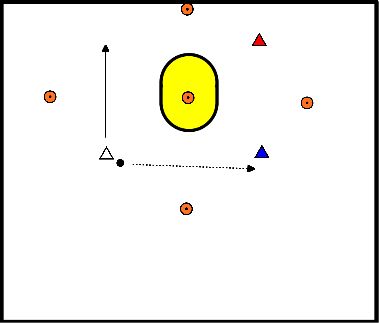
Per 3 or 4 at the basket:
- Using pawns, divide the attacking area around the basket into 4.
- There are players in 3 of these 4 areas.
- If 4 players, set up a rebound.
- The moment player white passes the ball to player blue, player white moves to the free area. Player blue plays on to player red, and then also starts filling in the free space.
- Note: do not let players run away too quickly, make sure they remain playable. The idea is that they make a timely attack. Walk towards the ball.
- Give a signal to shoot, the other 2 will fill in the rebound from space.
- Then play again and repeat.
- If it goes well, also try it with a defender -> let the pass be given, but then make it more difficult to get free.
- If feasible, you can also implement a support in the exercise.
Let the players think for themselves who best fills this position.
- If feasible, you can also implement a support in the exercise.
Let the players think for themselves who best fills this position.
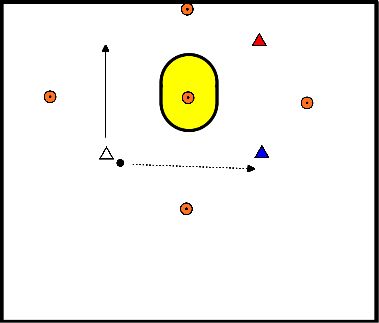
Per 3 players at the basket:
- With pawns, divide the attacking area around the basket into 4.
- There are players in 3 of these 4 areas.
- When player white passes the ball to player blue, player white moves to the free area.
- Player blue plays through to player red and then also fills the free area.
- Give a signal on which may shoot. The other 2 go out of space to fill in the rebound.
- Then play out again and repeat.
If feasible you can also implement a support in your exercise.
Let the players think for themselves who best fills this position.
Let the players think for themselves who best fills this position.
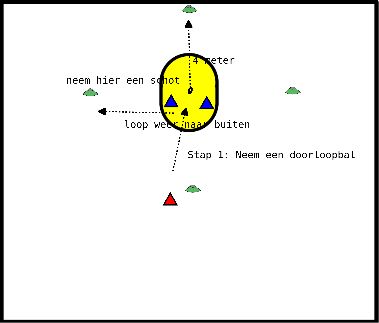
- In threes or twos to the basket.
- There is constantly 1 person working for 1 minute, ideally 2 people for the rebound.
- There are pawns/slip dots in a square around the basket, about 4 meters apart.
- Player 1 starts at the first pawn, walks in for a through ball.
- Then walks out to the second pawn and takes the shot there.
- Goes to the third pawn and makes another through ball there etc.
- After 1 minute it is the next player's turn.
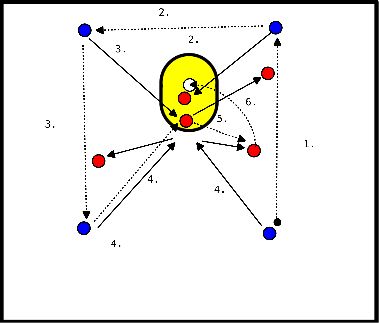
Building up to offensive positions to fall back on when creativity fails for a while.
Blue = static starting positions
Setup:
- Pass deep from front field
- Pass laterally into backfield + rebound run in
- Pass deep from backfield + run in support
- Pass passed to incoming support + attacking action by both strikers
- Support plays free striker + runs out into space
- Offloaded striker shoots
Once static has been mastered, move to dynamic. Agreement is that support follows immediately after rebound. The rest can be filled in freely with the variations below:
- Support runs around the block instead of cutting into it.
- Support does not shoot, but plays shadow striker to shoot. 7a.
- Offloaded striker does not shoot, but plays run-out striker to shoot. 7b.
- Played run-out support does not shoot, but shadow striker runs into support and takes over function + attack action strikers and shoot. 8.
- Played run-out support does not shoot, striker runs into support and takes over function + shadow striker connects with run-out support + strikers attack action and shoot. 9.
- ... innumerable variations to think of
Building up to offensive positions to fall back on when creativity fails for a while.
Blue = static starting positions
Setup:
- Pass deep from front field
- Pass laterally into backfield + rebound run in
- Pass deep from backfield + run in support
- Pass passed to incoming support + attacking action by both strikers
- Support plays free striker + runs out into space
- Offloaded striker shoots
Once static has been mastered, move to dynamic. Agreement is that support follows immediately after rebound. The rest can be filled in freely with the variations below:
- Support runs around the block instead of cutting into it.
- Support does not shoot, but plays shadow striker to shoot. 7a.
- Offloaded striker does not shoot, but plays run-out striker to shoot. 7b.
- Played run-out support does not shoot, but shadow striker runs into support and takes over function + attack action strikers and shoot. 8.
- Played run-out support does not shoot, striker runs into support and takes over function + shadow striker connects with run-out support + strikers attack action and shoot. 9.
- ... innumerable variations to think of
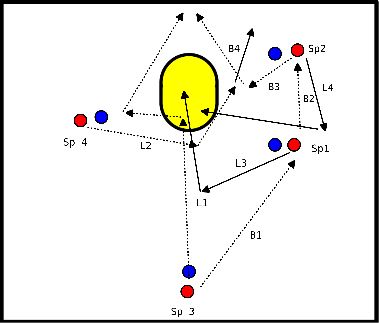
- Player 3 picks up the ball and throws it to player 1.
- Player 3 runs to the post.
- Player 4 goes over block, player 3 to the pointer.
- Player 1 throws the ball to player 2.
- Player 2 throws the ball to player 3 who enters the give way.
- Player 3 dodges and gets the ball moving, behind the post, and shoots.
- Player 4 connects, next to player 3.
- Player 1 runs to the front of the post and keeps the player engaged until shot.
- Player 2 takes player 1's position and after the shot goes to the post for the double-catch, ball over the basket.
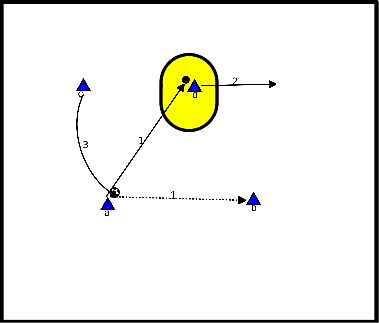
- Setup is that someone stands under the post and the 3 others stand in a triangle relative to the post.
- The player with the ball plays deep or wide and takes the pole position.
- If the ball is played deep, the player at the post moves backwards. If the ball is played wide, the player on that side runs with it.
- If the ball goes deep, the forward player takes the filling-in player's spot. If the ball goes wide, the back player takes that spot.
- The player who fills in from the side takes the shot. The caught ball goes back to the middle player and play can begin again.
- If everything is filled in on time, you have the catch out of space. If the intended shooter is blocked with a jump, he/she has 2 points of attack for a breakthrough.
- Score 10x via moving to the right.
- score 10x via moving to the left.
- score 10x via a through ball on a flying defender.
Setup:
Which team brings in most gold pieces/ pits?
Which team brings in most gold pieces/ pits?
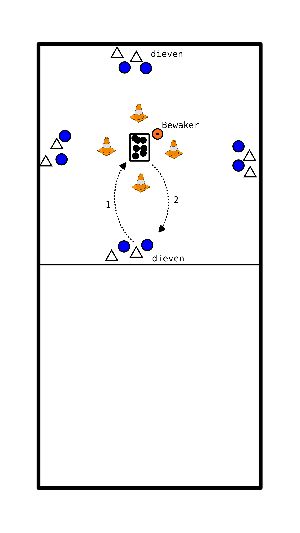
- 1 bank & one-against-all
- 2-4 gangs of thieves
- 1-2 guards.
Game consists of 4 rounds of play:
Game Round 1:
Game Round 1:
- Thief - attacker: per post only 1 active & 1 gold piece at a time try to steal from bank.
- Collect in own vault -hoop-.
- Guard - defender- may only defend outside the bank.
- If the thief is caught so tapped, he must leave the gold piece in the police station -under a cone.
- Which team was able to steal most gold pieces?
Game Round 2:
- Divide gold pieces equally among the thieves.
- Thieves: safely move your gold pieces 1-for-1 to other safe -from one hoop to another.
- Thief -attacker: walk around your cone without the guard catching you.
- Agent -defender: in this case may only defend inside the bank.
- If the thief is caught -attacked, he must leave the gold piece in the police station -under a cone.
- Which team was able to transfer most gold pieces safely?
Game Round 3:
- Thieves: for x time, steal as many gold pieces as possible from other safe.
- Thief -attacker: mandatory back & forth through bank = watch for guard inside bank.
- Guard may only defend inside bank.
- If the thief is caught so tapped, he must leave the gold piece in the police station -under a cone.
Game round 4:
Same as game round 3, but with double guard 1 guard outside & 1 guard inside the bank.
Which team will have the most gold pieces in their possession after 4 rounds of play?
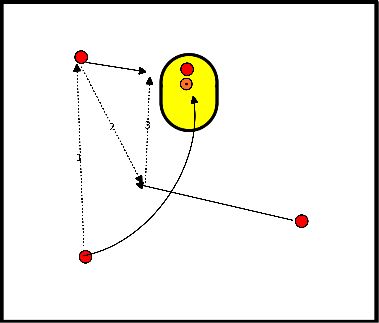
- The first ball is played deep from the front pocket.
- Then the other front comes in and passes the ball.
- The first passer runs over the block to the catch.
- The back player runs on the ball side for a through ball to the post.
- Alternatively, the ball is passed directly back for the distance shot.
- The player under the post steps out as soon as the rebound is taken over from the front and ensures that the player with the ball has two points of attack.
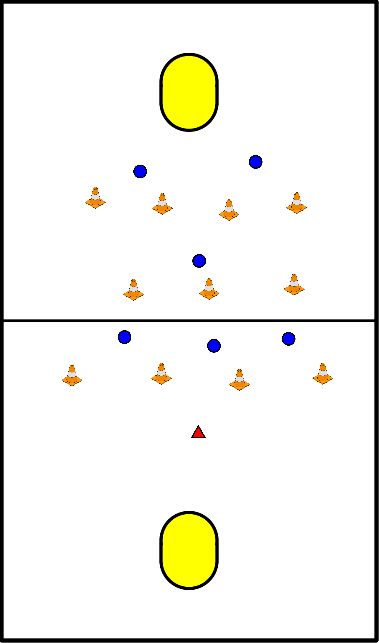
Attacker uses feints to get past the defender.
- There are 6 players between the pawns.
- There must be 1 hole per row of pawns.
- The other players try to use feints to find the hole.
- The defenders may only defend widthwise and try to tap the attackers.
- If you get tapped, you have to start over.
- If the attackers reach the other side, they get 1 point.
- After 5 points, the game is switched.
- The game can be made easier by adding fewer defenders.
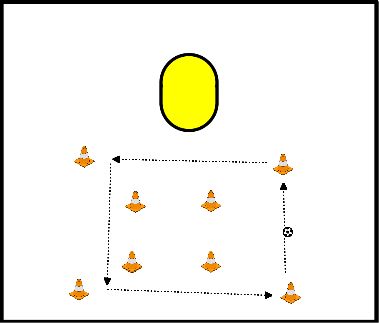
Only the square and not the diamond is used in this form of training. The primary training objectives here are:
- Keeping space in the box, through running lines in a square
- Timely replenishment of vacant position, timing running moments.
- Passing ball at pace to next player.
Note: the square must be smaller because the diamond is not used initially. Player must be at a distance they can throw.
For the exercise, there is an inside and outside square marked by pawns. So players are not allowed to go outside that path and therefore not make the square smaller than that:
- Player 1 plays to 2 -> runs after own ball at reasonable pace;
- Player 2 plays directly to 3 -> runs at reasonable pace after own ball;
- etc.
- The ball pace goes up slowly.
- When the children have this under control, the ball goes the other way.
The ball should be passed quickly and passed faster and faster.
Eventually, players should always be able to get to the empty spot just in time, because the pace of the ball is almost faster than that of the players.
Eventually, players should always be able to get to the empty spot just in time, because the pace of the ball is almost faster than that of the players.
Playing tight balls is a requirement here.
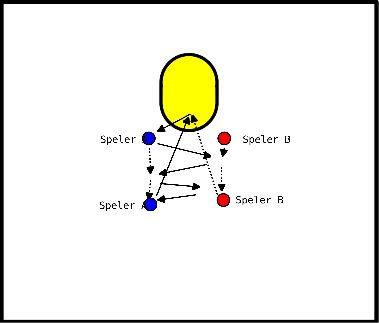
- Player A starts with the ball 2.5 meters diagonally in front of the post. Player B also stands 2.5 meters diagonally in front of the post.
- Player A throws the ball to player B and player B throws it back. Thus they bring the ball up to about 8 meters in front of the post.
- From there, player B starts for a through ball from the space indicated by player A.
- However, instead of player B taking the through ball, it now enters the declarer and player A comes in for a clearance ball. Player B catches the ball.
A variation on this:
Only throw the ball when player B runs next to/behind the basket and player B immediately makes a shot. Player A immediately runs in to catch the ball.
Only throw the ball when player B runs next to/behind the basket and player B immediately makes a shot. Player A immediately runs in to catch the ball.
There are more variations on this, such as:
- Most goals in a time frame of, say, 10 minutes
- Who scores 10 goals first
- Make it more difficult by deducting a point for each ball on the ground.
- Possibly with a 3rd player to rotate and keep a slightly slower pace.
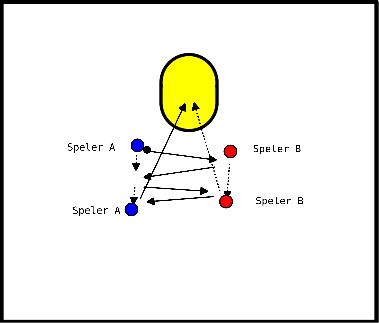
- Player A starts with the ball 2.5 meters diagonally in front of the post.
- Player B also stands 2.5 meters diagonally in front of the post.
- Player A throws the ball to player B and player B throws it back.
- Thus they bring the ball up to about 8 meters in front of the post.
- From there player B starts for a through ball from the space indicated by player A.
- Player A also runs in after it to catch the ball before it bounces on the ground.
Variations:
- Most goals in a 10-minute time frame.
- Whoever gets to 10 goals first.
- Make it harder by taking a point off every ball on the ground.
- Possibly with a 3rd person there to rotate through and keep a slightly slower pace.
- Most goals in a 10-minute time frame.
- Whoever gets to 10 goals first.
- Make it harder by taking a point off every ball on the ground.
- Possibly with a 3rd person there to rotate through and keep a slightly slower pace.
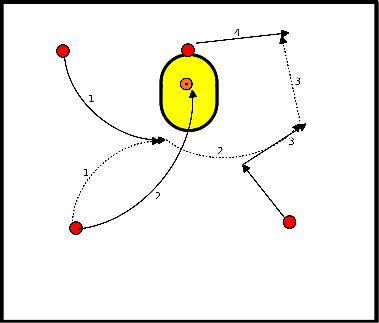
- the back player cuts in to the support as the ball enters the field and gets it played.
- the passer simultaneously runs across the support to the rebound and takes over.
- the support passes the ball to the diagonal player in the break and takes the shot
- If that is not successful, the ball can be passed to the outgoing first rebounder
At that point, there can be doubles/ breakthroughs from both the first and second players and you get opportunities again if the then standing rebounder steps out again or the earlier support makes an action without the ball.
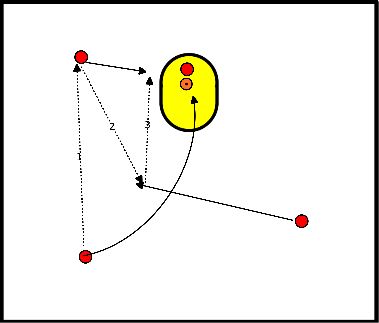
- The first ball is played deep from the front pocket.
- Then the other front comes in and passes the ball.
- The first passer runs across the block to the catch.
- The adjuster runs on the ball side for a through ball to the post.
Alternatively, the ball is played back directly for the distance shot. - The player under the post steps out as soon as the rebound is taken over from the front and ensures that the player with the ball has two points of attack.
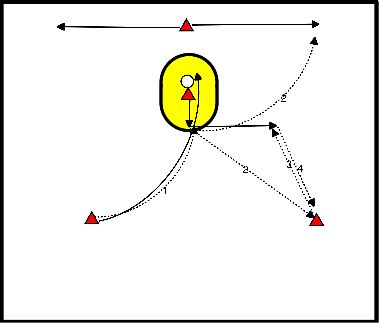
- The ball is played in from the front to the running player under the basket.
- At the same time, this player runs over the fulcrum to the basket for the catch.
- The fulcrum places the ball out to the other player in front, alternatively is to the back.
- The support player comes out to the side of the player who received the ball and is played back in.
- This doubles the ball back and the ball is shot by the front or back player.
- The catch is made by the player in the catch -who has the back of the box, as seen from the shooter- .
- The non shooter has the front.
- The declarer watches for a catch and the shooter keeps moving for a breakthrough.
- Score 5x from right front, 5x from right back, 5x from left front and 5x from left back.
- We can practice this with triplets or foursomes.
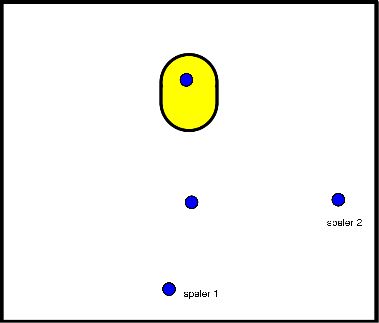
Objective:
2 runners on support create a distraction, so that they can pull away from under the basket and shoot.
Game:
2 runners on support create a distraction, so that they can pull away from under the basket and shoot.
Game:
- 2 attackers high in front of the basket.
- 1 support high in front of the basket.
- 1 attacker under the basket.
- Attacker 1 plays over with support a maximum of 2 times, while moving.
- Attacker2 runs in in such a way that he can also go in for a run after those two throws.
- Attacker 1 runs through at high speed; if no run through can be made, player 2 comes through.
- At the same time, player 1 moves away from the basket to the side where the run through is coming from.
- If player 1 is free, he may score; if he is well defended, he may pass to the player under the basket who is pulling away.
- If the ball cannot be passed to the support, check if player 2 is playable.
Agreements:
- Attackers 1 and 2 do not stand still.
- No more than 2 throws back to the support by the same person.
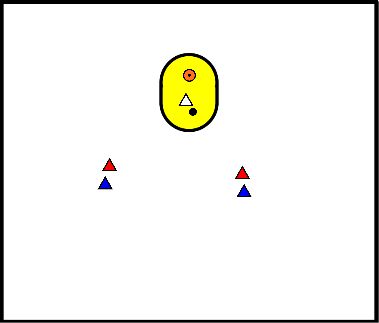
2 attackers with one defender each try to take chances.
The attacker under the basket makes sure they can create chances.
The attacker can also rebound, but stays in the basket zone.
Getting free becomes easier, but make sure you have the right timing. Make
sure that the attackers are always turned towards the basket.
The attacker under the basket makes sure they can create chances.
The attacker can also rebound, but stays in the basket zone.
Getting free becomes easier, but make sure you have the right timing. Make
sure that the attackers are always turned towards the basket.
- Start with the assist from under the basket.
- Extra: also leave space in front to free each other.
- Extra: if an attacker gets the ball from under the basket, he may not pass to the attacker again. --> stimulate the assist from space.
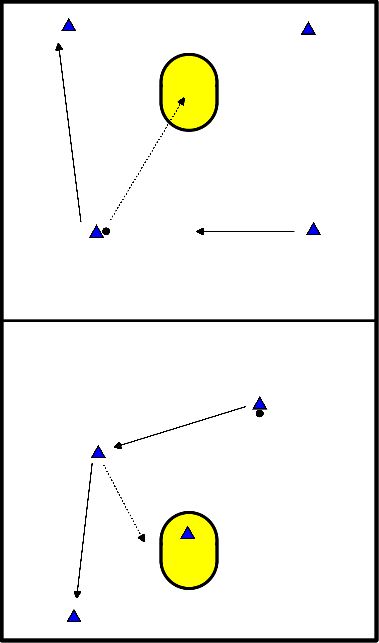
- From 4-0 to 3-1: shot directed and to 2nd chance, also from rebound
- Intermediate to pass --> filling space and to shot
- Defender on shooter (80%)
- Intermediate to pass --> searching for 2nd attacker
- Defender on shooter (80%) --> timing to release
- Intermediate and rebound change: rebounder draws from basket to chance
- Defender on rebound: do not let go in support --> recognized by attackers in front court
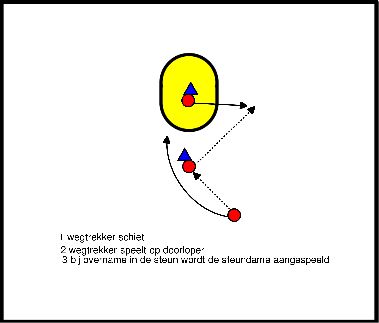
- The player in the support is played from the left or right of the front court.
- The player in the rebound pulls away to the side of play and gets the ball out of the support.
- The first times there will be no sharp running along and they can shoot themselves.
- The player runs around the support and catches the ball.
- If there is good defense, the outgoing rebounder plays the ball to the player who runs around the support and takes a through ball.
- (Sometimes there is cutting, often the defender is not short enough. If the declarer steps out when throwing, the other attacker runs past the defender and there is no cutting)
- If the player is taken over the support, the ball goes to the support who then shoots themselves.
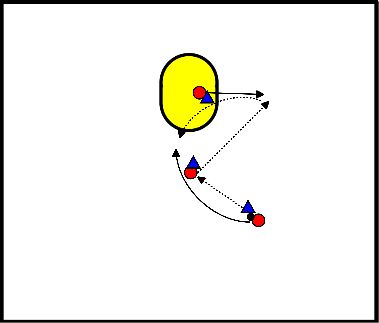
- Ball is played into the support.
- The lady under the post moves away to the side from where the ball is played into the support.
- In the meantime the first passer has run towards the support, after which the support player plays the ball to the outgoing pole lady and she steps with the ball threatening to run inside.
- The first passer runs around the block and gets the ball from the side and takes the through ball.
- Play this in the 3:3 as often as you can and do this on all sides of the post.
- The third trio practices free balls and penalty throws. The starting ball can also be practiced new. (Similar to above)