



Korfballexercises for technique attack / score
- 2-0 is meant to get rid of the opponent and use your fellow players as a block,
- Watch out for cutting off!
- Extend the game by having a defender take over under the basket and having the attacker sprint away and make a distance shot.
- When the group knows how to make the through ball, they can start with the technique with resistance from a defender.
- Not only the pace of the run-up is important, but also cutting off the defender's running line.
- A player is standing near the basket.
- Two players stand next to each other at a distance of 6 metres.
- One is attacker, the other defender.
- The attacker starts for the walkthrough, but in the meantime the defender tries to defend.
- The attacker must try to cut off the run of the defender immediately after the start.
- This means that when the runner starts to the left of the defender, the runner passes the basket on the left side.
- The runner therefore crosses the running line of the opponent
In short: a lot of shooting practice with a lot of running. (STRESS on learning to shoot on one leg at the end of the season plus stepping out with a throw).
Organisation: The baskets are placed in a square The number of baskets is very precise: aim for 5 baskets per 10 players.
a ) The players start at each basket, one person stands under the basket and the other person stands in the hoop in front of the basket with the ball, shoots on twolegs and goes on to the next basket.
changing: on time
in case of uneven numbers, run again or catch again.
b ) As a., but now with the assignment: Who will score 3 goals first?
c ) Like a., but with the assignment: pull one leg out of the hoop and the other leg up.
(for the ones who write with the right hand out of the hoop, SHOCK ON THE AIDE TRAINERS HERE TO HELP THEM)
d ) As a., but there is an 'over-taking situation': the runner from the circle, after having received the ball, plays the ball back to the declarer who started away from the post
(THE DECLARER STEPS OUT OF THE HOOP WITH ONE LEG TO THROW). The original declarator must try to score from this start. (NOW the one who shot the ball runs to the next corner).
change ; on time, or who scores 3 points first
In short: practise passing the ball from difficult situations.
Organisation: three or four teams per basket, one or two people under the basket, two in front of it. After marking the ball, walk forward to make a fastball, i.e. turn around.
(a ) Bouncing balls, indicated by a bounce.
(b ) Signalling too late: take overhead walkthroughs.
(c ) Signalling too late: the runner runs (left or right) past the basket and raises the ball more or less sideways or diagonally backwards.
(d) Late tagging: the runner runs along the near post and flings the ball over the head into the basket with one hand.
(e ) Marking too late: the ball is taken in the jump.
f ) The ball is passed too early: a 'long pull' must be taken with a long moment of suspension in the movement.
g ) The ball is not thrown in but rolled (can also occur in matches when the ball is knocked out of hands, or after an unsuccessful bouncing ball for example).
h ) the ball is indicated from the side, after which a through ball follows
With 3 players at the basket, 1 attacker with the ball under the basket and 2 players who shoot the ball in motion (minimum distance 3 meters
).
The attacker who is first to score 3 goals may remain in front of the basket and the attacker who has lost the game must take the place of the attacker.
- Make 2 squares of 4.
- The attack takes the ball from the trainers.
- When the defence has intercepted the ball, they first pass it back to the trainers.
- When a goal is scored, the team gets a bonus and can take the ball back out.
- Form 3 teams at the basket
- Person 1 stands 3 to 4 meters in front of the basket near the pawn.
- Person 2 will stand 3 to 4 meters behind the basket near the pawn.
- Person 3 stands under the basket as catcher
- Person 1 starts shooting, person 3 catches the ball and throws it to person 2.
- Person 2 shoots, person 1 catches and throws to person 3. Always change.
Exercises with distance shot, penalty throw and walkthrough.
- Make 2 squares of 4.
- The attack takes the ball from the trainers.
- When the defence has intercepted the ball, they first pass it back to the trainers.
- When a goal is scored, the team gets a bonus and can take the ball back out.
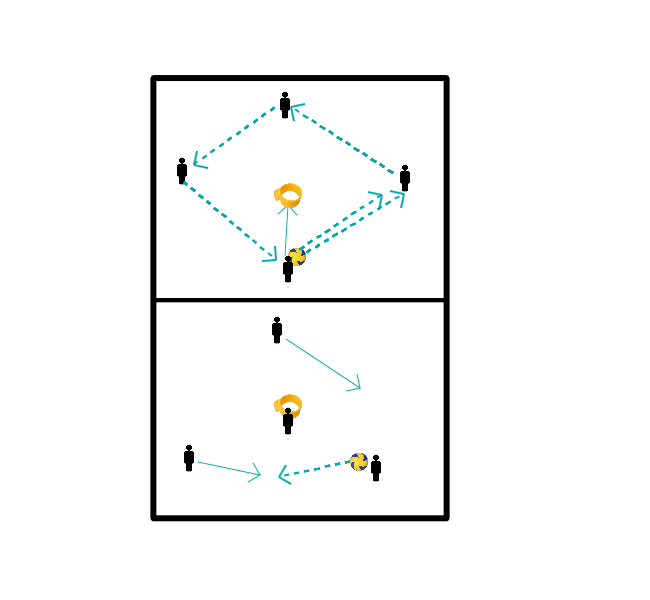
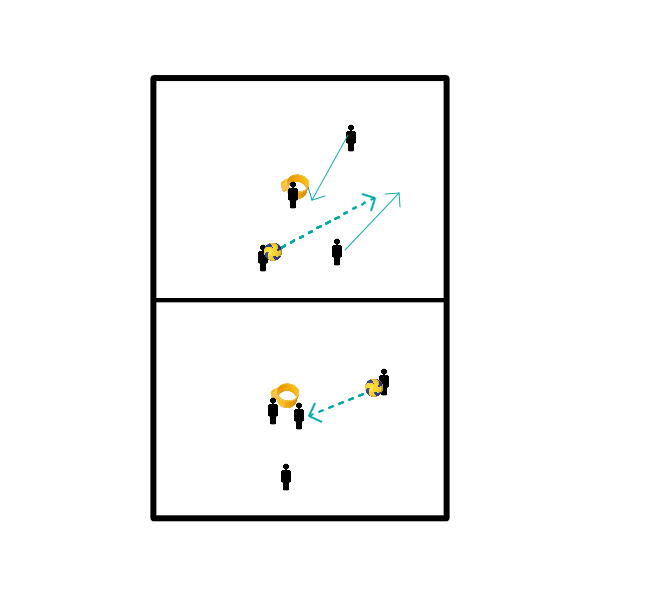
Do give orders, for example:
- Start in a diamond. Let the ball go around 1 time.
- The player in front throws the ball next to him/her one more time and catches it.
- The other players continue playing. The player who has the ball now chooses whether he wants to throw to the left or to the right. The other players run to the ball to pick it up. The ball is thrown and the player immediately runs a long line.
The long line is nudged and the thrower comes alongside. The other player walks behind the basket to walk into the support. The other two are going to attack.
Inshort: practise various forms of the shot in a fun competition format.
Organisation: each group a basket and a ball, the baskets are preferably (but not absolutely necessary) arranged in a circle or rectangle. The number of people per group is less important (all groups should be about the same size).
Pawns set up at 1,3,5 metres
The first assignment for the groups is: make 10 goals. When you are done, the creator of the last goal goes to the trainer to get the next assignment. Which group will have completed all assignments first?
The trainer walks around the room, encouraging or correcting the players. He has a piece of paper with a list of assignments. When someone comes to get the next assignment, first ask him which assignment he just completed (after a while this can vary considerably) and then give the next one. Here's an example: 10 walk-through balls, 15 penalty shots, 5 shots from 8 meters, 10 walk-through balls from behind the basket, 5 dodgeballs next to the post, 10 shots from 6 meters. Everything is possible of course, a lot of momentum comes from keeping the number of goals to be scored small.
Tasks:
- 6 scores from 2,5 meter in front of the basket
- 6 scores from 1 meter in front of the basket
- 6 scores from 6 meter in front of the basket
- 6 scores from 2,5 meter behind the basket
- 6 scores from 1 meter behind the basket
- 6 scores from 6 meters behind the basket
Indicate from the space
Keep space under the basket free and pass to the player from various positions in the field. First without and then with a defender.
Pay attention to good placement of the ball!
Setup: O v * * = pilon O = basket
* v O
[Make
sure that they first pass the ball before passing it.
Distance between the pile and the basket is +/- 10 meterAt
each pile there is one person with the ballAt
+/- 4 meter from the pile there is one defender.
The player tries to pass the ball. By changing tempo she tries to pass the defender first. Defender follows, but lets her pass. From pole 1 the attacker moves on to pole 2 and makes a new attempt at pole 2.
Variation:
- 2 attackers at the same time
- When scoring twice, switch to pass.
- Defender goes for preventing shot.
- Attacker can choose for walk through, dodge and/or distance with step behind
- adjust time
- multiple posts/pillars/players
Setup: O v * * = pilon O = basket
* v O
- Distance between the pile and the basket is +/- 10 meter.
- At every pole stands 1 attacker with the ball.
- At 1 meter from the pylon stands 1 defender (you must be able to touch the attacker by the shoulder).
- The player tries to pass the ball.
- By changing tempo she tries to pass the defender first.
- Defender follows, but lets her pass.
- From pole 1 the attacker continues to pole 2 and makes a new attempt at pole 2.
- We do this for 1 to 2 minutes per person.
Variation:
- 2 attackers at the same time
- When scoring twice, switch to pass.
- Defender goes for preventing shot. Attackers can choose for walk through ball, dodge and/or distance with step behind.
- adjust time
- Multiple posts/pillars/players.