



Korfballexercises for seniors
Setup
- 1 feeder under the post
- 1 attacker in front of the post
- 1 defender in front of the post
- The attacker starts 5-6 metres from the post.
- The attacker gets 3 attempts to score.
- If the attacker does not score, they remain and receive a different defender.
- Substitutions occur until the attacker scores.
Setup
- Create a square where an attacker is constantly moving.
- A defender follows the attacker.
- Other players stand around the square.
- The attacker starts with the ball and throws it to a player on the side.
- The player on the side throws the ball back to the attacker.
- The attacker then throws to another player on the side.
- The defender tries to intercept the ball.
- If the defender intercepts the ball, they throw it back, and the exercise starts again.
- The attacker continuously tries to find space, while the defender tries to intercept the ball.
Game Rules
- Form groups of 2 people per korf. Each group receives three playing cards. The playing cards are shuffled in advance, and the numbers 2 through 5 are removed from the deck.
- With the three received playing cards, the groups must try to get as close as possible to 31. The value of the cards is as follows: Six = six, Seven = seven, Eight = eight, Nine = nine, Ten = ten, Jack = ten, Queen = ten, King = ten, Ace = eleven.
- Examples: nine + jack + queen = 29 points or ace + jack + queen = 31, jack + jack + jack = 30.5.
- If the players have completed a series, they may exchange one of their cards for a new one to get closer to 31.
- The trainer sets a timer and says "stop" when it goes off. The team that is then closest to 31 wins.
- Running-in shots: three goals in a row.
- Short chance: four goals in total.
- Distance shot behind the korf: two goals in a row (4/5 meters).
- Penalty shots: three goals in a row.
- Round the korf: four goals on each side of the korf (3 meters).
Setup
- Create two zones with four players each.
- The attack starts with the ball at the trainers.
- When the defence intercepts the ball, they must first return the ball to the trainers.
- If a team scores, they receive a bonus and are allowed to take the ball out again.
Formation
- Four cones in a square.
- Four players, one at each cone.
- One player has the ball.
- The player with the ball passes it counterclockwise to the next player.
- After passing, the player runs clockwise to the next cone.
- There is always one cone without a player, but the ball keeps moving.
Formation
- Form two groups. The attacker receives a bib.
- The attacker starts with one defender.
- Within a playing area, the attacker must try to get free.
- At the front of the playing area stands the feeder, who must ensure the ball reaches the attacker well.
- The remaining players stand along the side.
- If the attacker receives the ball successfully without the defender intercepting it, an additional defender joins.
- Get free
- Throwing
- Avoid contact
Formation
- Three children per korfball post.
- One attacker, one defender, and one feeder/collector.
- The attacker tries to score.
- The defender tries to prevent this.
- Switch roles when the attacker has scored.
Execution
- Form pairs. Player 1 stands 6 metres in front of the korf. Player 2 stands with the ball under the korf.
- Place a marker cone to the left or right of the korf at approximately 4 to 6 metres.
- Player 2 throws the ball to Player 1. Player 1 places the ball on the ground and runs to the marker cone, goes around it, and moves towards the korf.
- Meanwhile, Player 2 runs to the ball on the ground and passes it to Player 1 for a deep running-in shot.
- Repeat this until 8 running-in shots are completed.
- The pace is crucial: the runners must not stop but also must not run too slowly.
- The timing of the passing must be correct.
Setup
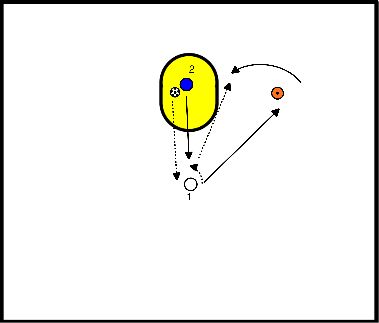
- 1 post
- 1 ball
- 4 cones in a square
- 9 players: 4 attackers, 4 defenders, 1 feeder
- The 4 attackers stand in a square at the cones around the korf.
- The 4 defenders hold the post with one hand.
- The feeder stands with the ball outside the square of cones.
- The feeder passes the ball to an attacker.
- The defender opposite the attacker who receives the ball must run around the cone.
- The attackers try to score quickly by finding the free player.
Execution
- All players stand in a circle.
- Player A throws the ball to player B and runs to player B's position.
- Player B throws the ball to player C and moves to player C's position.
Setup
- Each group has one korf and one ball.
- Preferably set up the korfs in a circle or rectangle.
- All groups should be approximately the same size.
- Make 10 running-in shot goals.
- The player who scores the last goal retrieves the next assignment from the trainer.
- The trainer asks which assignment was just completed and gives the next one.
- Which group completes all assignments first?
- 10 running-in shots.
- 15 penalty shots.
- 5 shots from 4 meters.
- 10 running-in shots from behind the korf.
- 10 shots from 3 meters behind the korf.
In Brief
- Shooting game where shots are taken from different sides of the korf.
- One pair per korf with a ball. If there are not enough korfs, two pairs with one ball each.
- Four markers per korf: front, back, left, and right at approximately 6 meters distance.
- One player starts under the korf, the other shoots from each marker.
- Switch roles after each round.
- Which pair completes the 'around the world' first?
- Distances can be increased or decreased.
- Make 2 goals at each marker.
- Shoot on the move or take dodge shots.
- With 2 pairs per korf, score 2 times together at each marker.
- Complete the task within 2 minutes, otherwise a penalty round.
- Shoot from different positions to get used to various angles and distances.
- Ensure variation in shooting positions to avoid favouring any team.
- Accurate shooting is crucial for success.
- Players become more focused and improve quickly.