

Korfballexercises for u11
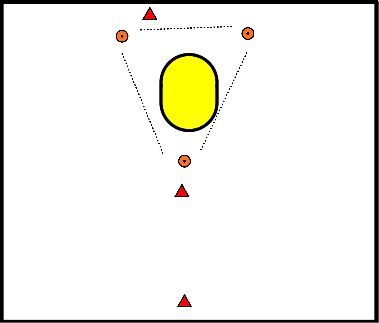
- 3 pawns around the basket to create a triangle.
- The attacker is allowed to get in, the defender is not.
- Attacker stands 6 meters from the basket and the attacker tries to get in front of it. For this he gets 2 points. If this does not work, he/she looks for an opportunity behind the basket. If he scores behind the basket he gets 1 point.
- Defender must always be in front.
- From 5 meters, make 6 shots.
- Make 8 shots
- Make for yourself 5 penalty throws (Count how many you scored)
In short: shooting practice (-game) in which you shoot from different sides of the basket.
Organization:
- Per basket one pair with a ball, or in case of lack of sufficient baskets 2 pairs each with a ball.
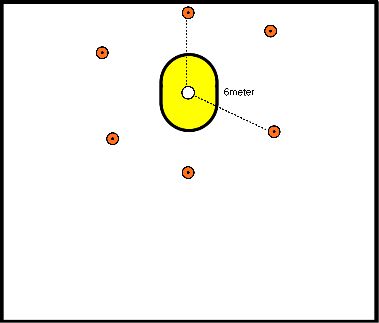
- At each basket, four pawns or other markers: one in front of and one behind the basket and one to the left and right of the basket, always at a distance of about 6 meters.
- One of each pair starts under the basket.
- The other is instructed to score a goal as quickly as possible from each pawn.
- Then switch positions.
- Which pair will finish 'the trip around the world' the quickest?
Variation:
- The distances can of course be made larger or smaller at will.
- Or: score 2 goals at each pawn.
Variation:
- Instead of shooting from standstill, it is possible to shoot from movement,
- Or simply: take evasive balls.
Variation:
- There are 2 pairs per basket.
- The two shooters are now instructed to score two goals together at each pawn, no matter who scores the goals.
- So there is a change of function after 4 times 2 goals have been scored.
- At which basket is the first to go around 2 times (and therefore has scored 16 goals first)?
The main consideration behind the above exercises is the fact that shooting is usually preferred from in front of the basket. And since a large part of the box is next to or behind the basket, it is necessary to practice from those spots as well. And shooting from there is really different: not only because the baskets usually hang slightly forward, but also because the attachment to the post is clearly visible to the shooter, which affects the estimation of the correct distance and height.
Clean shooting is always important of course, but here it comes down very much to scoring goals. When players play this game for the first time, they are initially quite vocal and there may be reactions like "this is impossible!" or "I don't like it". These reactions disappear after a short time, people start to shoot with great concentration and scoring improves by leaps and bounds. What seemed impossible at first, turns out to be possible after all!
- We work this exercise with pairs or trios (with 2 teams alternate, with 3 teams rotate).
- There are 6 pylons around the basket, all at 6 meters.
- Which 2/3 team is first to score 5 x a walk through ball from each pylon?
- Which 2/3 team is first to score 2/3x from each distance
- Then the pylons are set at 2 meters and each player scores 2 goals from each side
- Make groups of 4/5 or 6 players with 2 balls.
- These line up, with the first two players having a ball.
- Start at 4 meters from the basket.
- Once the first has shot the second may start shooting.
- The shooters go after the ball and shoot again from that spot.
- When the first one scores, he gives the ball to number 3 who then starts shooting immediately.
- If the last shooter started scores first the first shooter is finished.
- Who wins this challenge.
- We play it from 4 sides of the basket.
In pairs. One declarer and one attacker.
Communicator stands under the basket, attacker stands in front of the basket.
Communicator stands under the basket, attacker stands in front of the basket.
- The attacker runs wide left/right and gets the ball on the outside hand.
- Try to catch and play back with one hand.
- On the 4th pass the attacker is going to take a shot.
- Swap after 2 turns.
- Emphasis on solid passes, and acceleration after re-playing.
Game:
- Team stands in a row at basket 1.
- Participant 1 starts shooting, then participant 2 starts shooting immediately.
- If participant 2 scores before participant 1 then participant 1 is off and goes to basket 2.
- Participant 2 joins behind.
- If participant 1 scores earlier, she goes to the back.
- Participant 3 joins the shooting. If she shoots before participant 2, then she joins at the back and participant 2 goes to basket 2.
- This game continues on all four baskets until there is a winner on basket 1.
Agreements
- You may interfere defensively, but not knock the ball away.
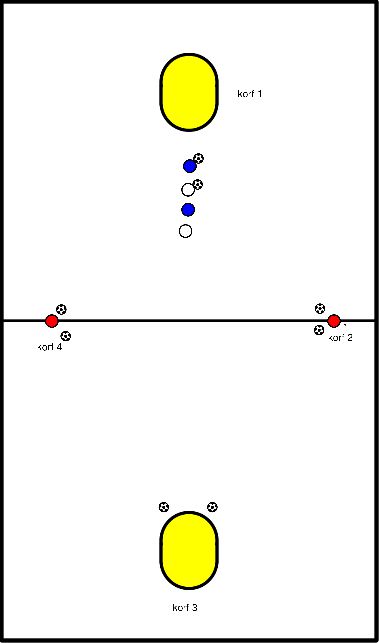
Number of players divided by 2 is the number of baskets needed.
Half of the players pick up a ball and stand at any basket. They remain here until the changeover time.
The rest of the players pick a basket to start. This group keeps working until the moment of change.
At the signal of the trainer, the players shoot.
How? The trainer can decide, distance, type of shot.
Round 1: 1 goal
Round 2: 2 goals
Round 3: 3 goals
Round 4: 4 goals
Round 5: 5 goals
The first player to score shouts loudly YES, all players must now immediately switch baskets.
The player who scored 1 goal in round 1 is in round 2, while the rest of the players are still in round 1.
Which player is first in round 5?
After this, the roles are reversed. The group of assist players/catch become workers and the workers become assist players/catch.
The exercise requires a lot of observation from the trainer. Who is in which round?
Half of the players pick up a ball and stand at any basket. They remain here until the changeover time.
The rest of the players pick a basket to start. This group keeps working until the moment of change.
At the signal of the trainer, the players shoot.
How? The trainer can decide, distance, type of shot.
Round 1: 1 goal
Round 2: 2 goals
Round 3: 3 goals
Round 4: 4 goals
Round 5: 5 goals
The first player to score shouts loudly YES, all players must now immediately switch baskets.
The player who scored 1 goal in round 1 is in round 2, while the rest of the players are still in round 1.
Which player is first in round 5?
After this, the roles are reversed. The group of assist players/catch become workers and the workers become assist players/catch.
The exercise requires a lot of observation from the trainer. Who is in which round?
Distance: 20 meters with a pawn after 10 meters.
- Jog back and forth 10 times at a steady pace.
- Up to half 10 meters walking on your heels, then jogging out and back.
- Up to half 10 meters on your toes, then out jogging and back jogging.
- 2 times back and forth side to side in the middle changing sides.
- 2 times to half (10 meters) knee lift, then sprint out and jog back.
- Jog back and forth 5 times at a slightly faster pace.
Target
- To shoot cleanly and build up fitness
- Which pair has the first 5 up and down runs?
Rules
- You start by sprinting up and down 10 times
- Then you shoot 10 times and count how many times you score
- If you have scored 5 or more times (half of your number of sprints up and down), you may sprint up and down once less, so 9 times.
- Then you start shooting again and count how many times you score. If this is half or more than the number of times you sprinted up and down, you may subtract another time.
In short: practicing the standard forms of shooting with three teams near the basket.
Organisation:
- Each team has a basket and a ball, the exercises start with one person under the basket (with the ball) and two persons in front of the basket.
- After the shot, the ball is passed to the next player, who has to catch the next ball and pass it to the next player.
- After passing the ball, another round of shooting follows.
- If necessary, the exercise can also be done with four people, the players just get a few less turns.
- If necessary, use a pylon for each basket.
- Play passing balls from about 10 metres in front of the basket.
- The same, but now overhead.
- As 1., but the ball is played forward from under the basket first.
- The shooter returns the ball to the receiver under the basket and runs after it to take the ball.
- Shooting from a standstill from a distance of approx. 8 metres (again, after the shot, run to the basket to catch the next ball).
- Shooting after a move to the left or right from about 7 meters distance.
- Take evasive action on the left (start at the pylon about 10 metres before the basket, at 5 or 6 metres before the basket make a sharp left hook).
- As 6., now over the right side.
- Take penalty shots.
- As 4., but after the distance shot, the shooter takes another walkthrough ball.
- The shooter threatens with a walkthrough, but stops very abruptly at about 3 metres before the basket (hoping that the defender will 'shoot through'), gets the ball and finishes the chance.
- The shooter makes an evasive move (over left, or right), receives the ball, but instead of shooting, he takes a walkthrough ball.
- There are various ways of putting the ball inside
- with the 'outside hand' - i.e. in a dodge to the right with a right-handed stretch -,
- with a bounce,
- by an overhand or an underhand sling throw,
- or by transferring the ball to the other hand with a left-handed stretch throw.
- There are several factors that determine which method is best, a good korfball player will need to master several ways.
- There are various ways of putting the ball inside
- The shooter makes an evasive move, pretends to receive the ball (possibly the attacker makes a feint), but immediately takes a through ball afterwards (so like c., but without the ball).
- The shooter takes a walk-through ball, after a few metres he suddenly sidesteps.
- However, the dodge is not continued: there will be a walkthrough anyway.
- I call it the Lucas move, after Albert Lucas who had a lot of success with it.
- Numbers 1 and 2 under the basket, number 3 (who has the ball) in front of it. Number 1 starts away from the basket, receives the ball, makes a half turn and shoots (= starting away from the basket).
- Number 2 catches, plays to number 1, takes off, receives the ball back, makes a half turn and shoots.
- Number 3 intercepts etc.
- The shooter makes an evasive move to the right, receives the ball, but returns it to the receiver under the post and runs straight to the basket himself (i.e. in the direction he just came from).
- He receives the ball back and shoots
- Lay out a rectangle (16x8 meters? Depending on the number of players).
- Divide into equal parts by a center line.
- Divide the group into 2 teams, each with their field.
- The goal is to eliminate the opposing players.
- The ball must not touch the ground first, the 'defending' player is not out if he/she can catch the ball.
- Round 1:
- The player who has been eliminated may re-enter the field if someone else from his/her team was eliminated.
- Round 2:
- The player who was thrown out may re-enter the field when he/she has scored 4 times.
- Round 3:
- Same as the previous one, but now the eliminated player is placed behind the opposing team's field, and may try to pass from there.
- If a previously thrown out player can hit someone from the back, he/she may be placed in the main field again.