

Korfballexercises for u11
In Brief
- Shooting game where shots are taken from different sides of the korf.
- One pair per korf with a ball. If there are not enough korfs, two pairs with one ball each.
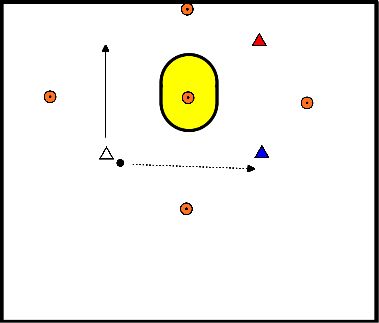
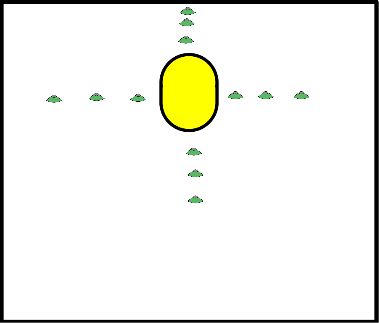
- Four markers per korf: front, back, left, and right at approximately 6 meters distance.
- One player starts under the korf, the other shoots from each marker.
- Switch roles after each round.
- Which pair completes the 'around the world' first?
- Distances can be increased or decreased.
- Make 2 goals at each marker.
- Shoot on the move or take dodge shots.
- With 2 pairs per korf, score 2 times together at each marker.
- Complete the task within 2 minutes, otherwise a penalty round.
- Shoot from different positions to get used to various angles and distances.
- Ensure variation in shooting positions to avoid favouring any team.
- Accurate shooting is crucial for success.
- Players become more focused and improve quickly.
In Brief
- A nice shooting exercise with a lot of running.
Organisation
- The korfs are placed in a circle.
- At each korf, there is a feeder with a ball.
- The rest of the players stand in the middle of the circle.
- Aim for 2 korfs per 5 players.
Execution
- Part a: The players in the center circle take running-in shots at one of the korfs. Those who are not fast enough must wait. Each player retrieves their own running-in shot and then looks for a free korf again.
- Part b: As in part a, but who scores 10 goals first?
- Part c: As in part b, but who scores a goal at each korf first?
- Part d: As in part b, but with overhead running-in shots.
- Part e: As in part b, but with a passing situation. The runner plays the ball back to the feeder who has moved away from the post. Who scores 5 goals first?
- Part f: As in part b, but the runner takes dodge shots. The feeder retrieves the shot and then tries to score themselves. Who scores 5 times first?
- Part g: As in part f, but after the dodging movement, no shot follows. The ball goes back to the feeder who shoots with a quarter/half turn.
Variation
- Add defenders. Which attacker scores 10 running-in shots or 5 goals from dodge shots first?
Execution
- At cone 1, touch the ground and jump up, fully extending your body. Repeat this ten times.
- Run to post 1 and take a feint shot.
- Run to cone 2 and do 5 sit-ups.
- Run to post 2 and take a running-in shot.
- Switch positions under the post each time.
- Repeat this 5 times.
Execution
- Set up several cones 2 to 3 meters apart.
- Create two rows of cones.
- Divide the team into two groups.
- Participants sprint forward two cones.
- Assume a defensive stance and move back one cone.
- Repeat this pattern: two cones forward and one cone back.
Execution
- The entire group runs a lap around the yellow lines in the middle in a line.
- When the trainer shouts "yes," the person at the back of the line sprints to the front and takes the lead.
- The children follow each other around the yellow lines in a line.
- The person at the front of the line may choose from different movements such as heel kicks, sprinting, or high knees.
- When the trainer shouts "yes," the person at the back sprints to the front and chooses a different movement than normal running or jogging. Sprinting is allowed.
Starting Formation
- Two groups at the first two cones.
- The first in line runs to the hoop and goes through it from the bottom, so the hoop goes over their head.
- Then they move in a defensive stance to cone two and spin around it four times.
- Finally, they run to cone three and score before they can run back to cone one and tag the next person in line.
- Move backwards and bend through the knees with your arm raised.
- Hoop from cone 1: 5 meters.
- Cone 2 from hoop: 5 meters.
- Cone 3 from cone 2: 5 meters.
- Post from cone 3: 4 meters.
Execution
- The passer throws the ball to the person in front of the korf.
- The receiver takes a shot.
- If the ball is caught under the korf, the player moves inside for a running-in ball.
- Finally, the player takes a short chance.
- Shot counts for 2 points.
- Running-in ball counts for 1 point.
- Short chance counts for 1 point.
- Play until someone reaches 20 points first.
- Or play for 1 minute and see which korf has the most points.
- One ball per pair/three.
- Players throw across until they reach a pole.
- At the pole, both players may shoot once.
- Then they must again throw over to another pole.
- All groups just go right through each other.
- Whichever two/three has 15 goals (optional) first.
- One ball per pair/three.
- Players throw across until they reach a pole.
- At the pole, both players may shoot once.
- Then they must again throw over to another pole.
- All groups just go right through each other.
- Whichever two/three has 15 goals (optional) first.
The chaos game is fun for younger children, but can also be played with older ones.
- In the chaos game, the idea is for each child to have a ball, and 3 to 4 poles (also depending on the number of players)
- Line up in a row.
- Each player starts at the same pole,
- There is a countdown and then they all start shooting,
- If they score, they move up one pole,
- If they don't score, they stay at the post until they do.
- You can agree in advance whether they have to pass each pole 1, 2 or 3 times depending on the level.
- Variation: you can use pawns to mark a circle outside of which the players must shoot,
- They may enter it only to catch the ball.
- Materials below are for 4 people (hat = pawn)
- 1 attacker and defender stand in 1/4 of the basket. The other 3 attackers and defenders do the same.
- The attackers may only stand in 1 box by themselves with the defender. There may never be 2 attackers in 1 box at the same time.
- This way they will play 4-0 and after each pass they have to switch squares by the one who threw.
- After that you can always extend it to 3-1 if it is too difficult. For example, by setting up a catch or give-up.
Per 3 players at the basket:
- With pawns, divide the attacking area around the basket into 4 "areas".
- There are players in 3 of these 4 areas.
- When player white passes the ball to player blue, player white moves to the free area.
- Player blue plays through to player red and then also fills the free area.
- Give a signal on which may be shot. The other 2 will fill in the rebound from the space. (In the D1 we do this by first setting up a support and then making an attack from the support. This may be from distance or through ball, Let the players think for themselves who best fills this position).
- Then play out again and repeat.