



Korfballexercises for u13
In pairs. One declarer and one attacker.
Communicator stands under the basket, attacker stands in front of the basket.
Communicator stands under the basket, attacker stands in front of the basket.
- The attacker runs wide left/right and gets the ball on the outside hand.
- Try to catch and play back with one hand.
- On the 4th pass the attacker is going to take a shot.
- Swap after 2 turns.
- Emphasis on solid passes, and acceleration after re-playing.
Game:
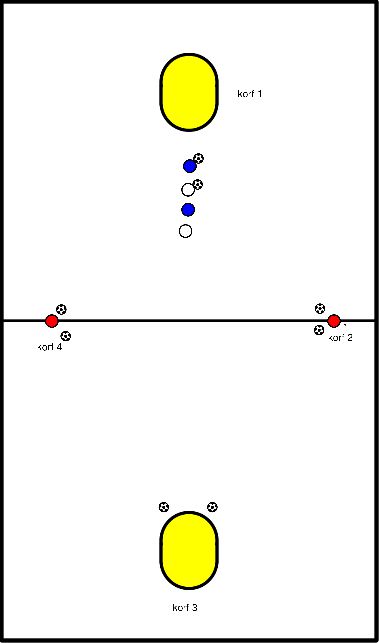
- Team stands in a row at basket 1.
- Participant 1 starts shooting, then participant 2 starts shooting immediately.
- If participant 2 scores before participant 1 then participant 1 is off and goes to basket 2.
- Participant 2 joins behind.
- If participant 1 scores earlier, she goes to the back.
- Participant 3 joins the shooting. If she shoots before participant 2, then she joins at the back and participant 2 goes to basket 2.
- This game continues on all four baskets until there is a winner on basket 1.
Agreements
- You may interfere defensively, but not knock the ball away.
- The children stand in pairs. The idea is that the children each have a tire and 1 ball.
- The children take turns bumping into the band, the other must take the ball before the ball falls to the ground next to the band.
- If this does happen, then five push-ups or five sit-ups are done.
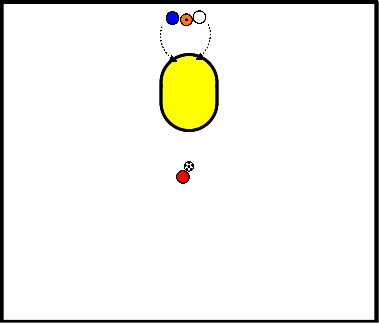
Play with 4 players around the post.
- 1 player takes the catch.
- Next player to pass the ball takes the pass.
- Ball is passed to the handler, handler passes to the person from whom he/she received the ball.
- Player takes a shot.
It is important to keep a high ball pace, to fill in quickly, to fill in the right persons and to throw in the right hand.
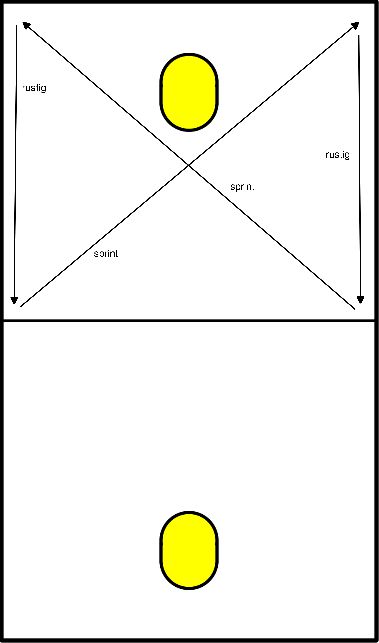
2 tours around the field with alternation in jogging and sprinting.
Number of players divided by 2 is the number of baskets needed.
Half of the players pick up a ball and stand at any basket. They remain here until the changeover time.
The rest of the players pick a basket to start. This group keeps working until the moment of change.
At the signal of the trainer, the players shoot.
How? The trainer can decide, distance, type of shot.
Round 1: 1 goal
Round 2: 2 goals
Round 3: 3 goals
Round 4: 4 goals
Round 5: 5 goals
The first player to score shouts loudly YES, all players must now immediately switch baskets.
The player who scored 1 goal in round 1 is in round 2, while the rest of the players are still in round 1.
Which player is first in round 5?
After this, the roles are reversed. The group of assist players/catch become workers and the workers become assist players/catch.
The exercise requires a lot of observation from the trainer. Who is in which round?
Half of the players pick up a ball and stand at any basket. They remain here until the changeover time.
The rest of the players pick a basket to start. This group keeps working until the moment of change.
At the signal of the trainer, the players shoot.
How? The trainer can decide, distance, type of shot.
Round 1: 1 goal
Round 2: 2 goals
Round 3: 3 goals
Round 4: 4 goals
Round 5: 5 goals
The first player to score shouts loudly YES, all players must now immediately switch baskets.
The player who scored 1 goal in round 1 is in round 2, while the rest of the players are still in round 1.
Which player is first in round 5?
After this, the roles are reversed. The group of assist players/catch become workers and the workers become assist players/catch.
The exercise requires a lot of observation from the trainer. Who is in which round?
Distance: 20 meters with a pawn after 10 meters.
- Jog back and forth 10 times at a steady pace.
- Up to half 10 meters walking on your heels, then jogging out and back.
- Up to half 10 meters on your toes, then out jogging and back jogging.
- 2 times back and forth side to side in the middle changing sides.
- 2 times to half (10 meters) knee lift, then sprint out and jog back.
- Jog back and forth 5 times at a slightly faster pace.
Versatile match exercise 4 against 4
- Make 2 teams of 4 players maximum.
If you have more players than 8, make 2 pairs and change quickly after each or after 2 goals. - Team 1 starts attacking at 1 basket, team 2 defends.
If team 1 scores, they may continue attacking, but start again at the starting pawn.
If team 2 intercepts the ball they have 1 shot opportunity to try to score on basket 2 or 3.
If the defence scores after 1 shot, they become the new offence team and may start at the starting pawn, to attack basket 1. - Which team has scored the 5 goals first? You can vary this.
- Change when there are more than 8 players: after 1 or 2 goals quickly change.
3 per basket
- 1 shooter and 2 rebounders behind the basket at 3 or 4 meters (depending on level).
- Of the 2 rebounders, 1 is attacker, 1 defender: agree in advance who has what task.
- Shooter in front of the basket calls "yes", at that moment both rebounders may move towards the basket to take the correct position.
- When attacker indicates that he/she is in a good position, shooter may shoot.
- 3 rounds, then switch positions.
Points of attention:
Pay attention to positioning of attacker/defender in rebound, properly blocking out opponent
Pay attention to positioning of attacker/defender in rebound, properly blocking out opponent
Variations:
- Do not agree in advance who has what position and let players count points separately for x-number of rebounds to get.
- Shooter shoots at any moment, then rebounders may only react to catch.
- Shooter joins the catch and, when the shot is missed, may pass to attacking rebounder for a short chance.
- This exercise is designed to let the players choose for themselves what they want to improve on.
- Which (improvement) goal, which they have set for themselves, do they want to improve here.
- As a trainer you can steer this by guiding the choice.
- For example: the exercise must have something to do with passing/shooting/attacking/looking etc.
- Set out a parcour of hats (= game board).
- Per pair of players a pylon is needed (or a water bottle/shirt).
- First exercise is the same for everyone, e.g. 20 balls. Then the game begins.
- Dice is the number of hats ahead.
- 1 through 5 are korfball drills, 6 = fitness task
- If you land on the same pylon as another duo, you may give them an extra assignment.
- Examples of korfball exercises:
- walk-through balls
- dodge
- shots
- penalty throw
- 2 walk-through balls and then a penalty throw
- pull-away balls
- Examples of fitness exercises:
- Squats
- Push-ups (possibly on knees)
- Jumping jacks
- Lunges, first stepping out with the left, then with the right.
- Burpees
Target
- To shoot cleanly and build up fitness
- Which pair has the first 5 up and down runs?
Rules
- You start by sprinting up and down 10 times
- Then you shoot 10 times and count how many times you score
- If you have scored 5 or more times (half of your number of sprints up and down), you may sprint up and down once less, so 9 times.
- Then you start shooting again and count how many times you score. If this is half or more than the number of times you sprinted up and down, you may subtract another time.