



Korfballexercises for u13
- 4-0 set up,
- 1 turn around and then play sideways for the short
- followed by a cut from behind the basket.
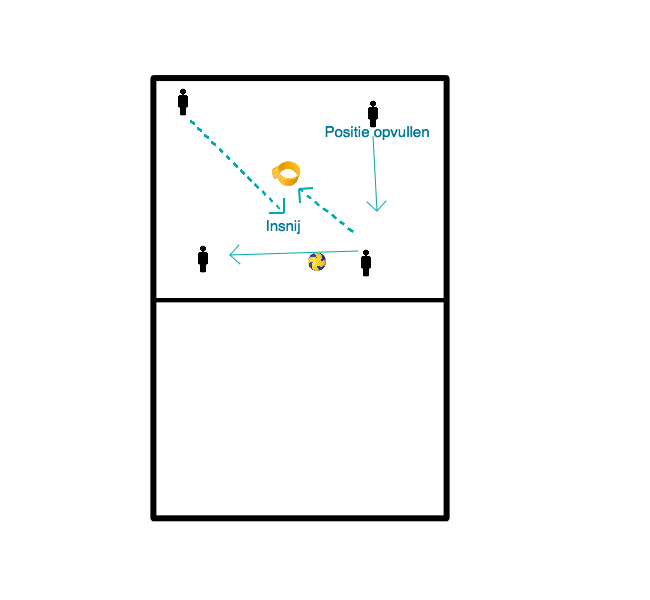
4 poles and 8 players, each pole 1 contributor with a ball. 4 players start from the middle.
1 - Run through from the centre and immediately swap with the attacker, who is the first to score 10 points?
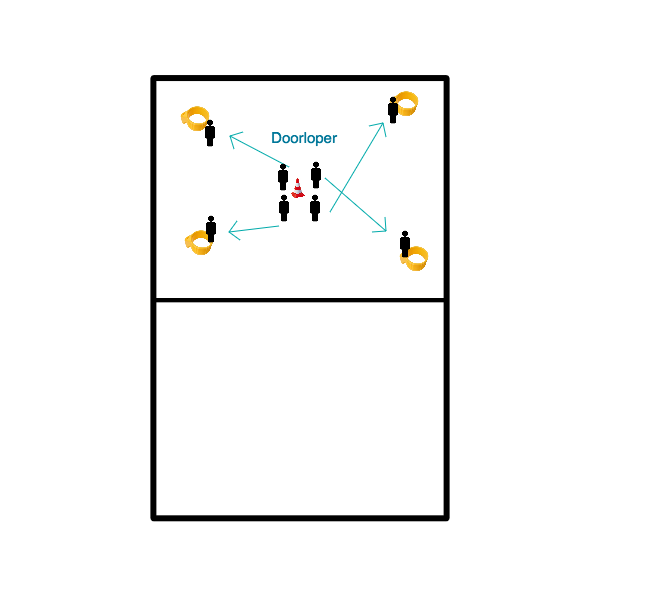
2 - Same exercise but now a run through (no shot), declarer pulls back and shoots. Who is the first to score 10 short chances?
3 - Addition to 2, from the middle a runthrough, stays behind (no shot), plays the ball again on the new incision and makes an evasion.
- The whole group walks a circle around 4 baskets.
- When the trainer calls 'yes', the person at the back of the line goes to the front of the line as fast as possible.
- The children do this by doing a sprint.
After that/ alternation
- Heels and buttocks, sprinting, lifting the knees etc.
- When the trainer calls 'yes', the person at the back of the row starts running as fast as he can and then he can choose what he wants to do.
- It must be something other than normal running/jogging, it may be sprinting.
- Goal; to practice condition / tempo change in running
- Game form 4 teams, 4 baskets, 4 balls.
- Goal is to defend own basket and score on other baskets.
- Counting, most goals on basket is loser.
- Goal; moving, tempo change.
- Let the players figure out themselves how to do this tactically; discuss and communicate about tactics.
- Stop the game a couple of times to discuss and emphasize the long ball / passing.
In short: a lot of shooting practice with a lot of running. (STRESS on learning to shoot on one leg at the end of the season plus stepping out with a throw).
Organisation: The baskets are placed in a square The number of baskets is very precise: aim for 5 baskets per 10 players.
a ) The players start at each basket, one person stands under the basket and the other person stands in the hoop in front of the basket with the ball, shoots on twolegs and goes on to the next basket.
changing: on time
in case of uneven numbers, run again or catch again.
b ) As a., but now with the assignment: Who will score 3 goals first?
c ) Like a., but with the assignment: pull one leg out of the hoop and the other leg up.
(for the ones who write with the right hand out of the hoop, SHOCK ON THE AIDE TRAINERS HERE TO HELP THEM)
d ) As a., but there is an 'over-taking situation': the runner from the circle, after having received the ball, plays the ball back to the declarer who started away from the post
(THE DECLARER STEPS OUT OF THE HOOP WITH ONE LEG TO THROW). The original declarator must try to score from this start. (NOW the one who shot the ball runs to the next corner).
change ; on time, or who scores 3 points first
training f1 and f2
number of baskets: 5
number of players:10
hats:all
hoops:5
warm-up
Make a square of hats or baskets.
- In the middle put balls (1 less than the number of players).
- The players walk in circles around the hats
- At the whistle they run in and try to get a ball
When you have a ball you may make a shot attempt (penalty throw distance, at pylon or in the hoop) and if you score you have a point,
Variations:
- keep doing it, who's first at 3 points
- Shoot in front of the basket.
Walk backwards/sweep arms/shake buttocks.
- At every new round one ball less in the middle. The players who did not get the ball keep on walking or waiting.
Note : it's not about running fast, as long as they keep moving.
In short: practise passing the ball from difficult situations.
Organisation: three or four teams per basket, one or two people under the basket, two in front of it. After marking the ball, walk forward to make a fastball, i.e. turn around.
(a ) Bouncing balls, indicated by a bounce.
(b ) Signalling too late: take overhead walkthroughs.
(c ) Signalling too late: the runner runs (left or right) past the basket and raises the ball more or less sideways or diagonally backwards.
(d) Late tagging: the runner runs along the near post and flings the ball over the head into the basket with one hand.
(e ) Marking too late: the ball is taken in the jump.
f ) The ball is passed too early: a 'long pull' must be taken with a long moment of suspension in the movement.
g ) The ball is not thrown in but rolled (can also occur in matches when the ball is knocked out of hands, or after an unsuccessful bouncing ball for example).
h ) the ball is indicated from the side, after which a through ball follows
3 attackers with 1 ball and 1 defender. In a small square, the attackers have to play around as often as possible. When the defender intercepts (or just touches the ball) the count starts over. The defender who has had the least number of passes within 1 minute wins.
simple running exercises for warming up, in which concentration and reaction also play an important role. Organisation: Pairs in an empty, marked out space.
Walk behind each other in a steady pace, criss-crossing the whole room. Number 2 follows every movement of number 1 as fast as possible, keeping about 1 metre distance. After a while change.
As a., but now the front runner tries to lose the back runner by sudden feints and/or tempo changes.
As a., but now other movements are also allowed: cross passes, jumping, lying down quickly and getting up again, etc.
Variations:
- Perform the same exercises with music
- Do the same exercises in groups of three or four. In this form, 'comical' situations will certainly occur now and then. It doesn't have much to do with korfball then.
- No more pairs: everyone walks freely through each other. The players walk towards each other, feint and then pass to the left.
- Like d., but now passing on the right
- Like d., but now they turn around each other and walk back.
- Special exercise for getting used to the hall: walk criss-cross through the whole hall, but not touching any line. Especially in halls with a lot of lines on the floor this is a good and fun exercise to get the 'contact with the hall' back in the legs.
- Like g., but now keep walking on the lines.
Divide the players over the baskets.
To score first 21 times by taking short shots from under the basket (alternating). Last shot must be scored backwards.
Penalty points:
- -1 when the ball collides with the ground more than once
- When the person who is not supposed to shoot catches the ball for another person.
- -1 when the person who is not supposed to shoot shoots
Divide the players among the baskets. Put 2 pawns about 7 meters in front of the basket and about 5 meters apart.
When 4 players per basket:
- 1 attacker under the basket
- 1 rebounder
- Other player(s) at the top of the pawns.
- Ball starts with the player(s) at the top
Player at the top of the pawn passes the ball to the declarer, walks towards the second pawn and receives the ball from the declarer in the run (and on the outside hand). Player makes a run through after changing hands (important that the player first points to the basket - shot threat - before playing the ball inside with the hand change). Rebounder catches the ball.
Passing on: player who took the pass becomes rebounder, rebounder becomes attacker and attacker goes up to make the pass.
With 3 players at the basket, 1 attacker with the ball under the basket and 2 players who shoot the ball in motion (minimum distance 3 meters
).
The attacker who is first to score 3 goals may remain in front of the basket and the attacker who has lost the game must take the place of the attacker.