



Korfballexercises for u13
Inshort: exercises in catching balls that bounce or roll at the right moment.
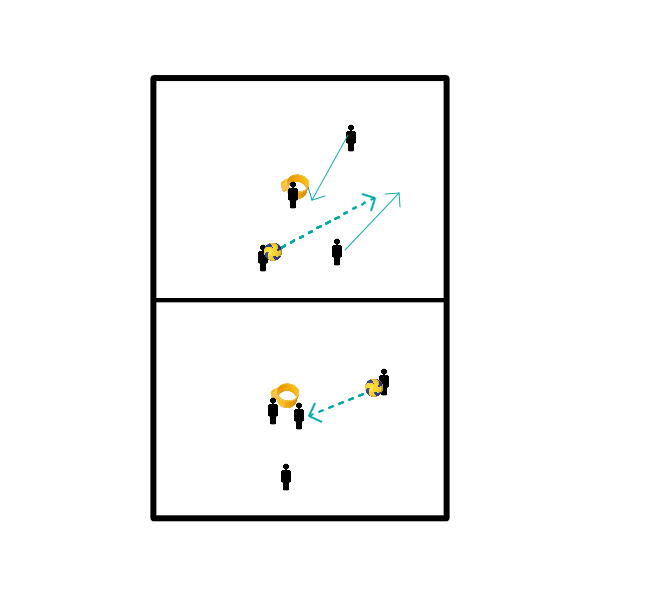
Organisation: each team has a ball and a basket.
- Three teams,
- the declarator stands in the middle under the basket.
- He rolls the ball a few metres away.
- As soon as the ball is loose, the other two may run.
- Who has the ball first, can make a turnaround or an attack with a pass?
- After 3 substitutions.
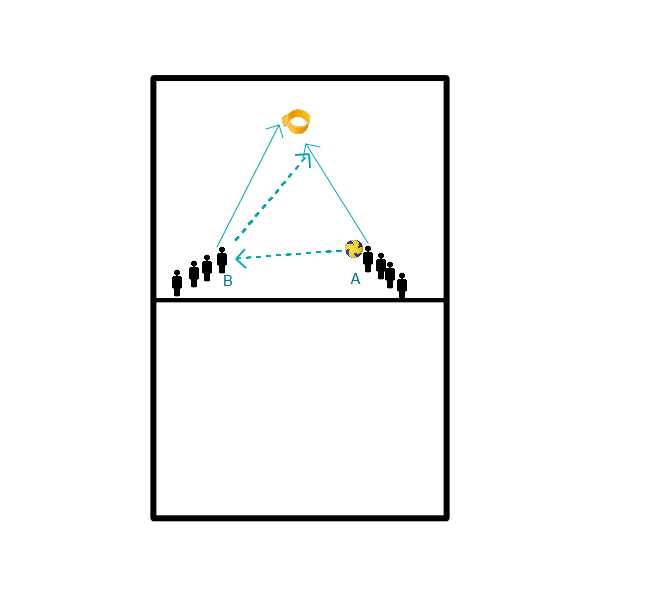
- Put a pole in the middle and divide your team in 2 groups.
- One group starts on the left, the other on the right (the right group (A) starts with the ball).
- Throw the ball to player B who stands left and walk directly to the basket for a walkthrough ball.
- You get this ball from the space of player B.
- Player B is going to catch.
As an alternative:
- You can start the ball at Player B.
- Throw to Player A and walk to the basket for support.
- Player A throws the ball to Player B and runs on for a walkthrough.
- See above but then Player A gets the ball for a walkthrough but does not take it but plays to Player B for a short chance. (Player B must then pull away).
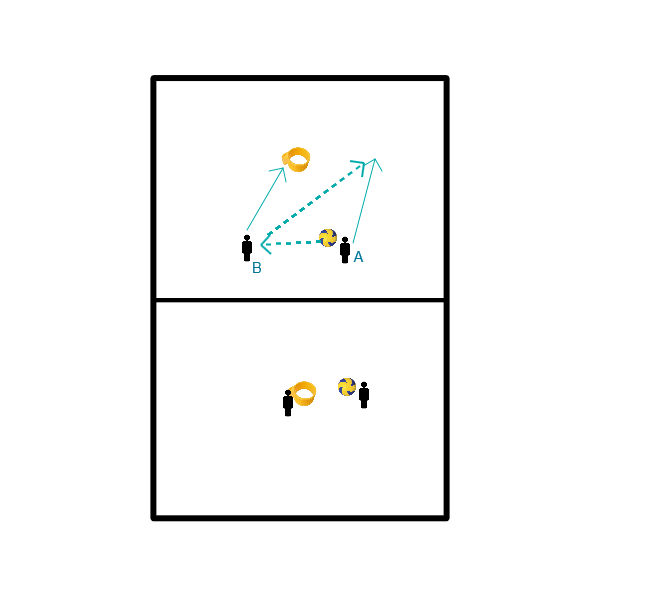
Make two pairs.
- Start both at the front of the basket.
- Player A throws to player B and immediately runs a long line.
- Player B passes to the long line and goes to catch.
- Player A shoots, Player B catches.
Things to coach for:
- Make sure players are deflecting the long line toward the basket.
- Coach on throwing the long ball, make sure it is tight and arrives well.
- Try to shoot quickly so that your opponent is not right in front of you.
You can alternate this exercise by
- Don't let Player B catch the ball, but cut in for support.
- Let player A catch the ball first, throw it back immediately and then run the long line.
- Have Player B catch and then pull away for a short chance under the basket.
Divide your team into two teams.
You will stand by a basket per pair and follow exercises that your trainer indicates.
Exercises can be:
- 3 laps of passing balls (catch your own ball) (depending on the number of baskets you can make more or less laps)
- 3 laps in out shot (pass to the outside)
- 3 laps of short chance
- 3 laps pass balls late (take overhead)
- 15 dots per person (per 2 on 1 basket)
- 10 free balls per person (per pair on 1 basket)
- 10x shot from standstill
- 10x shot from movement (try on 1 leg)
Start line-up
Two groups at the first two pawns.
Exercise
- The first in line runs to the hoop and goes through the hoop from the bottom, so the hoop goes over their heads.
- Then he runs through the defence posture to pawn two and circles this in 4 circles.
- Finally, he runs to pawn 3 and scores before he can run back to pawn 1 and tap the next one in line.
Set-up distance:
Hoop from pawn 1: 5 meters.
Pawn 2 from the hoop: 5 meter.
Pawn 3 from pawn 2: 5 meter.
Pole from pawn 3: 4 meter.

- Put out a square of 20 by 20 with hats.
- In the middle put balls (1 less than the number of players)
- The players walk in circles around the hats
- At the whistle they run in and try to get a ball
When you have a ball you can try to shoot (penalty throw - distance) and if you score you have a point, at every new round one ball less in the middle. The players who don't get the ball keep running.
- Form 3 teams at the basket
- Person 1 stands 3 to 4 meters in front of the basket near the pawn.
- Person 2 will stand 3 to 4 meters behind the basket near the pawn.
- Person 3 stands under the basket as catcher
- Person 1 starts shooting, person 3 catches the ball and throws it to person 2.
- Person 2 shoots, person 1 catches and throws to person 3. Always change.
Exercises with distance shot, penalty throw and walkthrough.
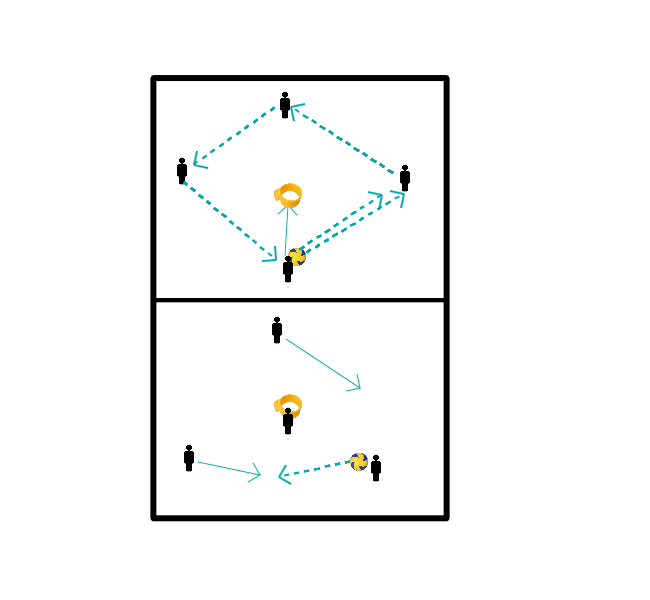
- Make 2 squares of 4.
- The attack takes the ball from the trainers.
- When the defence has intercepted the ball, they first pass it back to the trainers.
- When a goal is scored, the team gets a bonus and can take the ball back out.
Do give orders, for example:
- Start in a diamond. Let the ball go around 1 time.
- The player in front throws the ball next to him/her one more time and catches it.
- The other players continue playing. The player who has the ball now chooses whether he wants to throw to the left or to the right. The other players run to the ball to pick it up. The ball is thrown and the player immediately runs a long line.
The long line is nudged and the thrower comes alongside. The other player walks behind the basket to walk into the support. The other two are going to attack.
Place a number of cones/caps 2 to 3 metres apart. Make two rows of cones and divide the team into two groups.
The exercise is quite simple. One pawn sprints and one pawn knees high. Go behind each other
Inshort: exercises in catching balls that bounce or roll at the right moment.
Organisation: one ball per pair or trio.
(a) The numbers 1 and 2 of each pair stand next to each other. Number 1 rolls the ball a few metres away. Number 2 has to get the ball, pick it up and throw it back as fast as possible. Change after 5 games. Make sure the players 'get' the ball as soon as possible by putting one hand on it as soon as possible.
b ) As a., but now number 1 throws the ball away with a small curve, in such a way that it bounces on the ball at a distance of about 4 metres (and then makes a bounce of about half a metre high). Number 2 must try to get the ball as soon as possible after the bounce.
c ) As b., but now number 1 drops the ball from a height of 1.5 metres just in front of number 2. He/she has to try again to get the ball as soon as possible after the bounce. It will appear that almost everyone lets the ball rise a little and then catches it. Wrong (in the meantime an opponent can quickly put his/her hand on the ball). At the very moment that the ball is about to come up, the hand should be placed on the ball Take the ball!
Exercises:
1) Doubles: 2 players facing each other, 1 player walks from left to right, the other throws the ball, always playing on the outside hand. Catch ball, return same hand, walk to the other side. Change function after a few times.
2) As 1 but player takes ball over, i.e. catch right hand, pass to left hand and play with it, walk to left, catch with left hand, pass to right hand and play with it etc. footwork
Inshort: practise various forms of the shot in a fun competition format.
Organisation: each group a basket and a ball, the baskets are preferably (but not absolutely necessary) arranged in a circle or rectangle. The number of people per group is less important (all groups should be about the same size).
Pawns set up at 1,3,5 metres
The first assignment for the groups is: make 10 goals. When you are done, the creator of the last goal goes to the trainer to get the next assignment. Which group will have completed all assignments first?
The trainer walks around the room, encouraging or correcting the players. He has a piece of paper with a list of assignments. When someone comes to get the next assignment, first ask him which assignment he just completed (after a while this can vary considerably) and then give the next one. Here's an example: 10 walk-through balls, 15 penalty shots, 5 shots from 8 meters, 10 walk-through balls from behind the basket, 5 dodgeballs next to the post, 10 shots from 6 meters. Everything is possible of course, a lot of momentum comes from keeping the number of goals to be scored small.
Tasks:
- 6 scores from 2,5 meter in front of the basket
- 6 scores from 1 meter in front of the basket
- 6 scores from 6 meter in front of the basket
- 6 scores from 2,5 meter behind the basket
- 6 scores from 1 meter behind the basket
- 6 scores from 6 meters behind the basket