



Korfballexercises for u14
Execution
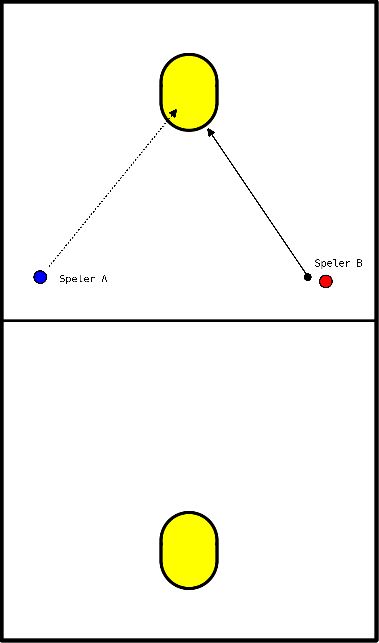
- Player A cuts inside to take a running-in ball.
- Player B passes the ball to player A.
- Player A catches their own ball and takes over player B's position.
- Repeat the process.
- Make the exercise more challenging by having the player who passes the ball also catch the ball themselves.
Formation
- Three players per korf: one shooter and two rebounders.
- Rebounders stand behind the korf at a distance of 3 or 4 meters, depending on their level.
- Of the two rebounders, one is an attacker and one is a defender. Agree in advance who has which role.
- The shooter stands in front of the korf and calls "yes".
- At that moment, both rebounders may move towards the korf to take the correct position.
- When the attacker indicates that he/she is in a good position, the shooter may shoot.
- After three rounds, switch positions.
- Pay attention to the positioning of the attacker and defender in the rebound.
- Ensure proper blocking out of the opponent.
- Do not agree in advance who has which role and let players count points separately for a certain number of rebounds.
- The shooter shoots at a random moment, after which the rebounders may react to catch the ball.
- The shooter also participates in catching and may pass to the attacking rebounder for a short chance if the shot fails.
Task
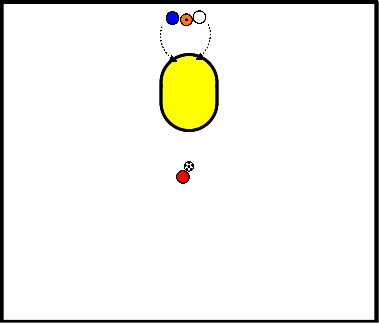
- Who is the first to complete a circle around the ball or the player?
- Everyone stands in a circle with enough space to quickly throw a ball.
- The ball starts to the right of the child who is going to run.
- The child who is going to run starts running simultaneously with the first throw of the ball on the outside of the circle.
Setup
- Player 1 starts 6 metres from the post.
- Player 2 stands between Player 1 and the post, 2 metres from Player 1.
- Player 1 runs for a running-in shot.
- Player 2 must prevent the running-in shot by bending their knees well and moving immediately when Player 1 starts running.
- If Player 2 does not react immediately, Player 1 will no longer be able to be caught up.
- The objective is to prevent the running-in shot.
Organisation
- Pairs per korf. One fixed feeder and one fixed shooter, for example, four metres in front of the korf.
- The shooters are tasked with scoring 10 points as quickly as possible.
- A goal counts for two points.
- If a shot is missed, one point is deducted from the total (the total remains at 0 points if you are at 0 and miss).
- As soon as someone reaches 10 points, the players switch roles.
- For less advanced players, you can reward a goal with, for example, 3 points.
- For advanced players, you can make it more challenging by awarding only 1 point per goal.
- The distances can be increased or decreased as needed.
Preparation
- Set up a 3x3 grid with cones, leaving some space between them.
- Give each team 4 cones.
- Create two evenly matched teams and place them at a korfball post with a ball.
- Come up with a task they must perform at the post, such as shooting from a distance of 5 meters.
- For each successful shot, a team may place a cone.
- The team that first gets three in a row wins the game.
Setup
- Work in pairs or groups of three. In pairs, alternate turns; in groups of three, rotate positions.
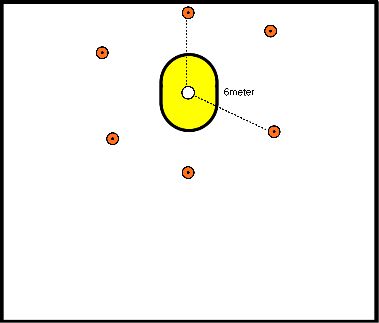
- Place 6 cones around the korf, all at a distance of 6 meters.
- Which pair or group of three scores first 5 times with a running-in shot from each cone?
- Next, which pair or group of three scores first 2 or 3 times from each distance?
- Then, move the cones to a distance of 2 meters and let each player score 2 goals from each side.
Game Progression
- Divide the players into two teams.
- Silently assign each child a number within their team.
- Once everyone has a number, place the ball in the middle between the teams.
- Call out a number (or multiple numbers), and the children with that number try to be the first to bring the ball to their "camp".
- Once a child has picked up the ball in the middle, the other child may attempt to tag them.
Organisation
- 3-5 players per korf with two balls.
- Marker cone approximately 6 metres in front of the korf.
- Players are numbered and stand in order behind each other at the marker cone.
- Numbers 1 and 2 have a ball.
- Number 1 starts shooting and retrieves their own ball.
- If they score, they pass the ball to the next player.
- If they miss, they shoot again from the spot where they retrieved the ball until they score.
- The shooter joins the back of the line and waits for their next turn.
- Number 2 starts shooting as soon as number 1 has taken a shot.
- Number 2 continues shooting until they score, then passes the ball to the next player and joins the back of the line.
- If someone scores before the person who started before them, that person is out.
- Who remains the longest?
- There are 4 participants.
- Number 1 scores immediately, passes the ball to number 3, and joins behind number 4.
- Number 2 misses, and the ball rolls away.
- Number 3 scores, number 2 is out and no longer participates.
- Numbers 2 and 3 pass the ball to numbers 4 and 1.
- Number 1 waits to shoot until number 4 has taken their shot.
Setup
- Place the cones approximately 6 metres apart.
- Divide the group into two teams. If there is an odd number, create one group of three and one group of two.
- The goal is to always keep the ball in the middle between the cones.
- When a player receives the ball, the player must be on the opposite side at the height of the middle.
- After passing the ball, join the back of the line on the opposite side.
- Note: No one stands still and estimate well when you should arrive. Not too early and not too late.
- Throw the ball while in motion.
- After five minutes, change direction and throw with the other hand (left hand).
Objective
- Improve shooting accuracy and build fitness.
- Which pair will be the first to complete 5 runs back and forth?
Rules
- Start with 10 sprints back and forth.
- Then shoot 10 times and count how many goals you score.
- If you score 5 or more times (half of your number of sprints back and forth), you may sprint one less time, so 9 times.
- Then shoot again and count how many goals you score.
- If this is half or more than the number of times you have run back and forth, you may reduce the sprints by one more.
Moving Freely and Maintaining Ball Possession
- Set up four cones in a square of 7x7 meters. Have three players work together within this square. One player is the interceptor who tries to intercept the ball. Play a game lasting 30 seconds; intercepting earns a point.
- Players must move freely by moving towards the ball or away from it, depending on their position relative to the interceptor, the distance to the ball, and the available space. Pause the game to demonstrate where they should move.
- The ball holder must learn not to make risky passes; it is better to make no pass than a wrong pass.
- Sometimes use a lob pass or a direct pass; a feint pass can also be useful.
- Slowing down, speeding up, and changing directions are important to move freely.