



Korfballexercises for u14
- Player 1 throws the ball to the oncoming player 2 who is not running straight into the ball,
- but diagonally to the right of the player.
- Player 1 runs to the other side, receives the ball halfway from player 2 and throws it to the pilon he came from, player 4, and connects behind the other pilon where only player 3 is.
- Player 2 connects behind player 4.
- Player 1 must make a quarter turn to be able to throw the ball from player 2 to player 4, this turn must be done airborne.
- Arrange a square with a distance of about 10 meters.
- For larger groups, pentagons can be used.
- Player 1 throws the ball to player 2, runs after the ball and gets the ball back to player 2.
- Player 1 throws the ball to player 3, runs after the ball, receives and throws it to player 4.
- Arrivin at player 4, player 1 should throw a long diagonal ball to player 2 and player 1 can take up his original position.
- Player 2 continues the exercise.
- This exercise should be done twice each and then be done in the other direction.
- Who is first to finish the exercise?
- Watch out for uneven distances.
- Shooter stand in front of the post, with a defender
- Shooter stand in front of the post, with a defender
- The ball is thrown in from under the post, after which the ball is handled from the outer to the inner hand for a through-ball.
- The pilon is now placed 6 metres in front of the post, a passer with ball stands under the post.
- A runner and defender stand at the pilon.
- The runner goes back and forth around the pilon and starts counting how many times he or she can double the ball with the passer, without it being intercepted by the defender (everything must be done with one hand).
- After four doubles, the through-ball is made, the defender only gives pressure and allows the through-ball if the defender passes over the right leg.
- 4 posts in a square, pairs of two of the same sex at a post.
- The posts are 16 meters apart lengthwise.
- The pairs stand in front of each other at a post.
- There is 1 runner and 1 passer per pair. The runners runs in the direction of the post on the other side, when the runners reach the middle, they turn around each other, in order to score in their own post: (changing function after an exercise)
- A player stand with the ball well behind post
- Attacker with defender in front of the post
- Attacker must always run towards the line of pilons after a shot
- Then wait until the passer throws the ball so he can run backwards and shoot
- Switch after a goal
- Pressure:
- Defender runs slowly with the attacker
- Defender 75%
- Defender full pressure
- Pressure:
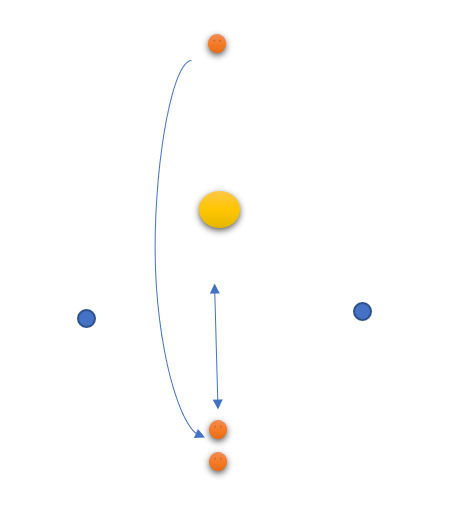
- Work in groups of 3
- Players throw the ball at each other
- Player A throws to player B.
- And player A runs deep
- Player A shoots the ball into the post
- Make sure you run straight to the post.
- Don't stop running too early and the pass should be good.
- You can extend the exercise further by passing the ball back to player B who takes a through-ball instead of taking a shot
- Pilon 1
- Tap the ground 6 times and jump up and stretch out all the way. RUN TO POST 1.
- Post 1
- then you take a dodgeball at post 1.
RUN TO PAWN 2.
- then you take a dodgeball at post 1.
- Pilon 2
- jumping lunge
RUN TO POST 2.
- jumping lunge
- Post 2
- take a through-ball at post 2.
Run to a pilon
- take a through-ball at post 2.
- Pilon 3
- 6x push-ups
RUN TO POST 3.
- 6x push-ups
- Post 3
- short chance behind the post
RUN TO PAWN 4.
- short chance behind the post
- Pilon 4
- 6x squad
RUN TO POST 4.
- 6x squad
- Post 4
- dodge to the other side
Run to PAWN 1
- dodge to the other side
- This is repeated 5 times
- but change every time under the post.
! Form groups of 2 persons per post
Each group gets three playing cards. The cards are shuffled from the front and the numbers 2 to 5 are removed from the pack. With the three playing cards the groups have to get as close as possible to 31. The value of the numbers and pictures are shown below:
- Six = six
- Seven = seven
- Eight = eight
- Nine = nine
- Ten = ten
- Jack = ten
- Queen = ten
- King = ten
- Ace = eleven
So nine + jack + queen = 29 points or ace + jack + queen = 31, but you can also have jack + jack + jack = 30.5
Once players have completed a series, they may exchange one of their received cards for a new one, in order to get closer to 31. The trainer will set a timer and says when to stop. The team closest to 31 wins.
Series:
1. through-balls: five goals in a row.
2. through-balls: 5 goals in a row from behind the post.
3. Play through-balls by going for the short chance, 3 times in a row.
! Make groups of 3 and let the players divide themselves in person 1, 2 and 3. After two rounds, change one person.
- Form groups of 3 at the post.
- Person 1 stands 6 meters in front of the post at the pilon,
- person 2 will stand 6 meters behind the post at the pilon.
- Person 3 stands under the post as a receiver.
- Person 1 starts with e.g. taking a though-ball, then goes back to the pilon.
- Person 2 takes a through-ball, as person 3 has caught the ball. This is how you perform all the exercises.
Exercises:
- Through-ball
- Dodge ball right
- Dodge ball left
- Turnaround-ball past the post
Groups of 3 change 1 by 1
Groups of 4 change 2 by 2
- At pilon 1
- 1 time up and down, sideways with small steps between the pilons.
- RUN TOWARDS POST 1 for a through-ball.
- At pilon 2
- 5 sit-ups.
- RUN TOWARDS POST 2 for a dodge ball (minimum 5 meters).
- At pilon 3
- again 1 time up and down between the pilons with small steps
- RUN TOWARDS POST 3 tap the post and take a short chance.
- If you have 5 points, you can change, only the shot counts for 2. (From post 3 to pilon 1 an interval for seniors with running at slow pace and sprinting.)
- A passer under the post with ball, a receiver behind the post and the attackers in front of the post at about eight metres.
- The attacker takes a distance shot while randomly in motion to the left or right.
- The passer joins the attackers, the receiver becomes the passer and the attacker becomes the receiver.
What can you see?
- Role rotation takes some getting used to.
- Not every player knows where to shoot from.
- Players have difficulty to estimate where the ball will be played.
- Throwing to a running attacker is inaccurate.
- Timing of the attacker's posture before the shot. posture becomes right when the shooter is standing still when the ball is caught. Standing means: standing in the direction of the post, nose and belly button pointing towards the post and feet are in a light spread position.
- Capturing the ball at the shooter's is done in two stages, first the shooter wants to get the ball, then the ball is taken firmly into the hands in order to release a shot. It is only good if, after catching the ball, a shot can be immediately thrown. Therefore, make sure that the hands are in the correct catching position before the shot is fired.
Variation 1:
- As a previous exercise, but after the shot, the shooter waits for the ball to be caught and takes a through-ball.
- The receiver also catches the through-ball.
What can you see?
- Waiting patiently after the shot, while the shooter is in motion, is difficult for the shooter because the concentration already goes to the through-ball. The shooting is then just a turn and not an attempt to score. Concentration of the shot also means following the ball after it has been released.
- Capturing the shot, playing the through-ball and catching the through-ball will result in malfunctions.
Variation 2:
- As a previous exercise, but before the shooter takes the through-ball, he receives the ball, makes a feint shot, throws back to the passer with one hand and only then takes a through-ball.
- A feint shot means that the initial starting position of a shot is taken, the arms are stretched but the ball is not released.
- Instead, the shooter throws back to the passer with one hand.
- The choice of left or right often depends on the position of the defender, this is dealt with in the next exercise.
Variation 3:
- As the previous exercise, but the 1st passer does not immediately join the attackers.
- After the shooter's first shot (this shot remains without an opponent), the receiver will throw the ball at the shooter.
- At that point, the first passer becomes a defender to block the (false) shot.
- The shooter passes the defender and takes the through-ball.
- The defender now joins the attackers.
What can you see?
- Through a lot of examples and patient practice, the form becomes controlled.
- The feint shot is skipped, as soon as the ball is received, the hands are placed inside. Emphasise the feint shot to fool the opponent.
- Throwing in is not done accurately and not with one hand.
- The number of goals may be disappointing in the beginning because there is a lot of concentration on the form of the exercise. Especially the right choice to pass the defender is important, that this is initially at the expense of the score is acceptable.
- The defender must be attentive to avoid collisions.
- The defender can use his hands to block the pass inwards. This leads to new difficulties for the attacker. Phase the pressure exerted by the defender (e.g. with two hands on the back, then use one hand, jumping in and only defending fully on the shot).
The attackers are in front of the post, at around 6 m distance.
The shooter runs in the direction of the post, stops at the penalty spot and turns right.
At that moment, the passer throws the ball. The shooter makes a dodge ball.
- The shooter is allowed one step to find his balance. The left leg acts as a playing leg to keep balance.
- The players learn from the examples given.
- As a trainer you can perform the exercise yourself, in slow motion to show the direction of the balance.
Practice this movement to the left as well.
Variant:
After the dodgeball, the shooter takes a though-ball.
The catcher catches the ball again.
Let the shooter move after the dodgeball before passing the though-ball.
This can be done in the same direction as the dodgeball, or in the opposite direction.
Make sure that you move further away from the post.
Variant:The dodgeball becomes a feint shot and is converted into a through-ball.
Converting the smooth movement of the shot into a pass to the inside requires more control of balance.
Throw the ball into the post with one hand.
What can you see?The coordination of catching the ball and balance is a problem.
The shooter determines the coordination by a rhythm, sometimes with the help of a hink.
Shooters find balance on their left leg after a dodgeball to right.
This makes turning to the post for the shot difficult.
The dodgeball is an option in the game because a through-ball attempt can be aborted when the defender keeps up well. In time, the dodgeball becomes an independent way to get free.
Variant:The passer acts as a defender to put pressure on the shooter.
After the move to the right, the passer gives the ball and tries to block the shot.
The shooter goes for the shot.
Variant:Same, but the shooter has the alternative of throwing the ball to the second passer present in the post area and setting up a though-ball.
The defender still goes for the block.
It has already been described how the defender can be phased.
Throwing to get someone to score