



Korfballexercises for u18
Exercise in 2 parts: a relative static part with 3 (point 1 and point 2), and a part from the movement with 3 and 2 (point 3 and point 4):
- Ball in the hoop:
- Player A stands facing player B, and must make sure he cannot tap the ball.
- Change position after tapping or after max. 20 sec.
- Same as previous,
- But now player A has to stand with their back to player B.
- Again blocking out with player B in the back, the 3rd person is going to move around.
- When the trainer calls 'yes', the player who has to tap the ball is changed.
- The person protecting the ball has to switch quickly
- This one per 2:
- Player 1 stands on the sideline, player 2 stands about 2,5 meter further on a cone with his back to player 1 and with his legs spread.
- About 8 metres further on is another cone.
- Player 1 is going to roll the ball through his legs, and the ball has to pass the furthest cone.
- At the moment player 2 sees the ball coming through his/her legs, he/she starts to block.
- 1 point for player 1 when he/she can tap the ball (without diving) before it reaches the furthest cone. 1 point for player 2 when the ball has passed the cone, without player 1 being able to tap the ball. When the ball does not pass the cone, also one point for player 2
- Place a square around the basket, in which the attackers must stay:
- Attackers must decide immediately (+/- 3 seconds) to play on or shoot.
- Play 3 attacks and then switch, attack ends when a goal is scored, when the ball is out of bounds or when there is an interception by the opponent
Upgrade:
- Attackers may also only give 5 passes
- Attackers allowed only 3 passes
- When attackers bring the ball (clearly) below the shoulders, the attack also ends (not being ready to shoot)
- We work with a 2 against 2 situation, the 5th player is always a striker and can also score. Change this player every 3 minutes.
- Indicate clearly the importance of passing, every pass must be a chance.
- The baskets are spaced about 10 meters apart.
- In case of a goal, the ball is for the defending side.
Upgrade:
- When attackers bring the ball (clearly) below the shoulders, the ball must be put on the ground and the other team may attack (not shot-ready)
- Indicate minimum number of passes
- Possibly define a small field around the posts, only in this field goals can be scored.
- Possibly shorten the decision period of the attackers in possession of the ball.
Ideally in pairs at the basket:
- Collect pots (for 3 posts 10 pots, for 4 posts 13 pots) in the middle when the tasks are completed (continue until there are no more pots, there will be no staking on other posts)
Tasks: (take chances in turns)
- Score 8 consecutive runs together
- Score 3 consecutive runs together
- First together 4 runners score, then together 4 shots (from movement) from about 6 meter
- First together 4 runners score, then together 4 shots from 4 meter behind the basket (from movement)
- First each player scores 1 runner, then each player scores 2 penalty shots.
- First each 1 runner scores, and then each 4 short chances under the basket
Per 2 (ideally) under the basket,
- 1 player with ball, 1 player without ball)
- Achieve a certain score per part (short chance and run through count for 1p, distance shot for 2p)
- Player without ball starts away from the basket and takes a short chance; after the ball is caught the shooter takes a shot after a wide line; after the rebound you fall inside for a run through (12p)
- Attacker starts via a lateral line with a shot; after rebound one falls inside to shoot again via a dodge; to finish an overhand (1 or 2 hands) through ball (15p)
- Same as mission 1, but now behind the basket (15p).
- Shooter starts under the basket again, and is played for a short chance; then via a wide line to a shot; after rebound falls in for a dodge to finish with a run through (20p)
- Training condition with 4 teams
- You stay with your team on your own side.
- Leaders change sides so that everyone stays in motion.
- The intention is that the exercise is done with high intensity.
- Start in front of the pawns. After pion 5 in sprint to the first basket.
- Rebound sprints to the second basket.
- Rebounder second basket joins again with the pawns.
- Count the scores per team
- Count out loud with your team, to keep the competition element in it.
- Round 1:
- Score 20 balls. (pawn exercises = slalom)
- Round 2:
- 10 shots 3-4m scoring. (Pawn exercise = 2 pawns forward, 1 pawn backwards)
- Round 3:
- Score 20 short chances behind the post. The sprinter is indicated and he plays back to the rebounder who stepped out from under the post (pawn exercise = hopping over the pawns).
- Round 4:
- Scoring 10 shots 4-5m. (Pawn exercise = skating over the pawns, holding landing).
- Round 5:
- Score 10 evasive balls. (pawn exercise jumping up at pawns 1, 3 and 5 and squat at 2 3n 4)
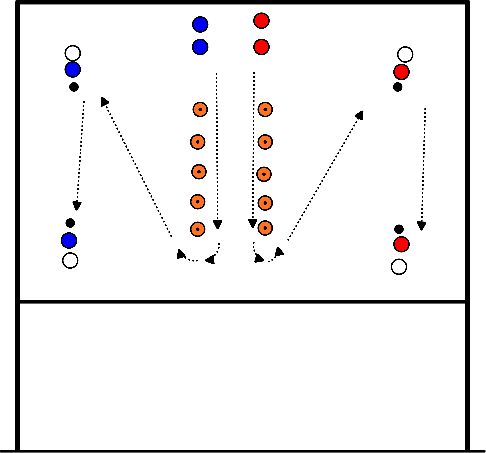
- Place a number of hoops in the terrain.
- Divide the group into two teams.
- A team can earn a point by playing a player who has at least one foot in a hoop at the moment the ball is in their possession.
- You may never play to the same hoop twice in a row.
- Start with an ordinary ball, then use a tennis ball.
The objective of this exercise is to collect the vests before being knocked off by a soft ball.
- Three cones in a triangle, on each cone lies a vest.
- The other players form a circle around the cones, making it wide enough.
- The player must collect all the vests, the others must try to hit them with the ball(s) before all the vests are collected.
- When a player is hit by the ball, he changes with a player from the outfield.
- As trainer, decide whether to play with 1 or 2 balls. It is easier for a player to grab the caps if they are playing with one ball.
- The distance between the cones on which the vests lie can be increased or decreased. The greater the distance between the pawns, the more difficult it is for the player to grasp the vests.
- As trainer, make sure that players do not hit the ball too hard or from too little distance!
The focus in this exercise is on finishing chances. If you don't score enough goals, you will lose the game.
- The goal is to score 2 goals.
- The rebounder under the basket plays against the shooter in front of the basket. Which of the two players will score two goals first?
- The rebounder starts as a declarer, so the archer has to shoot on the spot.
- The rebounder can only shoot if he or she catches the ball in one go without scoring a goal.
Too easy or too difficult:
- Then increase or decrease the shot distance.
- Play with the number of goals they have to score.
- To challenge the rebounder, you can have the rebounder start a few metres from the basket. It becomes more difficult for the rebounder to catch the ball in one go.
- Any airball is immediately 2 points for the opponent and means a change.
- Attacker with ball under the short, archer and defender in front of the basket.
- The archer is going to get free around the basket and is going to shoot 6 times.
- The defender is allowed to block maximum 2 of the 6 shots.
- On the other shots, passive pressure is applied.
- The aim is that the attacker will actually shoot, no matter what the defender does.
- And the idea is that shots are made convincingly, the balls that are not blocked should really be shot to score, so not too much focus on the defender but just keep on shooting.
- With 4 players you have an extra attacker/rebounder
Try, as attackers, together with the assisting player, to free up each other and to get a good shot in as few passes as possible. The key in this exercise is in the assist to the chance. When and who do you play?
Mark out a 7 meter playing area around the basket:
- The attackers remain inside the field of play.
- The assistant player remains outside the field of play.
- The attackers may shoot defensively.
- The substitution takes place after 3 goals for the attackers or 3 interceptions (incl. rebound).
- After each interception or goal, the new attack starts with the assistant.
Too difficult to give assist to attackers:
- Space: The playing field can be reduced.
- Goals: the game can be played on 2 baskets, with an assist player under each basket. The changeover after an interception offers opportunities for the assist.
Too easy to give assist to attackers:
- Playing rule: The attackers only get 3 passes to create an opportunity. Defensively, no shots are allowed.
- Players: more attackers can be played with a direct defender. More players means more choices.
- Play 4 against 3 on 2 posts (don't make the field too big).
- One player is assigned to be the attacker, who attacks for both teams.
- Change them regularly.
- The attackers receive a maximum of 3 to 5 passes to create an opportunity. No chance, ball for the other team.
Too easy to shoot for the attacker:
- The extra player is not allowed to score.
- The same attacker is not allowed to shoot twice in a row.