

Korfballexercises for technique warming-up
- groups of 3 at a post.
- 1 fixed passer.
- 2 shooters.
- These keep moving at about 5 - 6 meters from the post.
- Trying a shot must always be tuned to capturing it again.
- The time between capture and goal attempt must always be as short as possible.
- There are always 2 different types of goal attempts and the goalkeepers always take the same type of goal attempt.
- 1 through-ballplayer and 1 defector. (change at 5 scores pp)
- 1 defector and 1 chance behind post (change at 5 scores)
- 1 shooter in front of the post. 1 passer.
- Possibly with slight defensive pressure.
- Attacker moves left/right, gets the ball played and shoots (+-5 meters).
- When he scores, he earns a point and shoots through, if he misses he must first run to a line behind him at about 5 metres from the place of shooting.
- After this you can continue shooting.
- Switch goals every 3/4 of the time.
- Total 8/9 goals per post. (It depends on whether you play with or without a defender).
- Place the poles in a row next to each other.
- Underneath each post there will be a marker with a ball.
- The players take a through-ball on the first post after which they catch their own ball.
- The passer then runs to the front of the next post, moves on and takes a through-ball on this post.
- Here, the ball is caught again and the captain moves on to the next post.
- At the last pole, the passer runs behind the posts back to the first pole.
- Work towards a number of goals (2 times the number of poles is fine).
- This can also be done with other forms of chances such as drawback balls.
- 2 groups at pilons,
- Run to the hoop.
- Through the hoops and run to the pilons.
- Zigzag through the pilons.
- Finally shoot ( 2 attempts).
- Whoever scores 5 times first, wins
- Place 4 posts in a square.
- The whole group runs around the posts in a row.
- If the trainer shouts "yes", the person at the back of the row will run to the front of the row as quickly as possible.
- The children do this by sprinting.
- Options:
- The children follow each other around the posts in a row.
- The person at the front of the row can do what he wants, for example: heels to the back, sprinting, lifting knees etc.
- If the trainer shouts "yes", the person at the back of the queue gets to the front of the queue as soon as possible and can then choose what he wants to do.
- It has to be something else than running/jogging, it can be sprinting.
- Per group of 2, each player has to score.
- When both score, move to the left to the next post, regardless of whether the two next to you have already scored.
- Which group will be the first group to return to his own post and score again.
- All players line up.
- The front 2 players have a ball.
- Player 1 starts shooting, after this player has had a shot, player 2 can start.
- If 1 scores earlier than 2, he can stand in the back of the line.
- If 2 scores earlier than 1, 1 is finished and has to go to the side.
- The last remaining two players must start at the same time and the one who scores first wins.
PURPOSE: Warm-up (concentration and reaction)
ORGANISATION: groups of two, three or four in a defined space.
RUNNING THE GAME: slowly run behind each other, crisscrossing through the entire space. Number 2 always follows every movement of number 1 as quickly as possible and keeps a distance of about 1 meter. Switch positions after a while.
VARIATIONS:
- now the front runner tries to get rid of the back runner by sudden feints and/or tempo changes.
- But now other movements are allowed as well: cross steps, jumping, lying down and getting up again etc.
- No more groups: everyone runs freely. The players run towards each other, make a feint and:
- then pass each other on the left.
- pass each other on the right
- turn around each other and run back
- Put out a square of 20 by 20 with hats
- In the middle there are some balls (1 ball less than the number of players)
- The players run circles around the hats
- When the whistle blows, they run in and try to grab a ball
- If you have a ball, you can attempt a shot (penalty throw - distance) and if you score, you have one point, and there's one ball less in the middle for each new round. Players who do not have a ball continue to run.
- Make two teams and make sure there are two thick mats.
- The goal is to push the thick mat with your team to the other side.
- After each push you have to go back to the starting line.
- The smartest thing to do is to make a run with your whole team at the same time and push against the mat.
- divide the group into groups of 5 (it's also possible to have a different number, but adjust if necessary).
- make a box, for example 8/8 or 10/10 or 12/12.
- Of each group of 5, 1 person is a catcher, the others are the field players (if you have more than one group, you can put the catcher(s) of one group into the other group).
- The catcher tags 1 or 1½ minute and you count how many tags have been made (one player can't loose and stays in the game).
- The catchers that start tagging (recognizable because of the jacket / ribbon) and
- distribute the other remaining children per group in the box with a ball. They pass over the ball and walk free.
- The catchers try to tag someone who doesn't have the ball, so someone who has the ball is not allowed to be tagged.
- The player approached by the catcher must get the ball as quickly as possible.
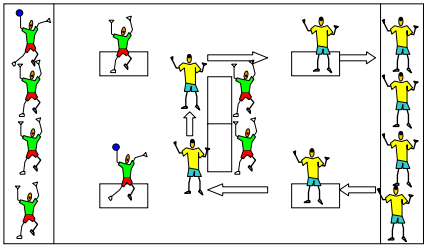
- Divide the group into two teams.
- 2 children of both teams will stand on the mats that belong to their team.
- There will also be 2 children per team in front of the box, these are the goalkeepers.
- The remaining children go to the throwing area (see drawing).
- When the balls enter the game, the children from the throwing box are supposed to throw the balls against the box.