




Soccerexercises for technique 1,5 meter / corona / covid-19
- The goalkeeper takes a goal kick and plays the ball to player number 1 and 3, alternately.
- Players number 1 and 3 perform a one-two with players number 2 and 4 and attempt to score.
- The shooter retrieves the ball and places it ready for the goalkeeper.
- The goalkeeper takes a goal kick towards player number 1 and 3.
- Players number 2 and 4 come to the ball and perform a one-two.
- Players rotate from number 1 to number 4.
- Two goalkeepers are used due to the workload.
- Distances can be increased or decreased.
- Eye contact and coming to the ball are important.
- Start with a goal kick from the ground, later followed by a drop-kick.
- When players number 1 and 3 have control of the ball, players number 2 and 4 may come to the ball.
- Ensure players do not play too close to each other, as this is easy to defend.
- The goalkeeper plays the ball from the ground, possibly followed by a drop-kick.
- Drop the ball from the hands and kick simultaneously as it hits the ground.
- 2 x 4 x 2 cones or markers set up next to each other to form two lanes.
- Players pass the ball precisely through the lane of cones or markers and sprint after it.
- Another player (white) receives the ball and dribbles to the other lane.
- There, this player repeats the action towards player 3.
- Player 3 starts again at the same place as player 1.
- The ball must go through the lane of cones or markers.
- If a cone is hit, the player must sprint to set the cone upright and do three push-ups at the end.
- The ball must pass all the cones before the receiving player can take the ball and dribble to the other position.
- Player 1 walks backwards and underhand throws the ball to the head of Player 2.
- At the other side, the roles are reversed.
- Player 2 walks forwards towards the ball and heads it into the hands of Player 1.
- Practice both heading, throwing at knee height, and executing a dropkick.
- A dropkick is passing the ball with the instep shortly after the ball has hit the ground.
- Work in pairs with one ball.
- Throw gently.
- The player walks into the ball, which is easier than the opposite.
- Keep the distances small.
- Player 2 must walk backwards and throw the ball underhand.
- Ensure at least four cones or markers are present.
- Make sure there are no obstacles on the field.
- Demonstrate and check the technique of heading, passing at knee height, and the dropkick for correct execution.
- The players position themselves in a circle. Ideally, there are 6 to 8 players per circle. Each circle has only one ball.
- A player passes the ball to another player and follows the ball towards the player they passed to.
- The second player receives the ball and passes it to another player in the circle. They also follow the ball towards the player they have just passed to.
- This repeats continuously.
- Passes must be clear and accurate. The passes are played along the ground, keep the ball low!
- Just after the pass, players accelerate (short sprint).
- Players call out the name of the player they intend to pass to.
- All players stand constantly on their toes, not flat-footed, to improve reaction speed.
- You can make the game more challenging by applying one-touch play.
- You can play with two balls.
- Player 1, who has made the pass, must try to tag the receiving player (player 2) before they pass the ball to player 3.
- Both players A dribble towards the central cone.
- Perform a cutting movement at the cone.
- Pass the ball to the next player.
- After the pass, the player runs diagonally towards player B.
- Player B throws the ball up for player A.
- Player A heads the ball into the goal.
- The player who heads retrieves the ball and stands behind the goal.
- The other player joins the group that needs to perform the movement.
- Player 1 engages in a one-two with player 2.
- Player 2 moves towards the ball.
- Player 1 provides a through pass to player 3.
- Player 3 plays into player 4, who moves towards the ball.
- Player 4 creates space for the incoming player.
- Player 3 passes to player 5 across the width.
- Player 6 moves towards the ball, and player 5 decides through the pass whether he wants the ball on the left or right.
- Player 6 controls the ball and scores.
- Start with a ball at player 1.
- Have three players at player 3 and player 5.
- Shift from player 1 to player 6.
- If there is no goalkeeper, player 6 goes for the goal.
- Distances can be increased or decreased.
- Pass to the outer foot.
- Maintain eye contact, create space, and move towards the ball.
- Add a defender at the position of player 2, player 4, and player 6.
- Ball can be played on the ground and/or through the air.
- For player 2, player 4, and player 6, first move away from the ball and then towards it.
- Only move towards the ball when player 1 has control.
- Ensure players do not play too close to each other, as it is easier to defend.
- Player 5 decides himself whether he wants the ball on the left or right through the manner of passing.
- Arrange your team in 2 lines with 4-5 players per line.
- Use only 1 ball.
- Players receive the ball and pass it to the first person in the line opposite them.
- Immediately after the pass, they sprint and join the end of the line they just played into.
- This process repeats continuously.
- Players stand on their toes ready for the pass.
- Passes are clear and accurate.
- Players call out when they want to receive the ball and name the player to whom they are passing.
- With the first touch, they bring the ball under control, and the second touch is the pass.
- Apply the one-touch pass.
- Have one line pick up the ball and throw it back underhand to the other line, which returns it with a volley pass.
- Players receive the ball with their thigh and bring it under control before passing it back along the ground.
- Place a cone 5 meters on either side of the central point between the 2 lines.
- After the pass, players must run around the cone before joining the line.
- Player 1 or the goalkeeper takes a goal kick.
- Player 2 receives the ball.
- Player 2 gives a through pass to player 3.
- Player 3 plays into player 4 who comes to the ball.
- Player 4 creates space for the incoming player.
- Player 3 plays to player 5.
- Player 5 controls the ball and scores.
- At player 1, there are two players with a ball.
- At players 2, 3, and 5, there are three players.
- Rotate from player 1 to player 5.
- If the goalkeeper is absent, player 5 shoots on goal.
- Distances can be increased or decreased.
- Play to the outer foot.
- Make eye contact and come to the ball.
- Add a defender at position 4.
- Play the ball on the ground and/or through the air.
- In case of delay, player 1 takes the goal kick.
- When player 1 has control of the ball, only then come to the ball.
- At player 4, first move away from the ball and then come to the ball.
- Ensure players do not play too close to each other, as it is easy to defend against.
- Two rows with players.
- Two captains call out the exercises.
- At the second marker, initiate a sprint directly.
- Jog calmly to the other side.
- Focus on speed and correct execution.
- Squat on one leg.
- Step-jump twice to the right, then twice to the left.
- Dribble quickly with short steps forward, sideways to the right, forward, sideways to the left.
- After the exercises, stretch well.
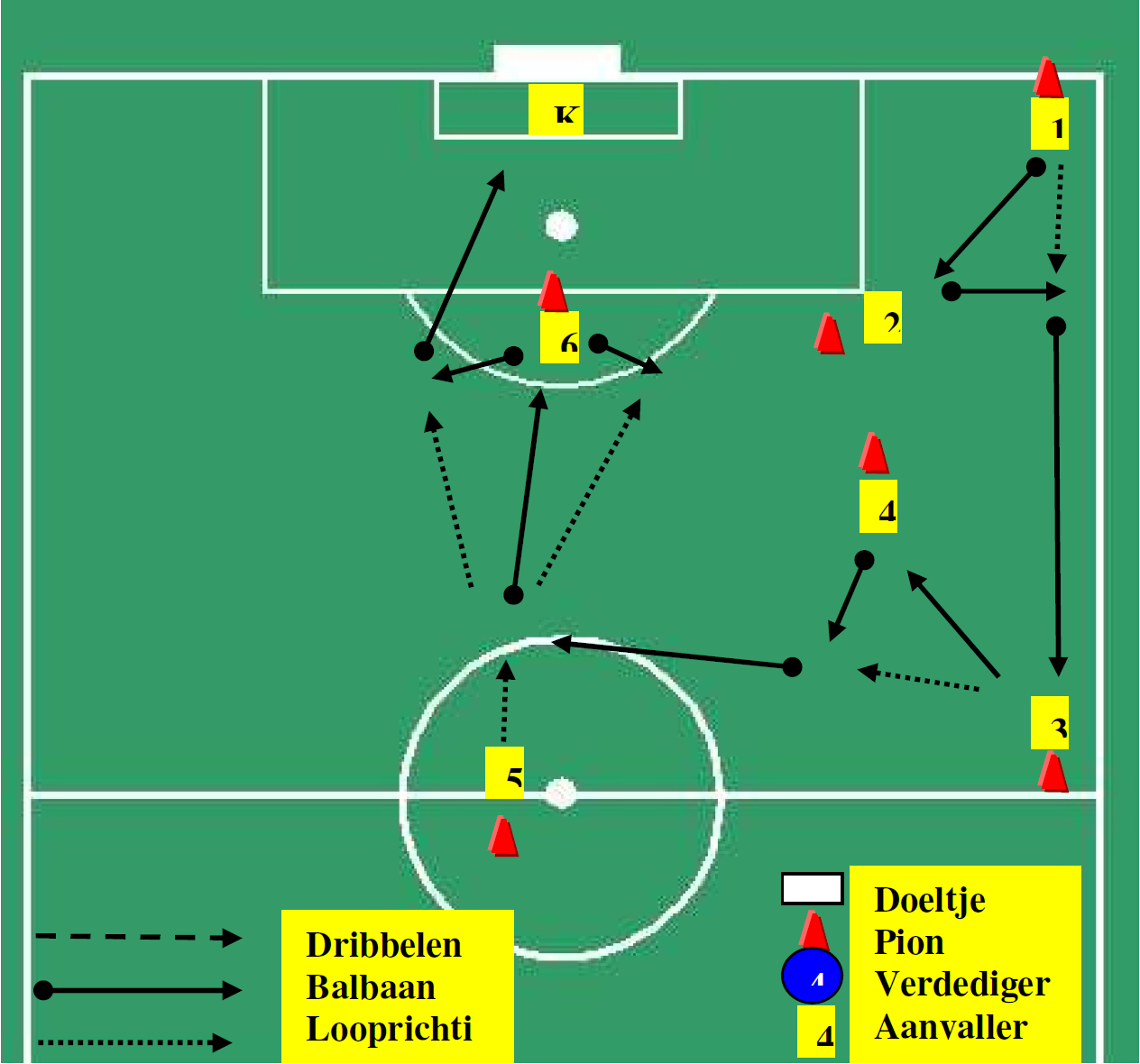
- Nr 1 enters into a 1 -2 with nr 2
- Nr 2 must get into the ball
- Nr 1 gives a depth pass to nr 3
- Nr 3 plays in to nr 4 who gets on the ball
- Nr 4 makes room for the incoming player
- Nr 3 plays to nr 5 in the width
- Nr 6 gets the ball and nr 5 determines by playing in whether he wants to have it to the left or to the right
- Nr 6 receives the ball and scores
Structure of the exercise form
- At number 1 players with one ball
- On nr 3 and nr 5 three players
- Move on from nr 1 to nr 6
- If no goalkeeper then nr 6 goes on target
- Increase/decrease the distances
- Play on the outside leg
- Make eye contact, create space and get on the ball.
- At position no. 2, 4 and 6 add a defender.
- Ball on the ground and/or through the air
Coaching
- At number 2, 4 and 6 first away from the ball and then get inside the ball.
- When nr 1 has control over the ball, then get inside the ball.
- Make sure that they do not play close to each other, because that is easy to defend
- No. 5 determines himself if he wants to have the ball l/re by the way he plays the ball.
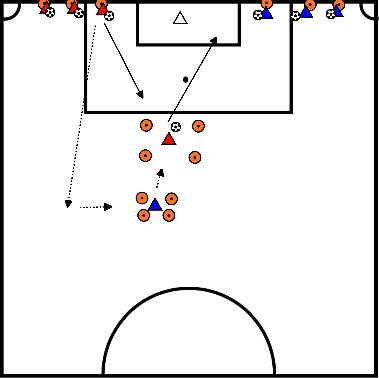
- 2 groups
- Both groups stand on one side next to the goal.
- 1 player plays the ball high/low (depending on level), to player 2 who stands in a square at the edge of the penalty area.
- Player 2 must control the ball in square and shoot.
- Retrieves his own ball and connects next to the goal.
- Player of the other team was waiting behind square, now moves up.
- Has to be done in high tempo, otherwise it is too static.
- The team with the most goals wins.
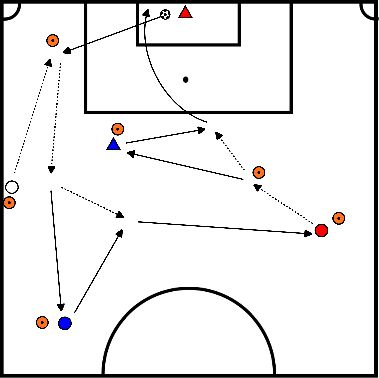
- Player ''WHITE'' Sinks in to retrieve the ball from the goalkeeper.
- Goalkeeper passes ball to ''WHITE''.
- Player ''WHITE'' Dribbles towards player ''BLUE''.
- At his starting point, he passes to Player ''BLUE'', ''WHITE'' runs on.
- Player ''BLUE'' rebounds the ball to ''WHITE''.
- Player ''WHITE'' passes to player ''RED''.
- Player ''RED'' dribbles towards the 16.
- Around the middle of the field, RED passes to BLUE2.
- Player "BLUE2" rebounds the ball to "RED".
- Player ''RED'' shoots the ball on goal.
- The ball goes through the goal.
- WHITE takes the position of BLUE.
- BLUE takes position of RED.
- RED takes position from BLUE2.
- BLUE2 takes position of goalkeeper. (not necessary if you have a goalie).
- Minimum 5 persons, to get and keep speed at least 7.
Team task:
Structure
Purpose:
Improve assumption to "move" opponent
Organisation:
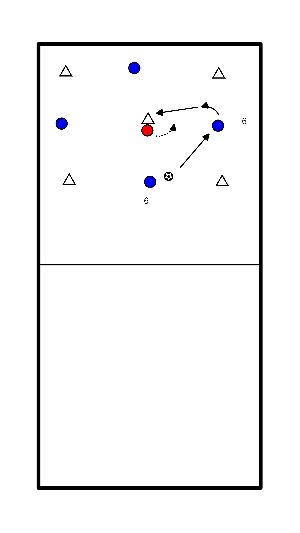
- Positioning game 3/4x1 in square box of 6x6.
- pawn in the middle, team ball-possession must shoot this pawn for points, defender must prevent this.
- Each player in team ball-possession is on one side of the square.
- A player may only defend by intercepting a pass on a pawn.
- Match/fun element can be reinforced by agreeing that the person with the most points has won after 5 minutes, the rest must for example do 10 push-ups or sprints.
- Can be made more difficult by the fact that attacking party has to score in 10 passes.
Coaching:
Direction in assumption to "move" opponent, freeing up space to play towards pawn.
1.5 metres:
- Because the defender is only allowed to intercept passes, there are no duels.
- Furthermore, perimeter ensures that players in team ball-possession do not come closer than 1.5 metres.
- the shape also invites players to keep the pitch as large as possible.
Team task:
Building up
Purpose:
Improve deep play at the right moment.
Organisation:
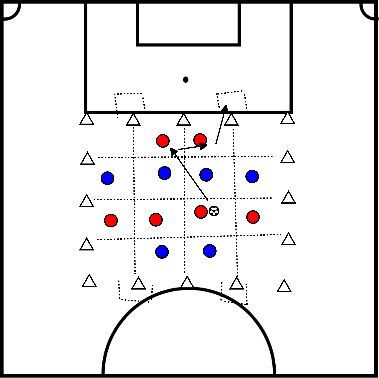
- Field of e.g. 30x30,
- Divided into 16 compartments.
- On the 2 sides
- 2 goals.
- 2 teams of 6.
- 2 players per team are divided over 4 boxes at the back,
- 4 players all have their own square.
- There is a box with defenders between the two parts of the team.
- Four must reach the duos, the duos can score in goals (see picture).
- More difficult:
- A maximum of 10 passes.
- See picture.
- 1.5 metres: boxes prevent players from duelling with each other or getting close to each other.
Drafting:
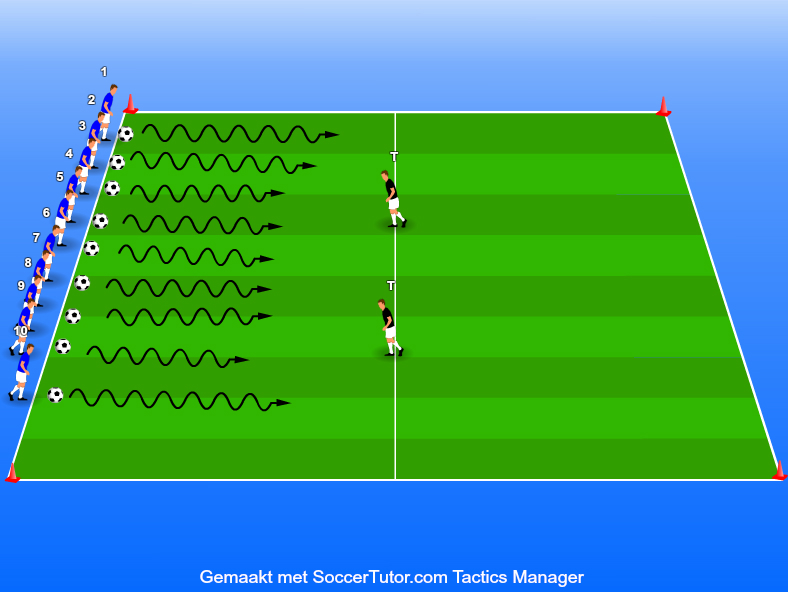
- Field of 10m by 10m
- 1 or 2 magic trees (trainers) in the middle.
- 1 ball per player.
- Task 1:
- Players walk from one side of the magic forest to the other.
- Without losing the ball.
- Task 2:
- Players walk from one side of the magic forest to the other.
- Without losing the ball.
- But watch out; the magic trees have woken up.
- And moving through the forest.
- Task 3:
- Players walk from one side of the forest to the other.
- Without losing the ball.
- But beware; the magic trees have woken up by a storm and are moving through the forest.
- But there are also branches and leaves everywhere.
This exercise can be used for each category in the warm-up.
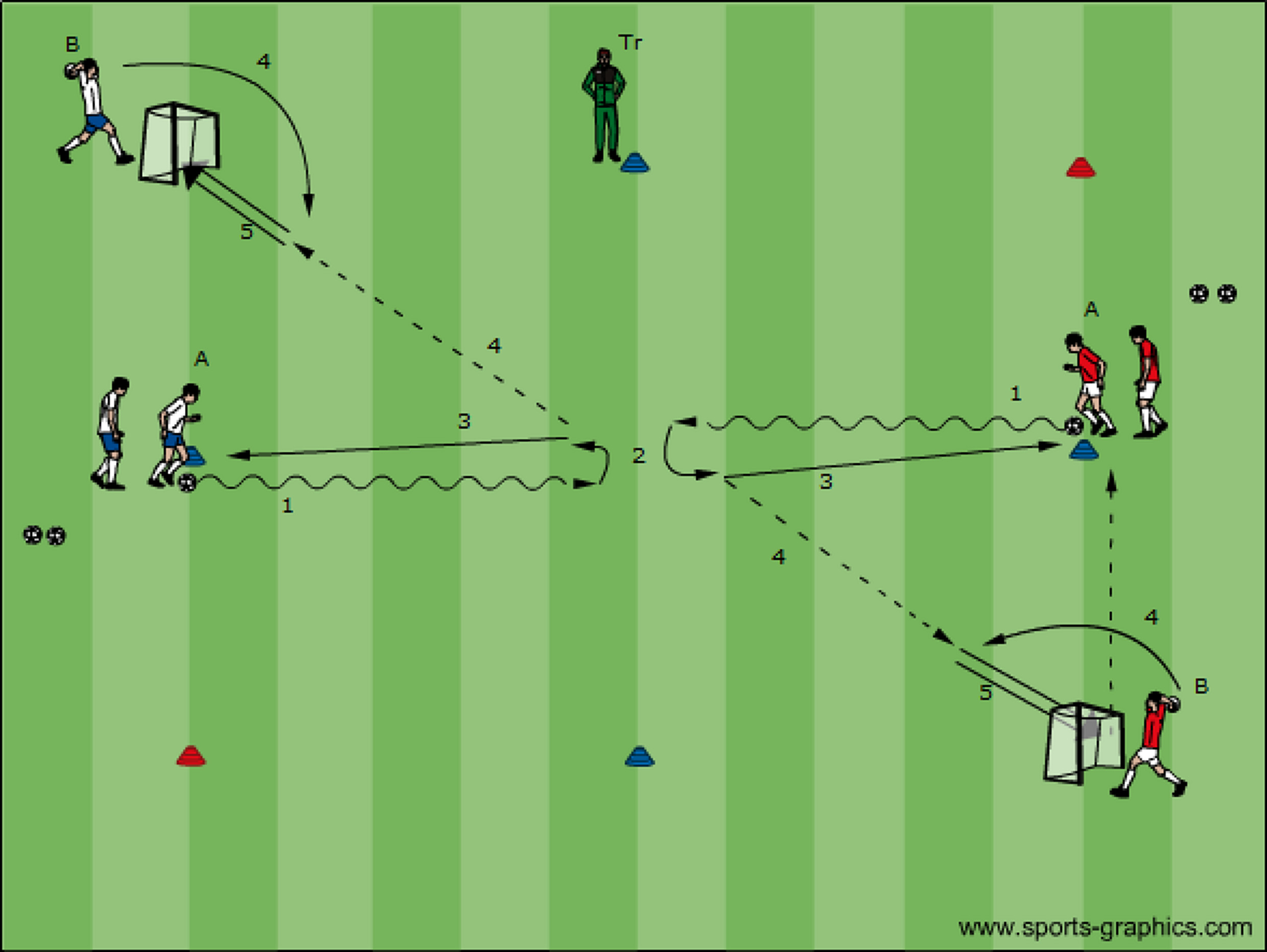
- Both players A lead the ball to the middle pawn where they perform a cutting move and then play the ball to the next player.
- After the pass, the player walks diagonally to player B who throws in the ball on which player A heads the ball in.
- The heading player then takes the ball and stands behind goal,
- The other player joins the group that has to perform the movement
Do you want to get in better shape? You can, but it takes a few things.
- What do you need?
- Pawns
- Football
- Clothes you can sport in
- Staircase
- First of all, it is important that you make sure you warm up before you start working on your cardio!
- What should you do?
- Run 2 pawns forward 1 to the back and repeat this every time.
- Do that 2x
- Grab the ball and run 5 rounds with the ball.
- This will ensure ball control and as well as do something about your condition.
- You can also do exercises indoors for your fitness, like running up and down the stairs 5 times.
- Run 2 pawns forward 1 to the back and repeat this every time.
- Of course you can also give your own twist to how you want to do it, but I think this is the best and nicest way to improve it.
- Don't try to run fast on the first day without stopping and take small steps!
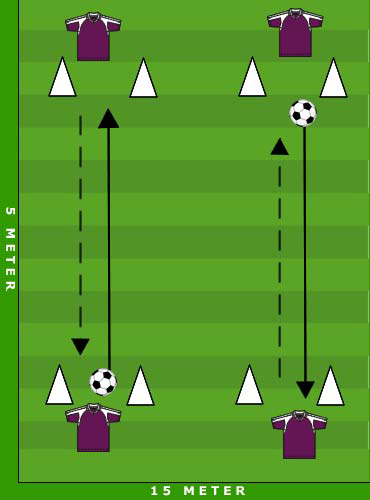
Field setup:
Set up 2 x 2 pawns per group of 2 players. Every 2 players get 1 ball.
Gameplay:
The ball is thrown up by one player and kicked back by the other. The following variants must be practised.
Variants:
- Head the ball back into the hands of the player.
- Head the ball over the player.
- Head the ball through the ground towards the player.
Tips:
- Make sure you head from your neck and don't just let the ball bounce on your head.
- Always tighten your arm muscles and move your head towards the ball.
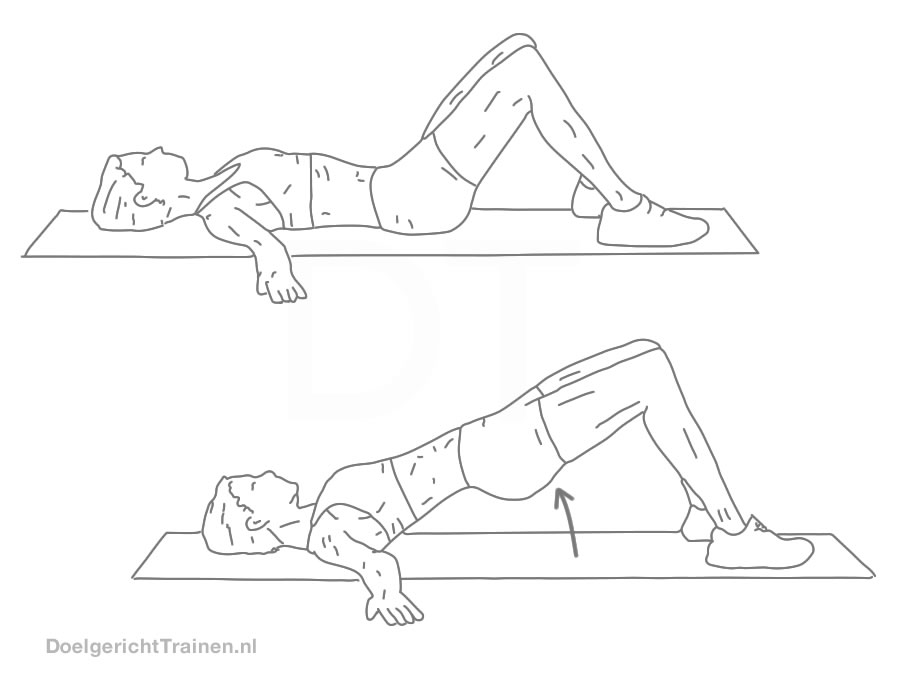
BRIDGE
Starting position
- Lie on your back.
- Bend your knees to 90 degrees and put both feet flat on the ground.
- Your arms lie along your body with your palms down.
Action
- Tighten your buttocks and belly.
- Lift your buttocks off the ground to form a straight line with your knees, hips and shoulders.
Difficulty
- To add a bit of weight to this exercise: stretch your right and left leg alternately, keeping your hips in position.
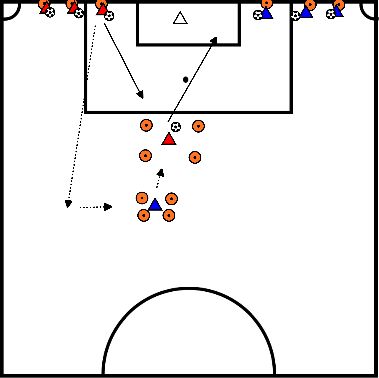
- 2 groups
- Both groups are on one side next to the goal.
- 1 player plays the ball high/low (depending on level), to player 2 who is in a square at the edge of the penalty area.
- Player 2 must check the ball in square and shoot.
- Retrieves his own ball and connects at the row next to the goal. Player of the other team was waiting behind square, now moves up.
- Must be done at high speed, otherwise it will be too static.
- The team with the most goals wins.
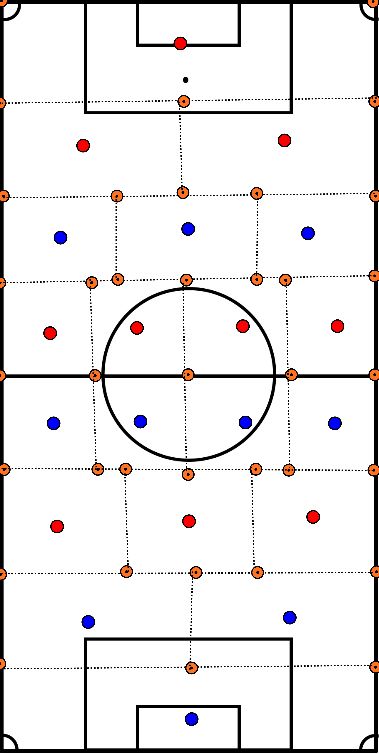
- The idea is to be able to play a game in corona time.
- The idea comes from a table soccer game
- Each player has his own space they are not allowed to leave.
- By passing, the ball can be brought to the other player
- Defense is allowed as long as it remains in his/her own discipline.
- The field can be adjusted to the number of players
Further goals:
- Passing
- Positioning game
- Shooting Distance
- The exercise can be made more difficult by making the game faster
- By only hitting the ball 2 or 3 times and playing quickly
- After all, during a match you don't have that much time either
- The players line up in a circle,
- Ideal is 6 to 8 players per circle.
- Per circle you only have one ball.
EXECUTION:
- A player plays the ball to another player, chasing the ball towards the player he is playing.
- The second player receives the ball and plays it back to another player in the circle,
- He, too, will chase the ball towards the player he has just played in.
- This keeps repeating itself.
QUALITY:
- Passes must be clear and accurate.
- The passes are played over the ground, keep the ball low!
- Just after the pass the players accelerate (short sprint)
- Players call the name of the player they want to play in
- All players constantly stand on their toes, not on flat feet, to improve the speed of action.
PROGRESS:
- You can make the game more difficult by hitting once.
- You can play with two balls
- Player 1, who has given the pass, should try to tap the player who has played the pass (player 2) before playing the ball to player 3, etc.
Set up your team in 2 lines (4-5 per line max) - only 1 ball needed.
IMPLEMENTATION:
- Players take the ball and then play it to the first person in the line opposite to them. Immediately after the pass they draw a sprint and close the back of the line they just played in. This is repeated over and over again.
QUALITY:
- Players are all on their toes ready for the pass.
- Passes are clear and accurate.
- Players must shout if they want the ball to play, and also shout the name to whom they are passing again.
- With the first ball contact they bring the ball under control, the second ball contact is the pass to the other player.
PROGRESS:
- Apply only one pass.
- Let one line pick up the ball and throw it back to the other line. They will then play the ball back with a volleypass and then simply join the other line.
- Let players take the ball with their thigh and bring it under control after which they pass the ball back over the ground.
- Place a pawn 5 meters on either side of the central point between the 2 lines. After the pass, the players have to walk around the pawn after which they connect in the row.
For this fun and interactive soccer warm up you let the players make a circle around you, about 15 meters away from you. So you are standing in the middle of the circle.
IMPLEMENTATION:
- The starting point of the players is their place in the circle, they stay "jogging" in place.
- Call: "Inside" and all players sprint towards you up to a meter or two away. Then they turn around and quickly sprint back to their spot where they keep moving.
- Call: "Outside" and all players sprint away from you until you call "Back", then everyone returns to the starting position in the circle.
QUALITY:
- Make sure players do not stand on their flat feet, but always on their toes.
- Players should sweat heavily after this exercise.
PREVENTION:
- You can apply different variations: sit-ups, push-ups, jump up, knees up by base position, sprint to the right or left while maintaining the circle shape.