


Soccerexercises for technique attack / offense
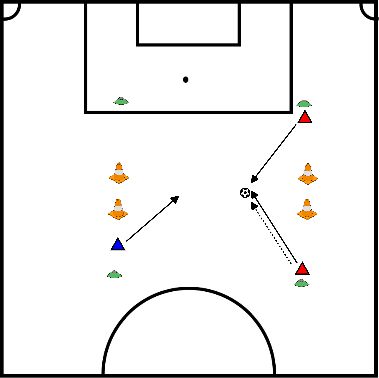
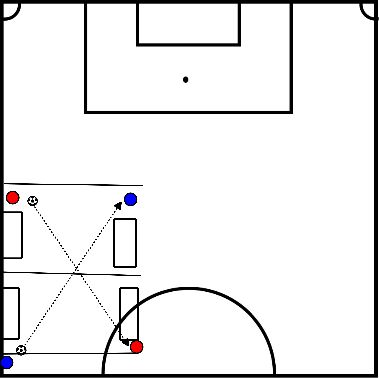
- Player blue on the back line plays the ball diagonally to player red opposite him.
- Player red on the back line plays the ball diagonally to player blue opposite him.
- Then the players on the back line try to defend.
- And the players who received the ball try to score on one of the two goals.
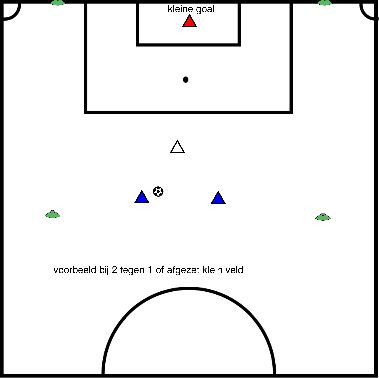
- On small goal 2 against 1 + 1 goalkeeper. At more 3 against 2, 4 against 3 etc.
- Fenced field.
- Goal: Free running, choosing position, scoring after action , not shooting from distance!
After 4 or 5 actions, turn around.
Total of 4 times so that everyone has 1 goalkeeper and 1 defender.
Varia:
Same as above but then 2 against 2 / 3 against 3 / 4 against 4 etc.
Important: Free running and action, do not score from a distance.
Possibly conditions minimum number of times overplaying.
Same as above but then 2 against 2 / 3 against 3 / 4 against 4 etc.
Important: Free running and action, do not score from a distance.
Possibly conditions minimum number of times overplaying.
- Players divide into 2 groups
- 1 group will attack and the other will defend
- The attacking group will focus on the long ball and free play in a defended zone.
- The attacker at the central pawn decides to which side the ball will be played, the attackers at the other pawns offer themselves to the ball.
- One of the defenders (red triangle) will pressure the attacker who receives the ball
- The attacker passes the ball back and the central striker plays it deep
- The defender takes his place again
- The deep-lying attacker crosses
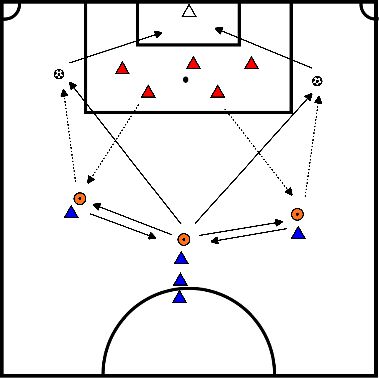
- The upcoming player (O) starts with the ball and plays it to the striker (S).
- The striker gives the ball back to the midfielder (M), who then gives the ball to the up-and-coming player.
- The intention is for the up-and-coming player to sprint the running action.
- It is all about the right timing.
- The up-and-coming player must keep a close eye on the bounce between striker and midfielder and judge when to give the ball deep.
- Starting too early would mean running offside.
- Starting too late would mean that the ball is intercepted by a defender.
- Running too slowly would mean being overtaken by a defender.
- The emerging player eventually plays with the ball to the emerging player on the other side and becomes the midfielder there.
- The midfielder becomes the striker, the striker becomes the emerging player
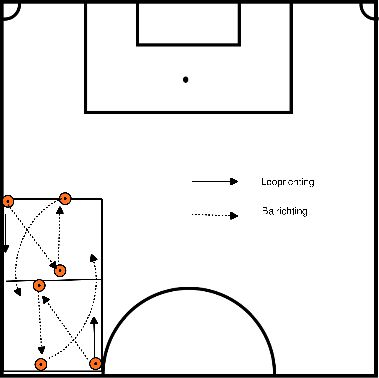
- In this practice form, two variants are completed.
- The team standing on the left plays against the team standing on the right.
- Always swap sides so players practice on both sides and with both legs.
- The deepest player is played in and drops the ball to the third man who finishes.
- The deepest player then gets directly into the ball and rebounds, after which the ball is played to the flank.
- The flank player can take the ball inside once to enter half space and must hit the low cross.
- Addition in the form is a defender of the opposing team may defend along with the low cross (2vs1).
SCORING SCORING (1) - YouTube
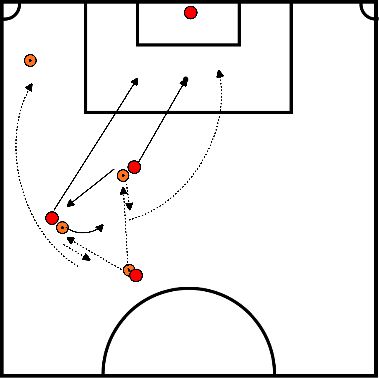
- Attacker does exercise 4 times.
- Attacker goes to pick up ball and tries to score via 1V1 in goal right in front of him.
- If defender can pick up ball he tries to score in goal at the side.
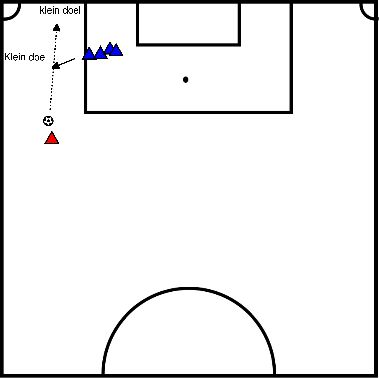
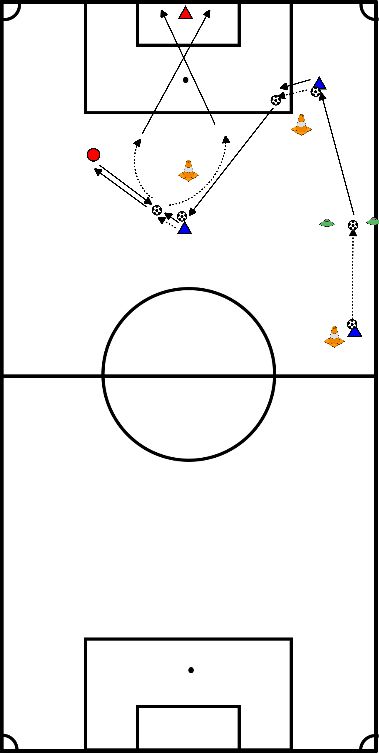
- Player 1 leaves with the ball for a 1V1
- If he can score he turns around because then he has to defend on the goal where he scored.
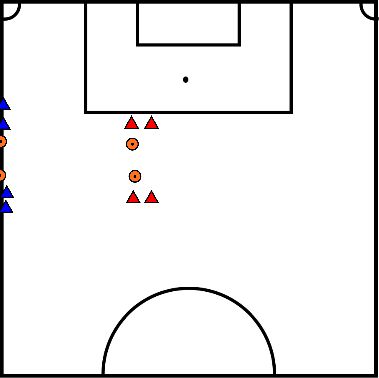
- Player 1 plays ball in to player 2, 2 turns out with farthest foot away from passive defender.
- 2 gives pass to 3 who turns out farthest foot, gives pass to trainer and asks for ball back.
- Trainer plays back, Player 3 takes ball, makes action and finishes on goal.
- Alternatively, instead of passing to 3, Player 2 dribbles to where 3 would be standing and then does a hand-off with trainer and finishes.
- Depending on the number of players you determine the size of the field and possibly the number of spaces.
- Max is 4 against 4.
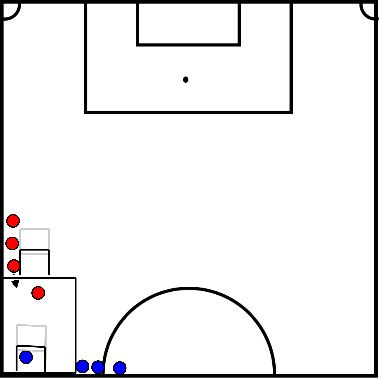
- You start 1 against 1 with small or big goals (with goalie).
- Next to the goals are the other players.
- At one goal team red and the other team blue.
- At goal or ball out a player of team A comes in.
- At the next goal, a player from row B.
- So on until your maximum players are deployed.
- Next round starts with team B.
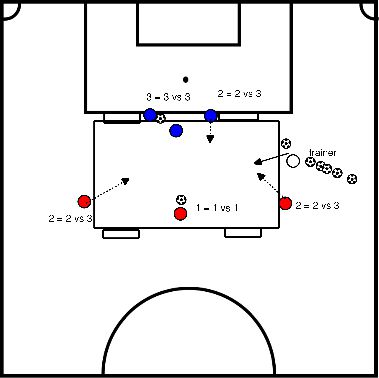
- 1st ball is a 1 vs 1 by means of a deep pass
- 2nd ball the outer players come into play and 1 defender on the other team, creating 3 vs 2
- 3rd ball another defender comes in and it becomes 3 vs 3
Organization
- Four players red + goalkeeper at a goal
- Four players blue + goalkeeper at a goal
- Trainer stands at the side of the field (with the balls)
Situation 1
- Trainer plays the ball to player 1 of team red
- Player 1 of team red and player 1 of team blue fight a 1 vs. 1 duel
Situation 2
- In this situation red has scored, that means that a blue player comes in.
- If blue steals the ball and scores, then a red player is added.
- In this case you create a 2 on 1 situation
Situation 3
- Blue managed to score in the previous situation, which means that a red player joins...
- You thereby create a 2 vs. 2 situation
Points of attention and rules
- Watch the numbers, 4 against 1 is no fun. Keep it challenging and keep the numbers at +1 at the most
- When the ball goes out, it starts with the trainer. The ball then goes to the person who is entitled to it.
- Next to it a player comes in (for a quick run through)
- Decide, as trainer, of which color a player must be added: logically this would be the team with the ball (but let it depend on the numbers).
- Continue to play until a 4 vs 4 situation has arisen.
Coach accents
- Passing to the front
- Depth in the game (think deep, run deep and play deep)
- Speed up your attack
- Make the field big (width and depth)
- Play a man off more by letting the defender choose
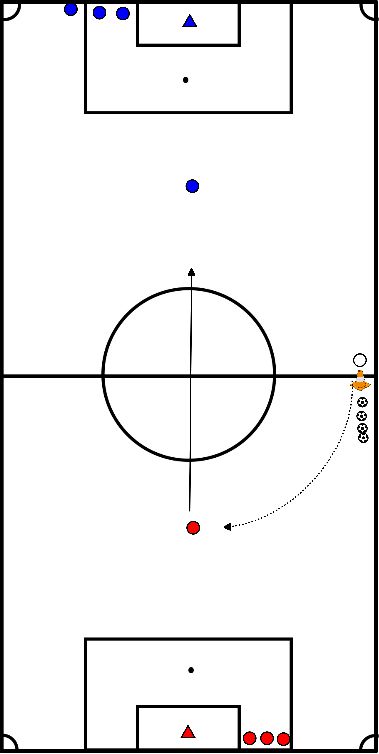
- Small field with small goals or cones.
- Player 1 moves with the ball from the corner point to a point on the field and leaves the ball there.
- Player 2 goes to pick up the ball and player 3 responds by defending.
- There is a 2v1