

Soccerexercises for technique condition
Formation
- The players position themselves in a circle. Ideally, there are 6 to 8 players per circle. There is only one ball per circle.
- A player passes the ball to another player and follows the ball towards the player he passes to. The second player receives the ball and passes it to another player in the circle, also following the ball. This process continues to repeat.
- Passes must be clear and accurate. The passes are played on the ground, keep the ball low!
- Just after the pass, players accelerate with a short sprint.
- Players call out the name of the player they want to pass to.
- All players are constantly on their toes, not flat-footed, to improve speed of action.
- You can make the game more challenging by applying one-touch play.
- You can play with two balls.
Rules of the Game
- The players play 4 versus 4.
- In the attack, the players must first pass the ball to each other 2 times before they are allowed to score.
- After a period of time, this can be expanded to 3 passes.
- When the ball is intercepted by the opponent, the counting of the passes must start again.
- Scoring is not allowed if there have not been enough passes.
Formation
- The players position themselves in a circle. Ideally, there are 6 to 8 players per circle. Each circle has only one ball.
- A player passes the ball to another player and follows the ball towards the player they passed to.
- The second player receives the ball and passes it to another player in the circle. They also follow the ball towards the player they have just passed to.
- This repeats continuously.
- Passes must be clear and accurate. The passes are played along the ground, keep the ball low!
- Just after the pass, players accelerate (short sprint).
- Players call out the name of the player they intend to pass to.
- All players stand constantly on their toes, not flat-footed, to improve reaction speed.
- You can make the game more challenging by applying one-touch play.
- You can play with two balls.
- Player 1, who has made the pass, must try to tag the receiving player (player 2) before they pass the ball to player 3.
Formation
- Form groups of two players. Each group has one ball.
- Players with the ball stand on the sideline.
- The other players stand opposite them, approximately 6 metres away.
- Player A dribbles forward while Player B jogs backwards.
- Player A passes the ball to B, who passes it back to A.
- Repeat this until the other sideline is reached.
- Switch roles when the other side of the field is reached.
- Player A walks backwards to the starting line.
- Alternate passes between the right foot and the left foot.
- Try to use one-touch passing; only if necessary, the ball may be touched twice.
- Focus on quality over speed; it is not a race.
- Encourage successes!
- Play the ball to the thigh, bring under control, and volley back.
- Play the ball to the chest, bring under control, and volley back.
- Play the ball to the head, head the ball back.
Execution
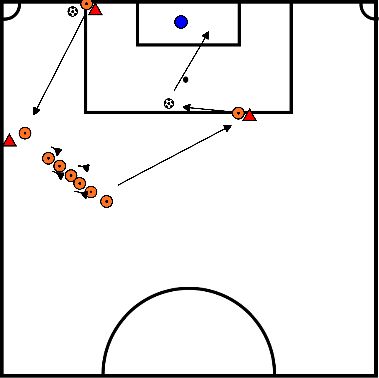
- Player 1 passes the ball to Player 2.
- Player 2 dribbles around the cones and passes at the end to Player 3.
- Player 3 returns the ball to Player 2.
- Player 2 finishes on goal.
- Player 3 retrieves the ball and takes the position of Player 1.
- Player 1 moves to the position of Player 2.
- Player 2 moves to the position of Player 3.
Execution
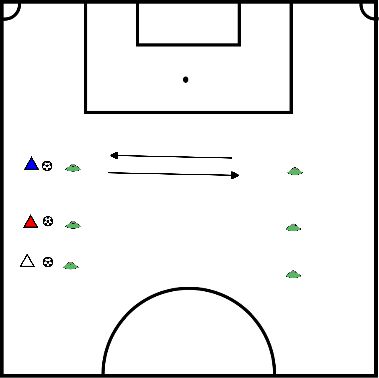
- For each player, place two cones approximately 15 metres apart. This distance can be adjusted as desired.
- The player runs back and forth with the ball around the cone.
- Upon return, the player stops the ball next to the cone.
- Then, the player runs back and forth at a high pace around the cone without the ball.
- The fastest player wins.
- Repeat the desired number of times.
- Try reversing the order: first without the ball and then with the ball.
Warm-up
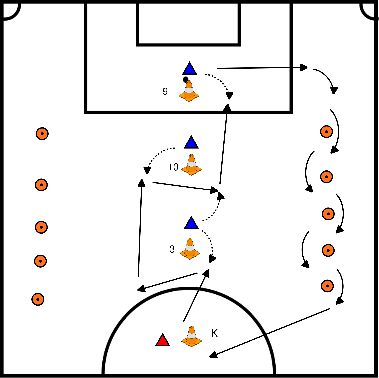
- The goalkeeper plays to the requesting central defender who drops back.
- The central defender passes back to the goalkeeper.
- The goalkeeper controls with the furthest foot and plays to the requesting attacking midfielder.
- The attacking midfielder controls with the furthest foot and passes back to the central defender.
- The central defender plays to the requesting striker who drops back.
- The striker controls with the furthest foot and turns out.
- The striker slaloms through cones back to the starting position.
- The goalkeeper takes the place of the central defender, the central defender takes the place of the attacking midfielder, and the attacking midfielder takes the place of the striker.
- Ball control with the left foot, pass with the right foot - or vice versa.
- Other technical or warm-up exercise along the cones instead of dribbling.
- The exercise can be applied on both sides.
Execution
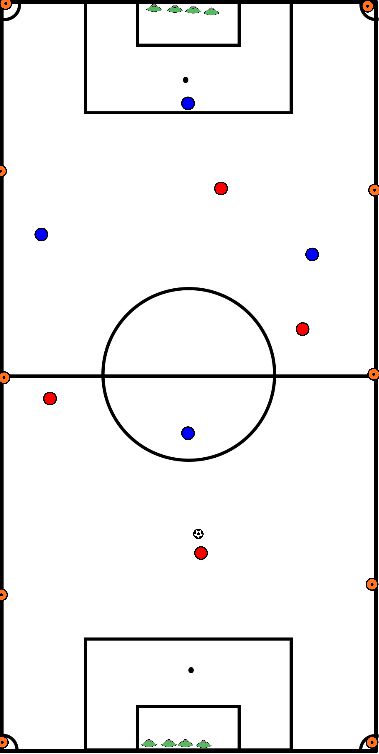
- A variation of the standard match play is executed.
- Behind each goal, there are 4 to 5 cones.
- As soon as team A scores, the scorer takes a cone from behind the goal where the goal was scored.
- The player runs as quickly as possible around the field to their own goal and places the cone there.
- Only after this may the player rejoin the game.
- A natural underload/overload moment arises.
- Players who "cut corners" must turn back, return the won cone, and then return to their own goal from outside the field.
Preparation
- Form groups of 2 players, with 1 ball per group.
- The players with the ball stand on the sideline.
- The other players stand opposite them, approximately 6 metres away.
- Player A dribbles forward.
- Player B jogs backward across the field.
- Player A passes the ball to Player B, who passes the ball back to Player A.
- Repeat this until they reach the other sideline.
- Switch roles when the players reach the other side of the field.
- Player A then jogs backward to the starting line.
- Alternate between right foot and left foot.
- Try to apply one-touch passing.
- Focus on quality over speed; it is not a race.
Execution
- Both players A dribble towards the central cone.
- Perform a cutting movement at the cone.
- Pass the ball to the next player.
- After the pass, the player runs diagonally towards player B.
- Player B throws the ball up for player A.
- Player A heads the ball into the goal.
- The player who heads retrieves the ball and stands behind the goal.
- The other player joins the group that needs to perform the movement.
Introduction
- This activity involves speed, agility, coordination, passing, and duels.
- Suitable for all age groups with possible variations.
- The FUN aspect is enjoyable for both young and old.
Execution
- Players A start shoulder to shoulder and sprint to the cones.
- Accelerate around the marker and move backwards to the pole.
- Move sideways over the hurdles and then back behind the pole.
- Accelerate forward to the furthest pole and then backwards to the other pole.
- Player B plays a ball to A who finishes on goal.
- The player who finishes first wins.
Variations
- For older age groups, the loser may receive an extra task.
- For younger age groups, points are accumulated.
- Players switch positions after each round.
- Player B can throw the ball so A must head it towards the goal.
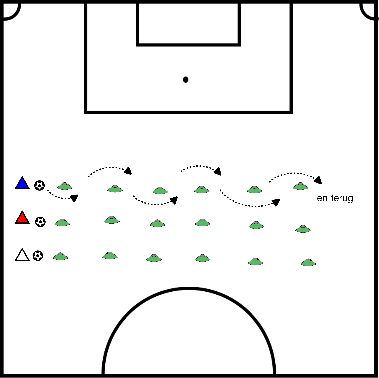
Execution
- Place 7 cones at a distance of approximately 15-20 meters from each other.
- With a small group: one player per series of cones; with a larger group: players one behind the other.
- Slalom at pace through the cones back and forth.
- Stop the ball next to the cone.
- The fastest player wins.
- Slalom at pace through the cones, but without slalom back.
- Stop the ball next to the cone.
- The fastest player wins.