

Soccerexercises
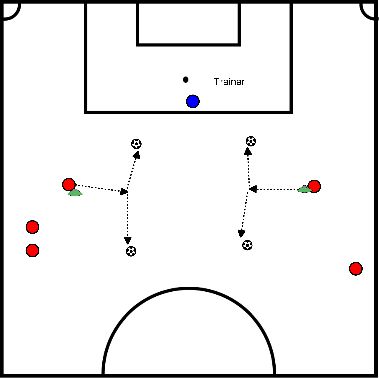
- trainer -blue- gives the starting shot.
- goalkeeper -red- goes into starting position between the two balls.
- goalkeeper stays on the spot dribbling on tips of toes.
- trainer says which side.
- goalkeeper dives to that side.
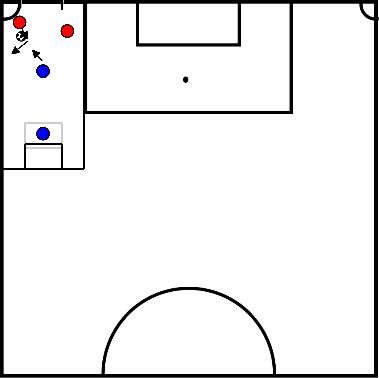
- Field 20 meters long, 5 meters wide next to the goals, goals of 3 by 1.
- In the middle put 2 large pawns so you have a clear center line.
- Party game with offside.
Because field is not super long, you are going to create many moments when players can run offside.
Ask the players why it was offside and how they could have prevented it.
Ask the players why it was offside and how they could have prevented it.
During this first phase of training, players are taught to choose position well while defending.
Players are encouraged to first choose a good position in relation to the attacking pair and to experience how to reduce the opponent's play.
Because of the one-against-two situation, the defender will have to shield the passing line well to the opponent without the ball, and then force the opponent with the ball to the side. Next, it is important that the opponent is forced to run diagonally forwards - in the direction of the sideline - and cannot turn.
The defender then waits for the right moment to intercept.
Coaching:
The defensive player shields the passing line to the opponent without the ball.
Goalkeeper checks off the goal and coaches fellow players.
Defender tries to force the ball-carrying opponent one way and at the right moment (at the side of the field) intercept the ball.
Organization:
Players are encouraged to first choose a good position in relation to the attacking pair and to experience how to reduce the opponent's play.
Because of the one-against-two situation, the defender will have to shield the passing line well to the opponent without the ball, and then force the opponent with the ball to the side. Next, it is important that the opponent is forced to run diagonally forwards - in the direction of the sideline - and cannot turn.
The defender then waits for the right moment to intercept.
Coaching:
The defensive player shields the passing line to the opponent without the ball.
Goalkeeper checks off the goal and coaches fellow players.
Defender tries to force the ball-carrying opponent one way and at the right moment (at the side of the field) intercept the ball.
Organization:
- Field is 20 meters long and 10 meters wide.
- 2 pupil goals.
- 3 caps in 2 different colors.
- Hats in 1 color to mark out the field.
- Sufficient balls at the build-up.
Contents:
- 1+keeper against 2.
- 1:1 against 2.
- Player of the constructing party takes the ball out.
- Defending player screens the goal halfway down the playing field.
- The opponent -attacking team- tries to score.
During this second form of practice players are taught to choose their position well while defending.
Players are stimulated to be well organized and to screen the center -the space in front of the goal- in order to force the opponent into one direction. This requires good mutual cooperation, which can sometimes feel unnatural for players because they have an urge for the ball. In this simplified underdog form of soccer, players can experience what happens when they give away too much space and do not cooperate well: the opponent will then be able to score easily.
It is important for the defender who presses for the ball not to give the opponent space to turn, and to force even more to the sideline. The other defender can learn to cover his/her back well.
To execute this exercise properly where the defending team can intercept the ball, the building up opponent is given a lot of space to build up. Only when one opponent dribbles with the ball towards the goal will one of the defenders step in and apply some pressure. Only when the opponent in possession of the ball explicitly looks for the 1v1 situation, one of the defensive players will try to intercept. Until then, they patiently screen the goal, waiting for the opponent to make a mistake .
Organization
Players are stimulated to be well organized and to screen the center -the space in front of the goal- in order to force the opponent into one direction. This requires good mutual cooperation, which can sometimes feel unnatural for players because they have an urge for the ball. In this simplified underdog form of soccer, players can experience what happens when they give away too much space and do not cooperate well: the opponent will then be able to score easily.
It is important for the defender who presses for the ball not to give the opponent space to turn, and to force even more to the sideline. The other defender can learn to cover his/her back well.
To execute this exercise properly where the defending team can intercept the ball, the building up opponent is given a lot of space to build up. Only when one opponent dribbles with the ball towards the goal will one of the defenders step in and apply some pressure. Only when the opponent in possession of the ball explicitly looks for the 1v1 situation, one of the defensive players will try to intercept. Until then, they patiently screen the goal, waiting for the opponent to make a mistake .
Organization
- The field is 30 meters long and 14 meters wide.
- 2 pupil goals.
- 5 caps in 2 different colors.
- Hats in 1 color to mark out the field.
- Sufficient balls for the build-up.
Contents
- 2+keeper against 3.
- 1:2 against 1:2
- Player of the constructing party takes the ball out.
- The defending team screens the goal halfway down the playing field.
- The opponent -attacking team- tries to score.
Coaching
- The two defensive players screen the pass line.
- The goalkeeper checks that they are shielding the goal and pass line properly and coaches fellow players.
- The two defensive players check spacing and pressure ahead.
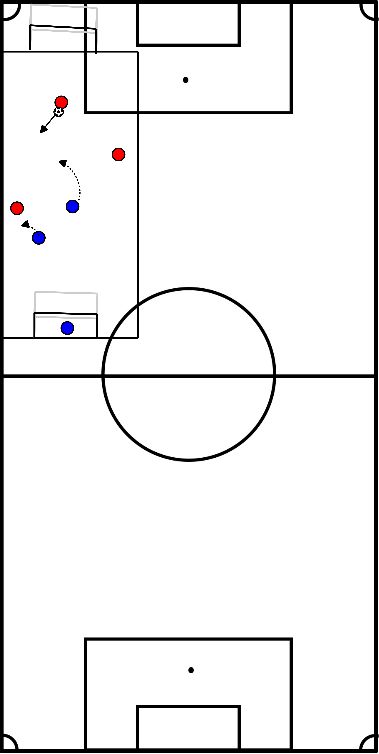
During this drill, players learn to remain patient and screen the goal properly, among other things, to resist resistance. An added difficulty is that there are two goals to be defended, making it extra important that the center is properly shielded. The most logical way is for the defending team to force the opponent to the side and for one side of the field to try to intercept the ball when the opponent tries to get closer to one of the two goals to create a scoring opportunity. This practice form is again more difficult than the first form due to the number of players, but remains manageable. It allows them to learn to cooperate and to maintain a proper distance between them.
Organization
Organization
- The field is 20 meters long and 40 meters wide.
- 2 mini goals and 1 pupil goal or 2 more mini goals.
- 8 caps in 2 different colors.
- Hats in 1 color to mark out the field.
- Sufficient balls for the build-up.
Contents
- 4 against 4+keeper
- 1:2:1 against 1:1:2:1
- Goalkeeper of the constructing party takes the ball out.
- Defending team shields the goal halfway down the playing field.
- The opponent -attacking team- tries to score.
Coaching
- The defending players screen the goal.
- The goalkeeper checks that they are shielding the goal properly and coaches fellow players.
- The defending players check the distance between them and wait for the opponent to come towards their half of the pitch.
- The player closest to the ball forces the dribbling opponent back out or to the side, the others keep the center close and provide back cover.
- The one closest to the ball waits patiently until an intervention leads to ball possession and forces the opponent back.
- The two goals are always shielded, the right moment to intercept the ball is only there if the goals are properly shielded.
- Coach your teammate when they can apply pressure to intercept the ball.
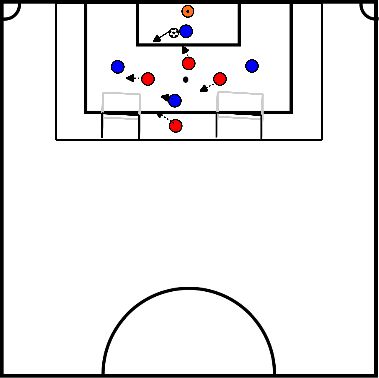
This type of exercise is a positional game in which the team with the excess number must press for the ball immediately after losing it.
The principle of play
What are your players supposed to do when the ball is lost somewhere on the field? If you want your team to put direct pressure on the ball in the transition from possession to loss of the ball, the following form of practice is very suitable to work on this. The playing principle that is central in this form of practice is 'putting pressure on the ball directly'. With 'putting pressure' I mean attacking the ball; actively moving towards the ball -and opponent- in an attempt to conquer it as soon as possible.
What are your players supposed to do when the ball is lost somewhere on the field? If you want your team to put direct pressure on the ball in the transition from possession to loss of the ball, the following form of practice is very suitable to work on this. The playing principle that is central in this form of practice is 'putting pressure on the ball directly'. With 'putting pressure' I mean attacking the ball; actively moving towards the ball -and opponent- in an attempt to conquer it as soon as possible.
The practice form
The red team plays the ball around or plays for possession. The yellow team tries to get rid of the ball.
When the yellow team is in possession of the ball, they must try to score as soon as possible in one of the four goals.
By keeping the size of the field relatively small, it is easy for the yellow team to attempt a goal from all positions on the field.
The red team is thus forced to put pressure on the ball immediately upon loss of possession to prevent a goal/attempt.
The red team plays the ball around or plays for possession. The yellow team tries to get rid of the ball.
When the yellow team is in possession of the ball, they must try to score as soon as possible in one of the four goals.
By keeping the size of the field relatively small, it is easy for the yellow team to attempt a goal from all positions on the field.
The red team is thus forced to put pressure on the ball immediately upon loss of possession to prevent a goal/attempt.
Coaching
What can you pay attention to in this exercise? Since pressure on the ball is central, it is logical to look mainly at this:
What can you pay attention to in this exercise? Since pressure on the ball is central, it is logical to look mainly at this:
- Is it pressured at all at ball loss?
- If yes, by whom and by whom not? If not, why not?
- If pressure is applied, how? Aggressively from the idea of capturing the ball immediately or from a shuffle pace?
Variations
Several variations are possible, some suggestions:
Several variations are possible, some suggestions:
- If you have no goalkeepers, you can also work with small goals only
- Let the under team score by dribbling out of the field (possibly in combination with the goals)
- Award points to the outnumbered team by playing around x number of times
- Award points to the outnumbered team if the ball is recaptured without a goal attempt by the underdog.
- More/less goals
- Count goals from the under number more heavily
Naturally, the form can also be played with other numbers, as long as there is an over- and undercount.
Direct pressure is very effective when it works. If it is not successful and the opponent can play under pressure, it is very likely that large spaces will be created, which is a risk. Correct adjustment of the pressure requires training.
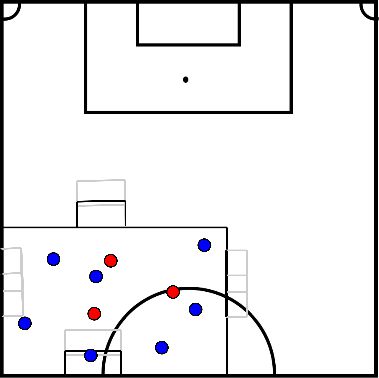
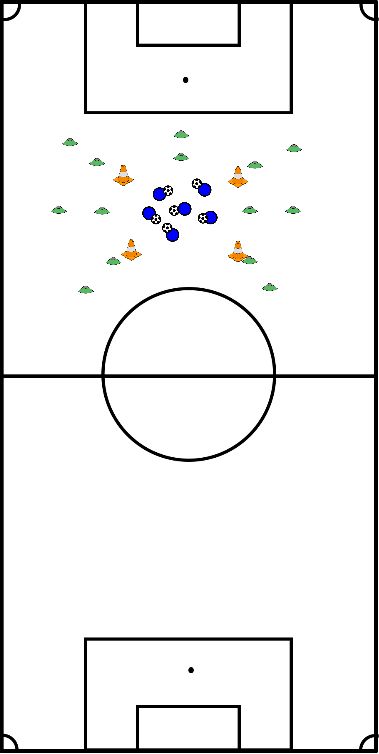
- Large square on the field.
- Dribble through each other with ball.
- At the sign of the trainer: turn around, jump, pass and so on.
1 v 1 individual defending O16 1 - 4 players 1/4 pitch Game description
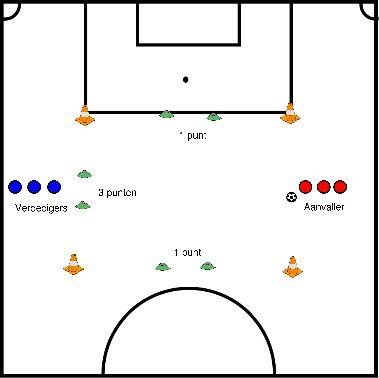
The attacker tries to reach a score by dribbling through a gate of pawns.
The defender tries to prevent a score. Because there are multiple goals, this becomes a challenge for him.
The goal of the defender is to send the attacker to the side and to conquer the ball or play the ball outside.
The rules of the game
The attacker tries to reach a score by dribbling through a gate of pawns.
The defender tries to prevent a score. Because there are multiple goals, this becomes a challenge for him.
The goal of the defender is to send the attacker to the side and to conquer the ball or play the ball outside.
The rules of the game
- The attacker starts the game by dribbling into the game.
- Once the attacker is through the gate, the defender may start preventing a score.
- Point count: a score through the side gates earns 1 point and a score straight through earns 3 points,
- If one game lasts longer than 2 minutes, a defender and attacker are added until a goal is scored. Only 1 ball remains in the field. If after 2 minutes - 4 minutes in total - no goal has been scored, another attacker and defender join in and so on until a goal is scored or the ball goes outside or is conquered by the defender.
- Variation: limit the number of ball contacts for the attacker, increase or decrease the size of the field, increase or decrease the size of the goals.
The preparation
Organization-wise you can lay out the field according to the following dimensions. If you want to make it more difficult for the player with the ball, make the field narrower and shorter.
The measurements Length: 15 meters Width: 15 meters, pawns should be 1.5 meters apart.
The measurements Length: 15 meters Width: 15 meters, pawns should be 1.5 meters apart.
Game description:
The player with ball starts at the back and passes the pawns and passes the ball to the player waiting on the right.
When the player waiting on the right gets the ball, the player on the right in line plays the ball to the incoming player on the left in line.
This player then tries to shoot the ball into the goal behind the goalkeeper.
In this way, there will be repeated passes.
The player who has passed the pawns joins the player who has given the depth pass.
The player who made the deep pass goes to the place to finish. The player who finished correctly goes to get the ball and joins the players at the back who must pass the pawn.
The player with ball starts at the back and passes the pawns and passes the ball to the player waiting on the right.
When the player waiting on the right gets the ball, the player on the right in line plays the ball to the incoming player on the left in line.
This player then tries to shoot the ball into the goal behind the goalkeeper.
In this way, there will be repeated passes.
The player who has passed the pawns joins the player who has given the depth pass.
The player who made the deep pass goes to the place to finish. The player who finished correctly goes to get the ball and joins the players at the back who must pass the pawn.
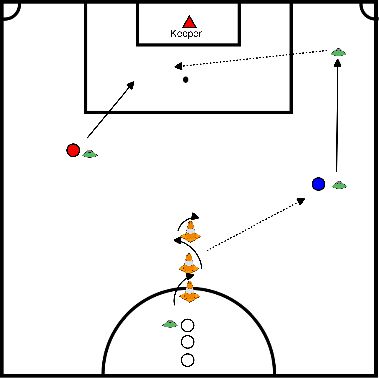
First left, then right, or both sides at once if enough players.
Encourage left to use left foot, right to use right foot.
Encourage left to use left foot, right to use right foot.
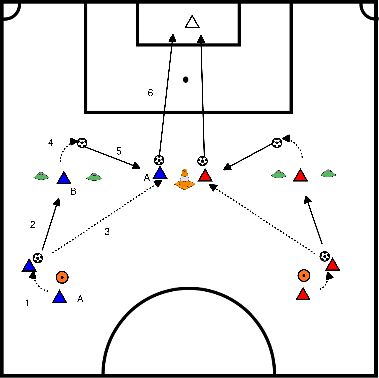
1. Player A turns open to outside behind opponent out.
2. Player A passes forward to player B between cones.
3. Player A runs diagonally to cone in front of goal.
4. At the same time, player B caps/turns out of the cones toward the goal line.
5. Player B passes diagonally behind to player A who meanwhile is standing at the cone.
6. Player A shoots at goal.
7. Player A becomes Player B, Player B joins the starting position.
Distances:
- A-B 5 meters.
- A to goal 5 meters.
- Hat to line B 1 meter.
- Distance goal differs in age younger goal is bigger.
Player dribbles to line A, cuts the ball off, dribbles to line B, cuts off and shoots the ball at the goal, picks up the ball and runs around the outside back.
Variations:
Inside/outside foot cut off, cut off behind stand leg, dribble with left and right.
Coach moments:
Dribbling, touching the ball at each step, short turn off, cutting off line B and having the ball in such a way that you step through and shoot and not having the player first walk backwards for a run.
Variations:
Inside/outside foot cut off, cut off behind stand leg, dribble with left and right.
Coach moments:
Dribbling, touching the ball at each step, short turn off, cutting off line B and having the ball in such a way that you step through and shoot and not having the player first walk backwards for a run.
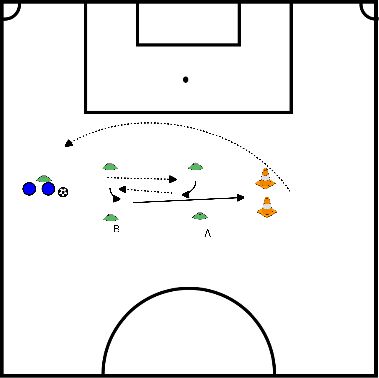
Check distances with the number of players.
- Have players dribble into the box.
- Trainer says 1: put players ball on foot.
- At 2: knee on foot.
- At 3: sit on ball.
- This one minute and then outside dribble through the goals in succession for about 2 minutes.
Game version 1: start in the box with dribbling at the sign of yes as fast as possible through a goal and dribble back into the box and finish with 1,2,3.
Game version 2: who will go through as many goals as possible within 1 minute.
Game version 2: who will go through as many goals as possible within 1 minute.