



Soccerexercises
- Pairs of two
- One of them rolls the ball and the other passes back.
- the passer runs back and forth between a pilon and the place of passing
- Challenge is to play as much passes as possible in 45 seconds.
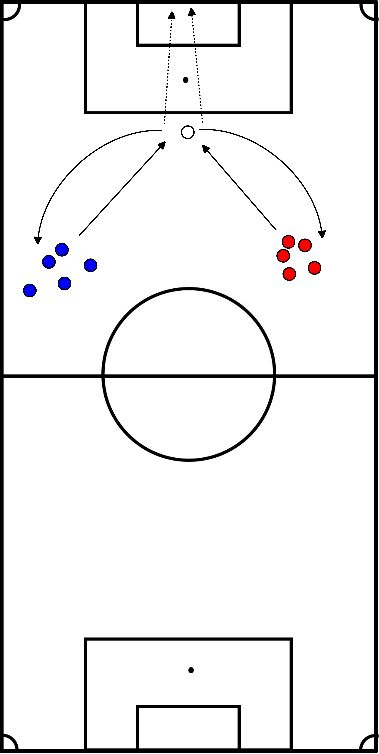
- Two groups of players
- 1 defender
- The defender attacks and the attacker must try to score
- After a shot at goal, the attacker takes over the defender's place and an attacker from the other group tries to score.
- Again tha attacker shoots and takes the place of the defender.
- And so on.
- Try to keep up the pace.
- The group is positioned in the four corners of the field.
- A tagger with a party ribbon
- On the signal, they cross the field in three directions of their choice:
- the short side, the long side or diagonal.
- This results in one, two or three points each time they return.
- A tagger operates in the free space and obliges the tagged children to first go back to their corner before they may cross again.
- How many points can you score in a set time?
- The group is on one side behind hoops.
- On the signal, the children steal objects on the other side one by one and put them in the hoops on their own side.
- If they are caught by a tagger, they have to put the object back.
- A tagger will be assigned from the group.
- The game is played all over the field.
- The group is on one side of the field.
- On the sign the children cross over.
- One tagger tries to tap as many children crossing as possible.
- Variation
- The children walk back and forth on a sign.
- Back and forth without waiting for a sign.
- The children are not free on the other side.
- With two taggers
- With boxes with one tagger in each box.
- The children can be tagged in each box.
- Who is not tagged on the way back and forth?
- Or which group of taggers has tagged the most children?
- The group is lined up on the short side of the field in a few relays.
- On a sign they all run to the other side at the same time and sit down as fast as possible in a random order.
- Which line can sit down first?
- Variation
- Varying start and end positions.
- Touching a line on the opposite side, returning and sitting in line again.
- The whole group is lined up behind a line on the side of the field.
- On a signal, they run over to the other side.
- Variation Starting positions:
- squat,
- sitting on knees
- lying on the stomach or back,
- sit with your back towards the running direction.
- The children run across the room in pairs.
- One child tries to follow the other.
- Variation
- The child at the front has to suddenly change tempo.
- The child in front must always change direction sharply.
- Groups of four or five children.
- Groups of four or five children and on a signal, the child in the back sprints to the front and then indicates the track and speed.
- There are all kinds of obstacles in the field, such as mats, hoops and pylons.
- The trainer leads the way along these obstacles, the children follow him.
- Variation
- The children run in pairs along these obstacles.
- They walk backwards.
- They walk with sideways steps.
- Put out a square.
- Each corner has a colour (hat, jacket, ...).
- When jogging randomly across the field, call out colour and then sprint to the corner.
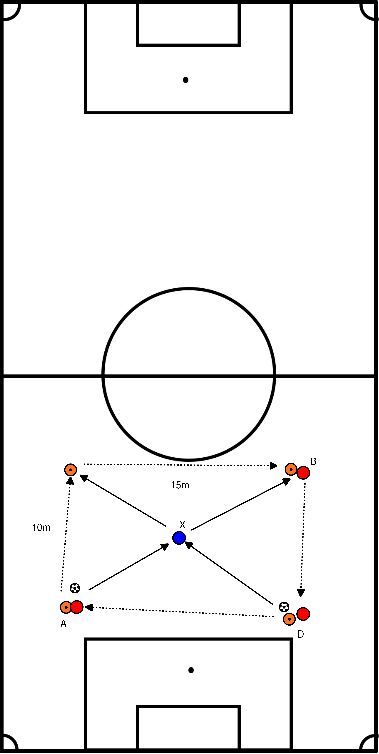
Make 4x a square of 10m x15m with 16 players
- 1 player (X) in the middle
- 3 players on the lines of the square with 2 balls
- Player X is played by player A on the corner.
- Player X takes the ball and moves to the other corner of the square and plays player B.
- Player A on the corner runs to the next corner.
- After this player D plays in on X who then takes the ball open again and passes on.
- What follows now is a kind of carousel.
- The ball always goes crosswise, from one corner to the other.
- Variation in this is to play the other way around.
- Player X controls the ball with his right foot and turns and then continues to pass with the left foot.
- Make sure you stand lightly on the forefeet here.
- There is one tagger without ball and two players without ball.
- The ball is thrown over accurately, so whoever has the ball may not be tagged without it
- The ball may be held for a maximum of ten seconds.
- If the tagger has intercepted a ball, the ball goes out of play.
- If you are tagged, you go to the side when no. 2 comes to the side, no. 1 goes back into the game