



Soccerexercises
Execution
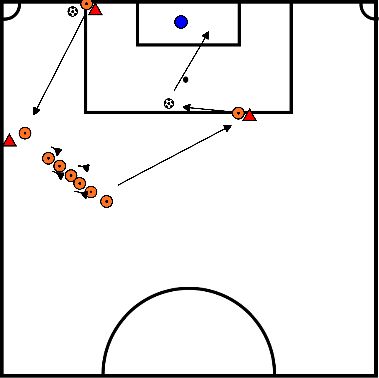
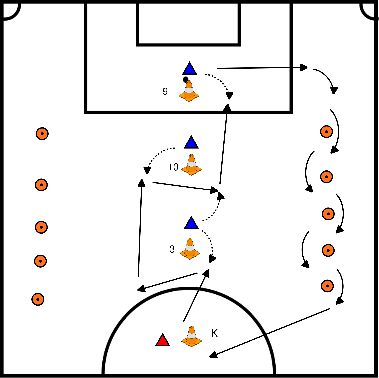
- Player 1 passes the ball to Player 2.
- Player 2 dribbles around the cones and passes at the end to Player 3.
- Player 3 returns the ball to Player 2.
- Player 2 finishes on goal.
- Player 3 retrieves the ball and takes the position of Player 1.
- Player 1 moves to the position of Player 2.
- Player 2 moves to the position of Player 3.
Objective
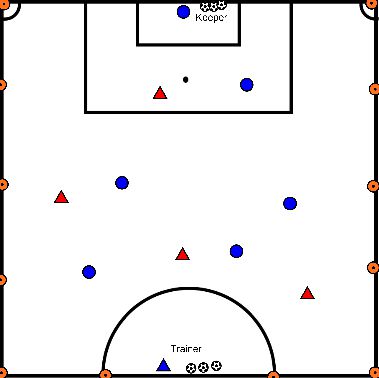
- Teams attempt to score on the goal with the goalkeeper.
- Teams must first earn the right to attack by making a pass with the trainer on the other side of the field.
- There is continuous transition between attacking and defending.
- Players must be alert and coach each other on actions and positions.
- In the event of a goal kick or when the goalkeeper has the ball, the goalkeeper plays to the team that was last defending.
- After a goal, the trainer immediately plays to the team that conceded the goal.
- Minimum width: 25 metres.
- Minimum length: 40 metres.
- Preferably play in a numerical disadvantage or advantage situation.
Execution
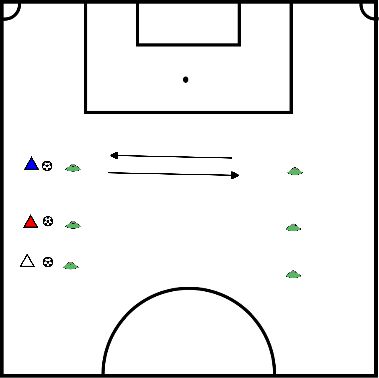
- For each player, place two cones approximately 15 metres apart. This distance can be adjusted as desired.
- The player runs back and forth with the ball around the cone.
- Upon return, the player stops the ball next to the cone.
- Then, the player runs back and forth at a high pace around the cone without the ball.
- The fastest player wins.
- Repeat the desired number of times.
- Try reversing the order: first without the ball and then with the ball.
Warm-up
- The goalkeeper plays to the requesting central defender who drops back.
- The central defender passes back to the goalkeeper.
- The goalkeeper controls with the furthest foot and plays to the requesting attacking midfielder.
- The attacking midfielder controls with the furthest foot and passes back to the central defender.
- The central defender plays to the requesting striker who drops back.
- The striker controls with the furthest foot and turns out.
- The striker slaloms through cones back to the starting position.
- The goalkeeper takes the place of the central defender, the central defender takes the place of the attacking midfielder, and the attacking midfielder takes the place of the striker.
- Ball control with the left foot, pass with the right foot - or vice versa.
- Other technical or warm-up exercise along the cones instead of dribbling.
- The exercise can be applied on both sides.
Execution
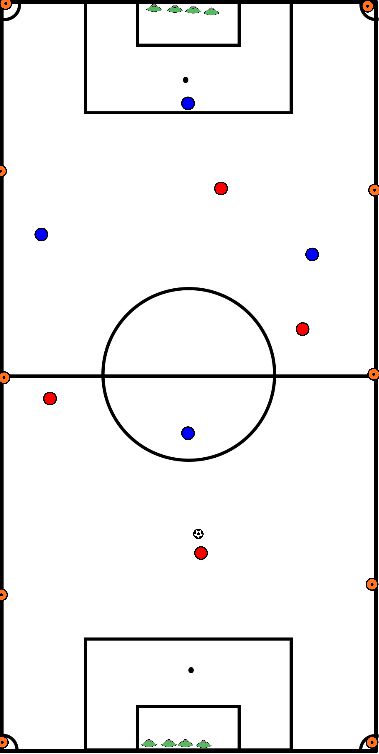
- A variation of the standard match play is executed.
- Behind each goal, there are 4 to 5 cones.
- As soon as team A scores, the scorer takes a cone from behind the goal where the goal was scored.
- The player runs as quickly as possible around the field to their own goal and places the cone there.
- Only after this may the player rejoin the game.
- A natural underload/overload moment arises.
- Players who "cut corners" must turn back, return the won cone, and then return to their own goal from outside the field.
Game Principle
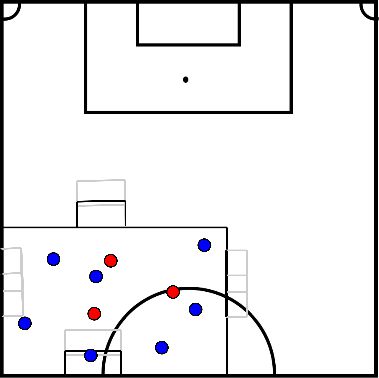
- Upon losing possession, the team must immediately apply pressure on the ball.
- The objective is to regain the ball as quickly as possible.
- The red team plays in possession of the ball.
- The yellow team attempts to take the ball away.
- If the yellow team gains possession, they try to score immediately in one of the four goals.
- The red team must prevent this by applying immediate pressure.
- The field is small to encourage quick attempts on goal.
- Observe whether pressure is applied upon losing the ball.
- Analyse who applies pressure and who does not.
- Assess the intensity of the pressure applied.
- Use small goals if there are no goalkeepers.
- Allow the team with fewer players to score by dribbling out of the field.
- Award points to the team with more players for a number of successful passes.
- Award points to the team with more players if they regain possession without a goal attempt from the team with fewer players.
- Adjust the number of goals.
- Count goals from the team with fewer players as more valuable.
Description
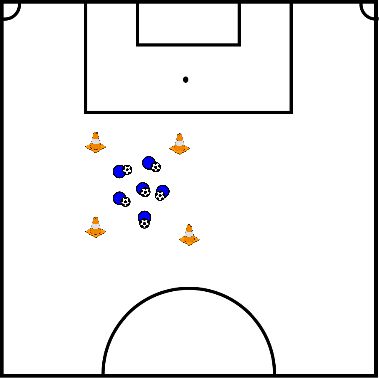
- Players dribble in a rectangle with various cones.
- They must not dribble over the cones and should avoid collisions with other players.
- The coach gives different tasks.
- Dribble with the inside of the right foot.
- Dribble with the inside of the left foot.
- Dribble with the outside of the right foot.
- Dribble with the outside of the left foot.
- Dribble with the ball between both feet.
- On signal, stop the ball with the sole and change direction.
- On signal, dribble to a cone and turn around the cone with the ball.
Formation
- Distances: 8 by 8 metres.
- Variations depending on the number of players and age.
- Ensure players are not too close to each other, but also not too far apart.
- Each player holds a ball in one hand.
- The ball may not be switched from hand to hand; otherwise, the player is out.
- Players move at pace through the area with the ball in hand.
- Try to knock the ball away from the opponent.
- The last player remaining wins.
- Players learn to be aware of their surroundings and opponents.
- Avoiding opponents to retain the ball.
- For advanced groups, this can also be done with the ball at the foot.
Preparation
- Form groups of 2 players, with 1 ball per group.
- The players with the ball stand on the sideline.
- The other players stand opposite them, approximately 6 metres away.
- Player A dribbles forward.
- Player B jogs backward across the field.
- Player A passes the ball to Player B, who passes the ball back to Player A.
- Repeat this until they reach the other sideline.
- Switch roles when the players reach the other side of the field.
- Player A then jogs backward to the starting line.
- Alternate between right foot and left foot.
- Try to apply one-touch passing.
- Focus on quality over speed; it is not a race.
Execution
- Player 1 passes to player 2.
- Player 2 returns the pass to player 1.
- Player 1 plays through to player 3.
- Player 3 returns the pass to player 2.
- Player 2 plays to player 4.
- Player 6 returns the pass to player 5.
- Player 5 plays a deep pass to player 6.
- Player 6 finishes, takes the ball, and joins player 1.
Execution
- Distance from point A to point B is 5 metres.
- Distance from point A to the goal is 5 metres.
- Distance from the cone to line B is 1 metre.
- The size of the goal varies depending on the age; younger players have a larger goal.
- The player dribbles to line A, cuts the ball, dribbles to line B, cuts again, and shoots the ball at the goal.
- The player retrieves the ball and runs around the outside back to the start.
- Cutting with the inside or outside of the foot.
- Cutting behind the standing leg.
- Dribbling with both the left and right foot.
- Dribbling: Touch the ball with each step.
- Make a short turn when cutting.
- At line B, cut so the ball is well positioned to step directly and shoot, without needing to go backwards for a run-up.
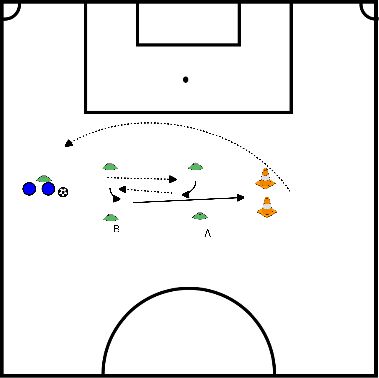
Execution
- Both players A dribble towards the central cone.
- Perform a cutting movement at the cone.
- Pass the ball to the next player.
- After the pass, the player runs diagonally towards player B.
- Player B throws the ball up for player A.
- Player A heads the ball into the goal.
- The player who heads retrieves the ball and stands behind the goal.
- The other player joins the group that needs to perform the movement.