

Soccerexercises for u12
Setup
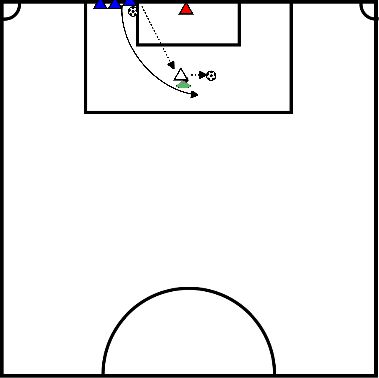
- Players stand on one side of the goal next to the post.
- One wall passer is positioned at the penalty spot.
- The player passes the ball directly to the wall passer.
- The player sprints around the wall passer.
- The player finishes on goal.
- Use a large goal or a small goal.
Formation
- The players position themselves in a circle. Ideally, there are 6 to 8 players per circle. There is only one ball per circle.
- A player passes the ball to another player and follows the ball towards the player he passes to. The second player receives the ball and passes it to another player in the circle, also following the ball. This process continues to repeat.
- Passes must be clear and accurate. The passes are played on the ground, keep the ball low!
- Just after the pass, players accelerate with a short sprint.
- Players call out the name of the player they want to pass to.
- All players are constantly on their toes, not flat-footed, to improve speed of action.
- You can make the game more challenging by applying one-touch play.
- You can play with two balls.
Organisation
- Start with dribbling.
- Then shoot through small gates.
- Via a one-two pass, a cross is delivered which is then shot on goal.
- Depending on the number of players, you can start with 2 balls at positions A and C, or with 3 balls simultaneously.
- Everyone shifts one position each time.
- If necessary, control the ball first.
- Dribble with both feet.
- Do not pass too hard or too softly.
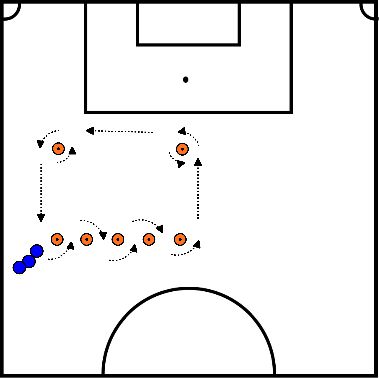
Slalom Between Cones
- Run to the next cone.
- Execution: 2 rounds without the ball as a warm-up.
- 2 rounds with the ball, use both feet.
- 2 rounds with the ball, use only the right foot.
- 2 rounds with the ball, use only the left foot.
- At speed to the free-standing cones.
- Make a circle around the 2 free-standing cones.
Description
- This activity focuses on calling for the ball and movement.
- The setup consists of four players in a line.
- If there are more players, two starting positions can be created.
Execution
- Player A has the ball and passes to Player B.
- Player B must call for the ball before receiving it.
- Player B receives the ball and rotates to Player C.
- Player C calls for the ball, receives it, and rotates to Player D.
- Player D calls for the ball and dribbles back to the starting position.
- Repeat the exercise starting from Player A.
Note
- Call for the ball before passing.
- Ensure a good pass.
- Receive the ball well and rotate.
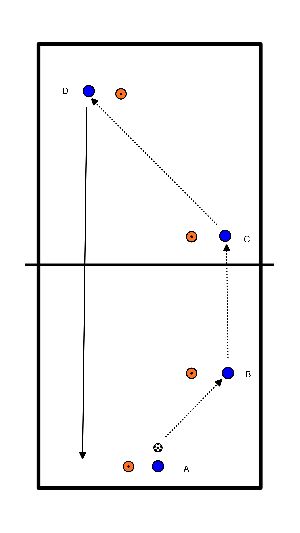
Setup
- Four players in position as shown in the diagram.
- Two players are in line at Player 2's position.
- Player 1 plays the ball to Player 2.
- Player 2 turns and passes to the winger, Player 3, on the right side.
- Player 3 delivers a cross-field pass at the 16-meter mark to the left, to Player 4.
- Player 4 lays the ball off wide, and Player 1 finishes.
- Player 1 moves to Player 2's position, Player 2 moves to Player 3's position.
- Player 3 moves to Player 4's position, and Player 4 retrieves the ball and joins the back of the line.
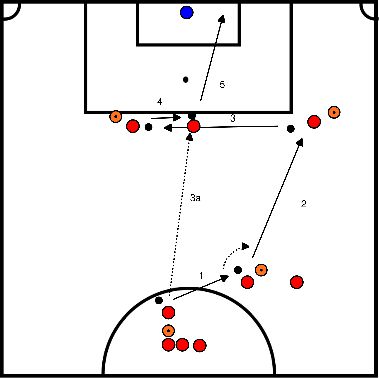
Rules of the Game
- The players play 4 versus 4.
- In the attack, the players must first pass the ball to each other 2 times before they are allowed to score.
- After a period of time, this can be expanded to 3 passes.
- When the ball is intercepted by the opponent, the counting of the passes must start again.
- Scoring is not allowed if there have not been enough passes.
Formation
- The players position themselves in a circle. Ideally, there are 6 to 8 players per circle. Each circle has only one ball.
- A player passes the ball to another player and follows the ball towards the player they passed to.
- The second player receives the ball and passes it to another player in the circle. They also follow the ball towards the player they have just passed to.
- This repeats continuously.
- Passes must be clear and accurate. The passes are played along the ground, keep the ball low!
- Just after the pass, players accelerate (short sprint).
- Players call out the name of the player they intend to pass to.
- All players stand constantly on their toes, not flat-footed, to improve reaction speed.
- You can make the game more challenging by applying one-touch play.
- You can play with two balls.
- Player 1, who has made the pass, must try to tag the receiving player (player 2) before they pass the ball to player 3.
Formation
- Form groups of two players. Each group has one ball.
- Players with the ball stand on the sideline.
- The other players stand opposite them, approximately 6 metres away.
- Player A dribbles forward while Player B jogs backwards.
- Player A passes the ball to B, who passes it back to A.
- Repeat this until the other sideline is reached.
- Switch roles when the other side of the field is reached.
- Player A walks backwards to the starting line.
- Alternate passes between the right foot and the left foot.
- Try to use one-touch passing; only if necessary, the ball may be touched twice.
- Focus on quality over speed; it is not a race.
- Encourage successes!
- Play the ball to the thigh, bring under control, and volley back.
- Play the ball to the chest, bring under control, and volley back.
- Play the ball to the head, head the ball back.
Objective
- Teams attempt to score on the goal with the goalkeeper.
- Teams must first earn the right to attack by making a pass with the trainer on the other side of the field.
- There is continuous transition between attacking and defending.
- Players must be alert and coach each other on actions and positions.
- In the event of a goal kick or when the goalkeeper has the ball, the goalkeeper plays to the team that was last defending.
- After a goal, the trainer immediately plays to the team that conceded the goal.
- Minimum width: 25 metres.
- Minimum length: 40 metres.
- Preferably play in a numerical disadvantage or advantage situation.
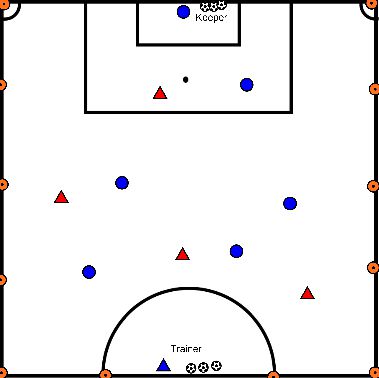
Execution
- For each player, place two cones approximately 15 metres apart. This distance can be adjusted as desired.
- The player runs back and forth with the ball around the cone.
- Upon return, the player stops the ball next to the cone.
- Then, the player runs back and forth at a high pace around the cone without the ball.
- The fastest player wins.
- Repeat the desired number of times.
- Try reversing the order: first without the ball and then with the ball.
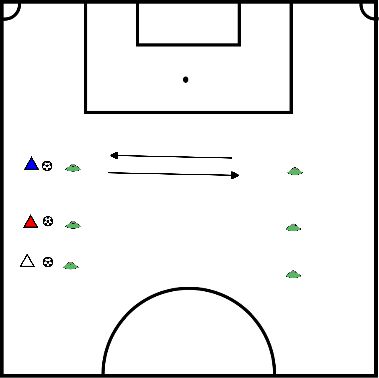
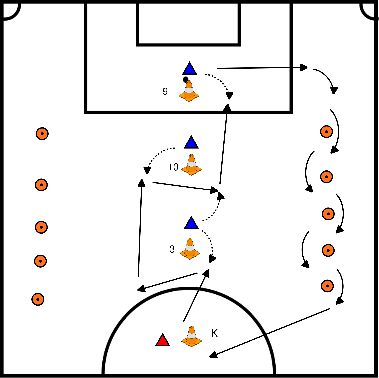
Warm-up
- The goalkeeper plays to the requesting central defender who drops back.
- The central defender passes back to the goalkeeper.
- The goalkeeper controls with the furthest foot and plays to the requesting attacking midfielder.
- The attacking midfielder controls with the furthest foot and passes back to the central defender.
- The central defender plays to the requesting striker who drops back.
- The striker controls with the furthest foot and turns out.
- The striker slaloms through cones back to the starting position.
- The goalkeeper takes the place of the central defender, the central defender takes the place of the attacking midfielder, and the attacking midfielder takes the place of the striker.
- Ball control with the left foot, pass with the right foot - or vice versa.
- Other technical or warm-up exercise along the cones instead of dribbling.
- The exercise can be applied on both sides.