



Soccerexercises for u14
- Positional defending needs to be very good
- Forcing opponent to play wide
- Take away the ball
- Defend close to each other / mutual distances
- Recognize the right moment to attack the ball
- Active defense
- Game can move under pressure of the defenders
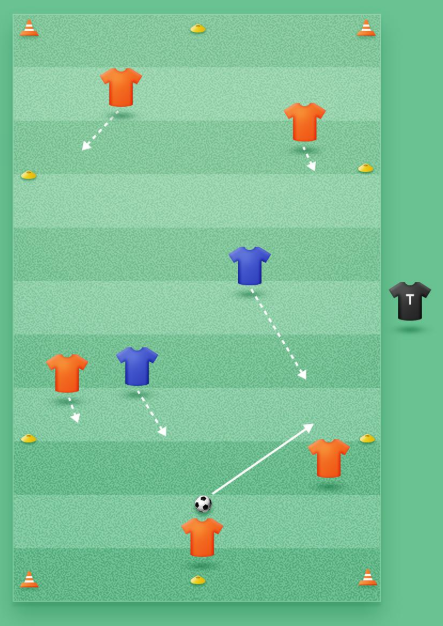
- Player 1 and Player 2 start dribbling at the same time.
- At the end they pass through pawns to the other side.
- The next player receives the ball and starts dribbling.
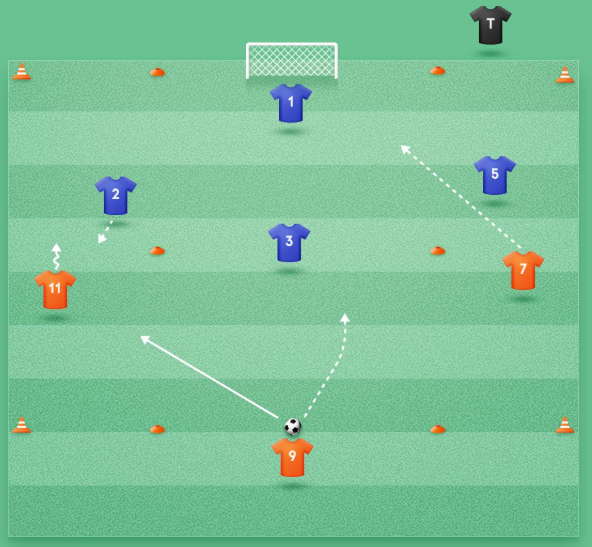
- Attackers can score in a big goal
- Defenders must intercept the ball ( prevention of goals)
- The middle player of the attackers starts with the ball and plays the ball to one side
- On the side, the outside player plays one-on-one with the defender, a cross follows with the center attacker and the outside player from the other side closing in on the goal.
- If the defenders get rid of the ball, the attackers turn and a new attacker plays the ball to the other side.
- When the defenders have intercepted the ball three times, the defenders switch between them
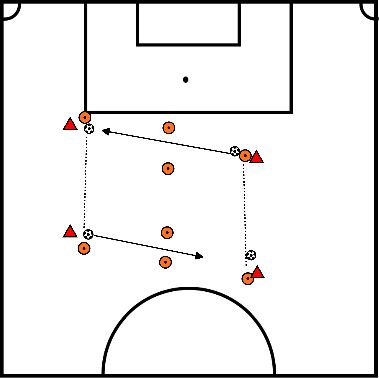
- The idea is to be able to play a game in corona time.
- The idea comes from a table soccer game
- Each player has his own space they are not allowed to leave.
- By passing, the ball can be brought to the other player
- Defense is allowed as long as it remains in his/her own discipline.
- The field can be adjusted to the number of players
Further goals:
- Passing
- Positioning game
- Shooting Distance
- The exercise can be made more difficult by making the game faster
- By only hitting the ball 2 or 3 times and playing quickly
- After all, during a match you don't have that much time either
- Walk over the field in 2 numbers.
- Both players hold one end of a rope (1.5 meters).
- Once the attacker determines the pace and direction.
- As soon as the rope is released when it comes to tension, the attacker has a point.
- Defender may only hold the rope loosely.
- All players jog in over the field (square)
- Half the number of players has a ball
- players with ball pass the ball to a player without ball (eye contact).
- The players are not allowed to keep the ball with them for longer than 5 sec.
- At the moment the trainer whistles (signal), all players without a ball sprint as fast as possible to the closest player who has a ball and try to take it away.
- The player who has the ball should try to fence it off. (1:1 duel)
- When the trainer blows the whistle again we switch back to jogging and passing!
Nice variant is when you have an odd number of players, the player who can't find a direct opponent gets a command (for example sprint over the width of the field).
- The players line up in a circle,
- Ideal is 6 to 8 players per circle.
- Per circle you only have one ball.
EXECUTION:
- A player plays the ball to another player, chasing the ball towards the player he is playing.
- The second player receives the ball and plays it back to another player in the circle,
- He, too, will chase the ball towards the player he has just played in.
- This keeps repeating itself.
QUALITY:
- Passes must be clear and accurate.
- The passes are played over the ground, keep the ball low!
- Just after the pass the players accelerate (short sprint)
- Players call the name of the player they want to play in
- All players constantly stand on their toes, not on flat feet, to improve the speed of action.
PROGRESS:
- You can make the game more difficult by hitting once.
- You can play with two balls
- Player 1, who has given the pass, should try to tap the player who has played the pass (player 2) before playing the ball to player 3, etc.
Set up your team in 2 lines (4-5 per line max) - only 1 ball needed.
IMPLEMENTATION:
- Players take the ball and then play it to the first person in the line opposite to them. Immediately after the pass they draw a sprint and close the back of the line they just played in. This is repeated over and over again.
QUALITY:
- Players are all on their toes ready for the pass.
- Passes are clear and accurate.
- Players must shout if they want the ball to play, and also shout the name to whom they are passing again.
- With the first ball contact they bring the ball under control, the second ball contact is the pass to the other player.
PROGRESS:
- Apply only one pass.
- Let one line pick up the ball and throw it back to the other line. They will then play the ball back with a volleypass and then simply join the other line.
- Let players take the ball with their thigh and bring it under control after which they pass the ball back over the ground.
- Place a pawn 5 meters on either side of the central point between the 2 lines. After the pass, the players have to walk around the pawn after which they connect in the row.
- Split your team into four teams of four
- 1 ball per team
IMPLEMENTATION:
- Players play the ball around within their team of four in the area that was put out
QUALITY:
- Players are constantly moving, with many tempo changes to find space.
- Each team must try to maintain a diamond shape
- Players must all communicate with teammates, the ball must be asked for and the player's name must be called by the person who is playing the ball.
- Passes should arrive well, in space or in the feet.
- Players should not touch each other, nor should the balls touch each other.
- This exercise requires great vigilance on the part of the players.
PROGRESS:
- Add a passive defender who can defend any ball.
- Add a defender who can conquer the ball.
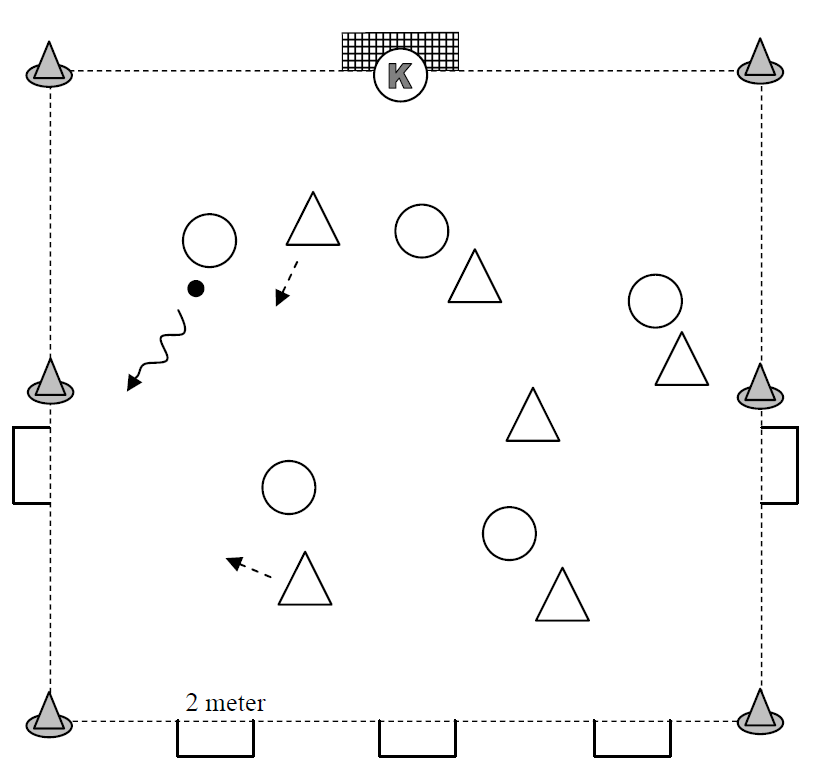
Organization:
There will be 6 against 5 + goalkeeper.
If the party that has to score on the big goal has lost the ball, they have to defend 5 goals.
After 15 minutes of changing halves.
Remarks:
If the attackers of the triangle game lose the ball, it can very quickly result in a counter-goal.
Especially the players who don't play in the league games can't like this kind of game.
Points of attention:
Cover the man in time.
Do not go in recklessly.
Cover on the good side.
Posture during the duels, through the knees.

Organization:
There is 3:3 played. Without goalkeepers.
On the goal of 7 meters may only be scored from the 16 meters area.
The other party can score on the 2 goals, from any position.
If the ball goes out at the sides, it is restarted with a kick.
After a goal or if the ball passes the backline, the game is restarted on the back line of the offensive team (triangles).
There will also be 2 new defenders and 3 new attackers in the field.
Points of attention:
Fierce defending before they are in the 16 meter area.
Make the field small when defending.
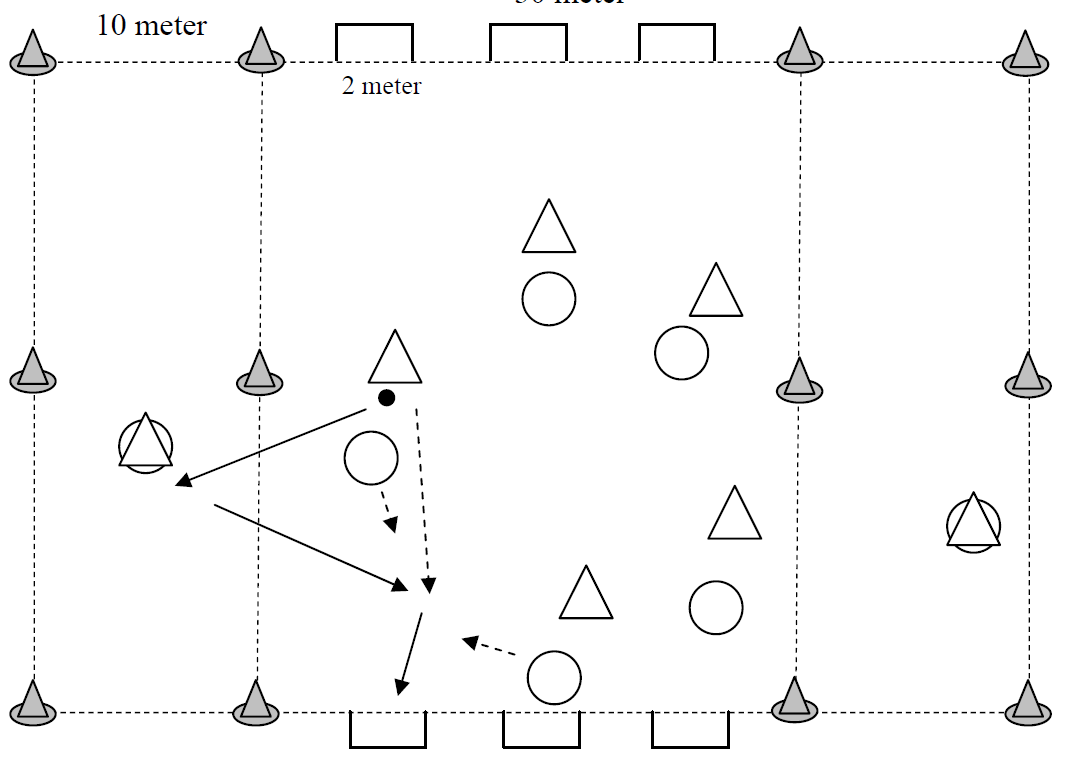
Organization:
There will be 5:5 or 4:4 with extra players on the sides, the wingers. These 2 players are with the ball owning team.
The wing players may dribble with the ball first.
After a few minutes they have to play immediately.
The players on the sides are not allowed to score.
After 10 minutes or a little less the offside players change.
Remarks:
Players sometimes find it better to keep their own man, than to prevent a goal by stepping in or covering an opponent standing closer to the goal. Let them do it wrong a few times first. Use these situations later to give them directions.
Points of attention:
Do they know how their fellow players stand when they have to defend?
Don't let anyone release his marked man.
Stand between the opponent and the goals.
Have them positioned so that they can see the opponent and the ball.