



Soccerexercises for u15
Execution
- Pass the ball and move quickly.
Field Setup
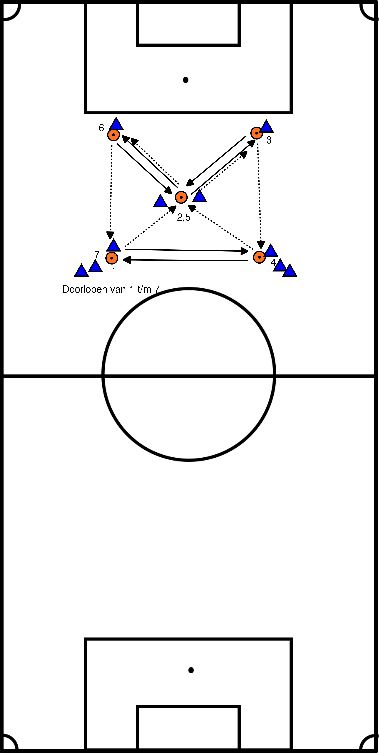
- Mark out a field with four cones, 10 by 10 metres.
- Divide the players into two groups. One group moves horizontally from left to right. The other group moves vertically from bottom to top.
- At the whistle signal, players return to their starting position.
- Players must not touch each other or the ball of another player. In case of contact, both the player and the one who is touched receive a penalty point.
- Crossing is only allowed at the whistle signal from the trainer.
Setup
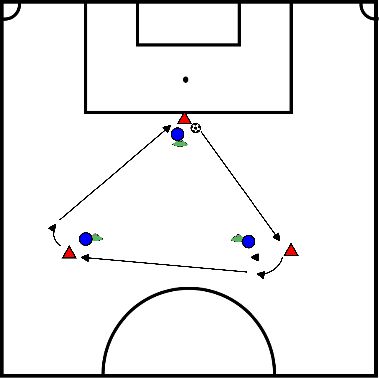
- Place three cones as reference points in a triangle.
- Players stand in pairs at each cone.
- The rear player performs the exercise.
- The player gets open from the player in front.
- A firm, hard pass is given along the ground.
- The receiver controls the ball with the furthest foot and passes to the next player.
- After the pass, the player sprints to the cone where they passed the ball.
- The player takes position in front of the player still standing there.
- Accurate and firm passing.
- Good one-touch ball control.
- Getting free from the defender.
Setup
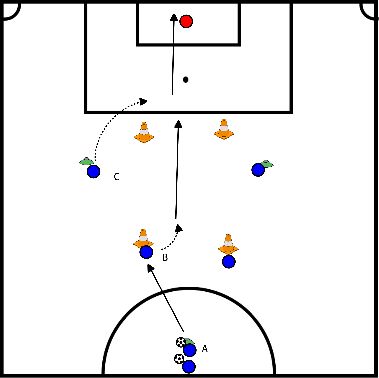
- Large cones are placed 3 meters outside the penalty area.
- Player C stands 10 meters outside the penalty area.
- The distance between C and B is 10 meters.
- The distance between B and A is 5 meters.
- Large cones act as opponents.
- Player A passes the ball to player B.
- B turns away from the opponent towards the inside and plays a through pass between the defenders into the running path of C.
- Player C finishes on goal.
- After the action, A becomes player B, B becomes C, and C retrieves the ball and joins the back of the line.
- The exercise then starts on the other side.
- Ensure that player C does not leave too early to avoid being offside.
- Do not leave too late, otherwise the goalkeeper can easily collect the ball.
Objective
- Practise switching sides during a match.
- Quickly transition from defending to attacking.
- Set up the goals with different coloured cones.
- Adjust the field size as desired, depending on the number of players.
- Form two teams; playing with a numerical disadvantage or advantage is possible but not necessary.
- Emphasise teamwork, not individual scoring.
- Start with a passing round, then call out a colour of a cone and they must score there.
- Continue scoring at that goal until a new colour is called.
- Begin with a new colour every 30-60 seconds, increase the pace if it goes well.
- Add an extra dimension by passing the ball in from the side when the ball is out.
- Players must come to the ball, otherwise the ball is not played.
- Adjust the level of difficulty to the team's level.
Content
- Player 1 walks backwards and underhand throws the ball to the head of Player 2.
- At the other side, the roles are reversed.
- Player 2 walks forwards towards the ball and heads it into the hands of Player 1.
- Practice both heading, throwing at knee height, and executing a dropkick.
- A dropkick is passing the ball with the instep shortly after the ball has hit the ground.
- Work in pairs with one ball.
- Throw gently.
- The player walks into the ball, which is easier than the opposite.
- Keep the distances small.
- Player 2 must walk backwards and throw the ball underhand.
- Ensure at least four cones or markers are present.
- Make sure there are no obstacles on the field.
- Demonstrate and check the technique of heading, passing at knee height, and the dropkick for correct execution.
Setup
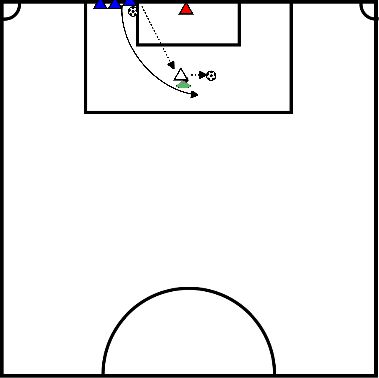
- Players stand on one side of the goal next to the post.
- One wall passer is positioned at the penalty spot.
- The player passes the ball directly to the wall passer.
- The player sprints around the wall passer.
- The player finishes on goal.
- Use a large goal or a small goal.
Formation
- The players position themselves in a circle. Ideally, there are 6 to 8 players per circle. There is only one ball per circle.
- A player passes the ball to another player and follows the ball towards the player he passes to. The second player receives the ball and passes it to another player in the circle, also following the ball. This process continues to repeat.
- Passes must be clear and accurate. The passes are played on the ground, keep the ball low!
- Just after the pass, players accelerate with a short sprint.
- Players call out the name of the player they want to pass to.
- All players are constantly on their toes, not flat-footed, to improve speed of action.
- You can make the game more challenging by applying one-touch play.
- You can play with two balls.
Organisation
- Start with dribbling.
- Then shoot through small gates.
- Via a one-two pass, a cross is delivered which is then shot on goal.
- Depending on the number of players, you can start with 2 balls at positions A and C, or with 3 balls simultaneously.
- Everyone shifts one position each time.
- If necessary, control the ball first.
- Dribble with both feet.
- Do not pass too hard or too softly.
Description
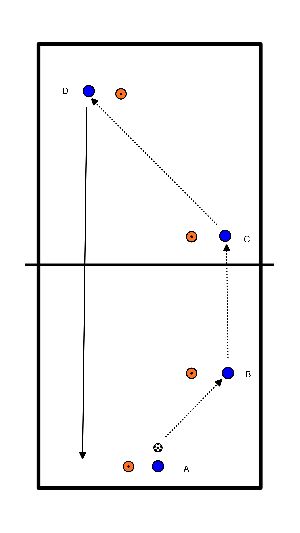
- This activity focuses on calling for the ball and movement.
- The setup consists of four players in a line.
- If there are more players, two starting positions can be created.
Execution
- Player A has the ball and passes to Player B.
- Player B must call for the ball before receiving it.
- Player B receives the ball and rotates to Player C.
- Player C calls for the ball, receives it, and rotates to Player D.
- Player D calls for the ball and dribbles back to the starting position.
- Repeat the exercise starting from Player A.
Note
- Call for the ball before passing.
- Ensure a good pass.
- Receive the ball well and rotate.
Setup
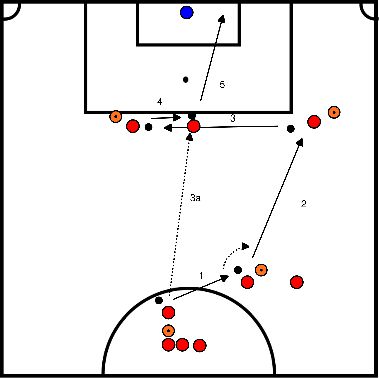
- Four players in position as shown in the diagram.
- Two players are in line at Player 2's position.
- Player 1 plays the ball to Player 2.
- Player 2 turns and passes to the winger, Player 3, on the right side.
- Player 3 delivers a cross-field pass at the 16-meter mark to the left, to Player 4.
- Player 4 lays the ball off wide, and Player 1 finishes.
- Player 1 moves to Player 2's position, Player 2 moves to Player 3's position.
- Player 3 moves to Player 4's position, and Player 4 retrieves the ball and joins the back of the line.
Formation
- The players position themselves in a circle. Ideally, there are 6 to 8 players per circle. Each circle has only one ball.
- A player passes the ball to another player and follows the ball towards the player they passed to.
- The second player receives the ball and passes it to another player in the circle. They also follow the ball towards the player they have just passed to.
- This repeats continuously.
- Passes must be clear and accurate. The passes are played along the ground, keep the ball low!
- Just after the pass, players accelerate (short sprint).
- Players call out the name of the player they intend to pass to.
- All players stand constantly on their toes, not flat-footed, to improve reaction speed.
- You can make the game more challenging by applying one-touch play.
- You can play with two balls.
- Player 1, who has made the pass, must try to tag the receiving player (player 2) before they pass the ball to player 3.