



Soccerexercises for u16
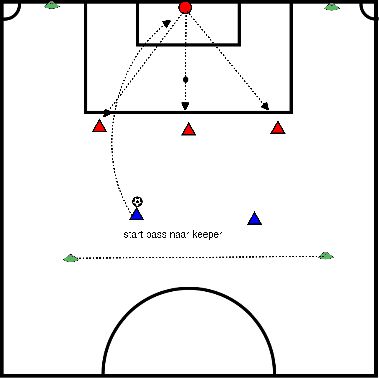
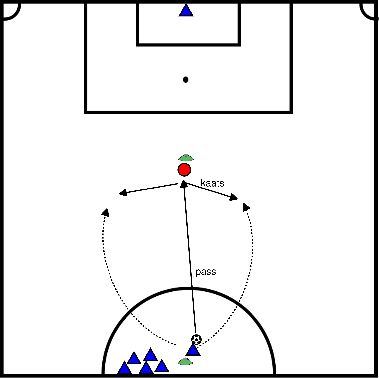
2 attackers against 3 defenders and goalkeeper.
In other group size 3 against 4 or 2 against 1 and so on.
Goal: The goal of the assignment is to have the goalkeeper play the ball into one of the 3 defenders.
In other group size 3 against 4 or 2 against 1 and so on.
Goal: The goal of the assignment is to have the goalkeeper play the ball into one of the 3 defenders.
- The ball starts with the 2 attackers. They play the ball deep to the goalkeeper to have a realistic start.
- The goalkeeper can catch the ball, take it and so on.
- The three defenders must constantly be on the ball.
- The goalkeeper tries to get the ball to one of the three defenders
. - The attackers' task is to block as early as possible to make the build-up by the defenders difficult.
- The task of the defenders is to get the ball over the line by means of play/construction, then again from the start.
When the 2 attackers capture the ball, start again.
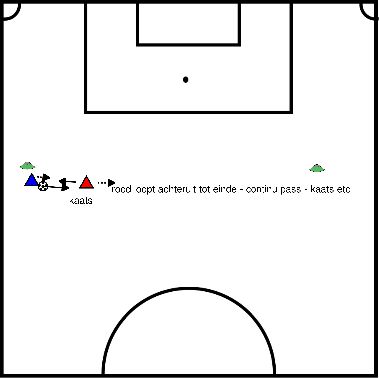
- 2 players
- Player 1 rebounds ball to player 2 whereby player 2 runs backwards and player 1 forwards.
- Once across turn around so player 1 is running backwards.
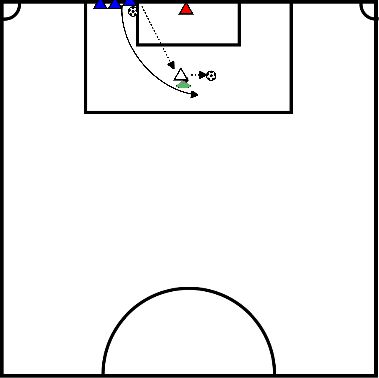
- Players on 1 side of goal next to post.
- 1 handball at the height of the penalty spot.
- Player must pass tightly around the handball and sprint to finish.
Option: big goal or small goal.
- Pass in from the center line, indicate where you want the ball to go, left or right, and shoot low in own corner right legged/right corner - about 5 times.
- Passing in from the center line, indicate where you want the ball to go and shoot controlled high into own corner, right legged/right corner - about 5 times.
- Passing in from the center line and free angle and free power - About 5 times.
Option: big goal or small goal
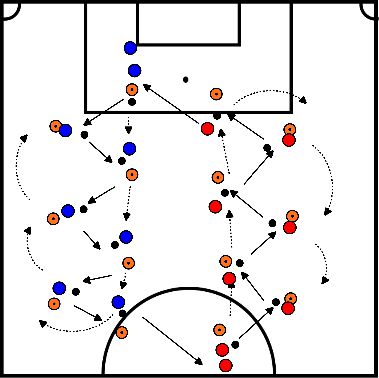
- Place pawns as on the plate
- Start from both sides at the same time
- Player makes 1-2 runs with players near the cones
- The last one he passes to the other starting point
- Start player goes to last pawn and the rest moves on
- Place pawns as on the picture
- Pass, handball and finish in several variants.
- Pay attention to the run-in, turn-out and correct speed and direction.
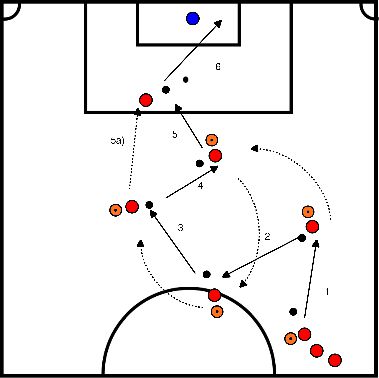
- Stand in diamond shape as shown
- Pass the ball at the right speed and on the right leg
- Run after the ball where you passed it
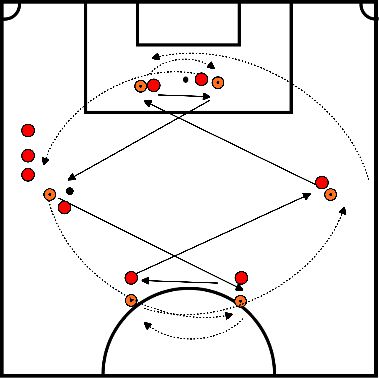
- Put pawns as on picture
- Quick passes and chase the ball. Bounce the ball several times and pass at the right speed and direction
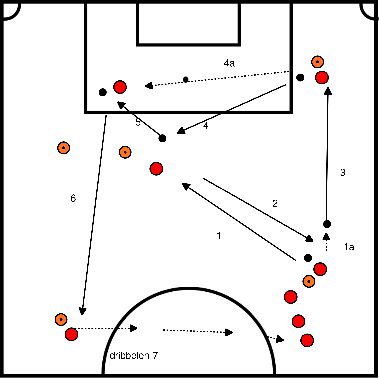
- Player 1 passes the ball to player 2
- Player 2 dribbles around pawns, passes to player 3 at the end
- Player 3 passes ball to player 2, player 2 finishes the game
- Player 3 gets ball, goes on spot
- Player 1 stand
- Player 1 to player 2
- Player 2 to player 3
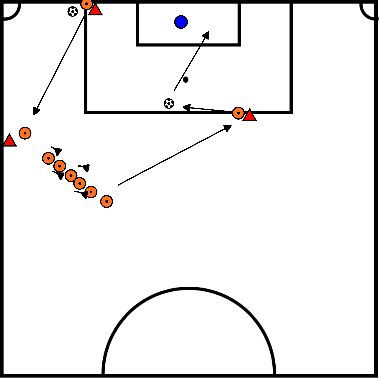
- See picture for exercise
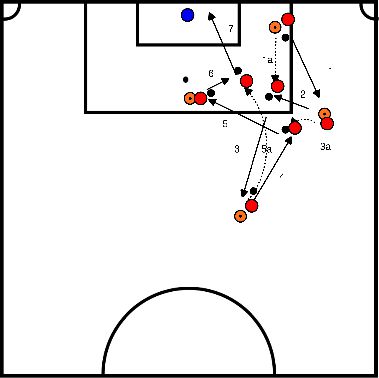
Finish on a mini-goal with both feet
- At the first cone you give a pass to the player on the right, who controls the ball and passes it to the centre.
- If the teammate is on the left, finish with the right foot,
- If the team-mate is on the right, you finish with your left foot.
Passing on:
- Player who was allowed to finish passes on to rebound, player who rebounds passes on to finish.
Equipment:
- 3 bowls
- 1 mini goal
- One ball per player
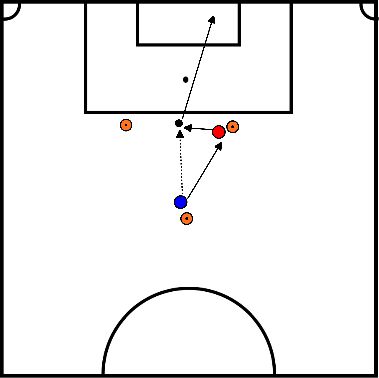
Many goalkeepers have great difficulty setting up a wall correctly Often the situation is hectic and no agreements have been made beforehand about how to set up the wall. It is of the utmost importance that you do this and that you remain calm when facing a dangerous free kick. Here are some agreements that you, as the goalkeeper, should make with your defenders
1) You have an agreement with one of the players that he, together with you, will place the wall. He/She is the player on the outside of the wall. This player stands on the side of the short corner.
1) You have an agreement with one of the players that he, together with you, will place the wall. He/She is the player on the outside of the wall. This player stands on the side of the short corner.
This player stands 9 metres from the ball and turns round to face you. You are standing against the inside post at the short corner. You therefore have eye contact and use hand movements to guide him/her to the left or right We call this player the beacon. The marker turns back to face the ball when you indicate that he is facing the right way. The other players close up against the beacon.
2) In the wall, place your longest people in the middle of the wall. It is often the case that a curled ball is placed over the middle of the wall in the cross. So by putting the longest players in the middle it becomes more difficult for the opposing team to curl over the wall.
3) The number of players you put in the wall depends on how far the free kick is from your goal. You can use the following rule:
- Distance 16 to 18 metres: 6 defenders (this free kick is not so dangerous. Over the wall is almost impossible because the distance is too short, so there is a good chance that the defender will try to shoot into the long corner. Concentrate on the long corner)
- Distance 19 - 22 metres: 5 defenders (this is the most dangerous free kick, as it can go both into the short and long corners)
- Distance 22 - 28 metres: 3 defenders
- Distance more than 28 metres: no wall
4) For an indirect free kick, the outside player runs out and tries to block the ball. This player is not the beacon but the player who covers the long corner.
5) Jumping from the wall is only allowed for free kicks from 19 to 22 meter. At these free kicks the risk of a curled ball is the biggest. Make sure they don't jump too high, because then there is a risk they will shoot under the wall and you won't have a chance. It is therefore no more than a hop that the wall can make.
6) The wall will always remain closed. The players in the wall are not allowed to turn their backs to the ball Therefore, it is preferable that they stand on one side of the body with their arms together and remain standing until the free kick is taken. In this way, the wall remains closed and the players cannot turn.
7) Speak to the defenders, who are not in the wall, that they will walk with the ball back to your goal. This will enable them to clear any loose balls.
8) You are never in the middle of the goal* At a free kick, you stand towards the long corner, about 1/3 of the way. Furthermore, you stand behind the line, you can make the rule that the tip of the shoe touches the line This will increase your reaction time and give you a better chance of stopping the ball going past the wall. Furthermore, you are standing on your front feet.
The further away the free kick is from the centre, the closer you will be to the centre of the goal