



Soccerexercises for u17
- The players try, dribbling with a ball, to dribble from their pawn to the middle square (the pond) and back.
- The player(s) in the box (crocodile) tries to keep the ball out of the box (pond) by picking it up or tapping it away. If the ball is touched, first go back to the pawn where you started.
- If the player succeeds in returning to the box without the ball being touched by the crocodile, he may place a hat on his pawn. The player who is the first to have five hats on his pawn is the winner.
Size: depending on age and skill.
Length: 30 metres.
Width: 20 metres.
- All players start with a ball and dribble through the box.
- The players try to keep the ball inside the box and not collide with each other.
Size: depending on age and skill.
Length: 20-25 metres.
Width: 15-20 metres.
Attacking: Score goals.
- Dribble through the box (“try to keep the ball close to youâ€).
- Try to dribble where there are no other players.
- Stay active.
- All players start with a ball, except the defender. The defender tries to take or knock balls away from the other players.
- The defender counts how many balls he has taken or tapped away. After a certain time, the defender will be changed.
Size: depending on age and skill.
Length: 20-25 meter.
Width: 15-20 meters.
Attacking:
Score goals.
- Dribble through the box.
- Staying active.
Defence:
Preventing goals and conquering the ball.
- Take away the ball.
- Staying active.
- All players start with a ball and dribble through the box.
- The players try to keep the ball inside the box and not collide with each other.
Size: depending on age and skill.
- Length: 20-25 metres.
- Width: 15-20 metres.
Material:
• Every player one
Attacking: Scoring goals.
- Dribble through the box (try to keep the ball close to you).
- Try to dribble where there are no other players.
- Stay active.
- Half of the players start with a ball, the other players try to conquer the balls.
- The players who lose a ball, try to conquer another one.
Size: depending on age and skill.
Length: 20-25 meters.
Width: 15-20 meters.
Attacking:
Score goals.
- Dribble through the box.
- Staying active.
Defence:
Preventing goals and conquering the ball.
- Take away the ball.
- Staying active.
- All players start with a ball and dribble through the box.
- The players try to keep the ball inside the box and not collide with each other.
- The players with the ball can score points by dribbling through the small goals, not being allowed to dribble through the same small goal twice in a row.
depending on age and ability.
Length: 20-25 metres.
Width: 15-20 metres.
Goal Scoring.
- Dribble through the box (“try to keep the ball close to youâ€).
- Try to dribble where there are no other players.
- Stay active.
- All players start with a ball and dribble through the box. The defender tries to take or knock balls away from the other players.
- The defender counts how many balls he has taken or tapped away. After a certain time, the defenders are changed.
- The players with the ball can score points by dribbling through the small goals. They are not allowed to dribble through the same small goal twice.
Size: depending on age and ability.
Length: 20-25 metres.
Width: 15-20 metres.
Goal Scoring.
- Dribble through the box (“try to keep the ball close to youâ€).
- Try to dribble where there are no other players.
- Keep participating actively.
- All players start with a ball and dribble through the box.
- The players try to keep the ball inside the box and not collide with each other.
Size: depending on age and ability.
Length: 20-25 metres.
Width: 15-20 metres.
Attacking: Score goals.
- Dribble through the box (“try to keep the ball close to youâ€).
- Try to dribble where there are no other players.
- Stay active.
Team task:
Structure
Purpose:
Improve assumption to "move" opponent
Organisation:
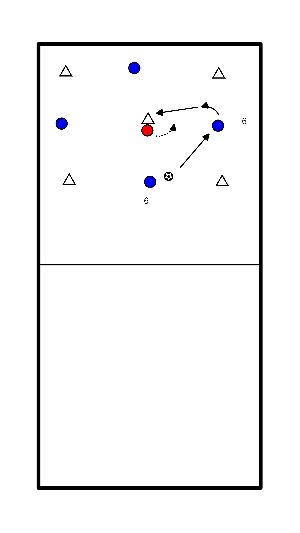
- Positioning game 3/4x1 in square box of 6x6.
- pawn in the middle, team ball-possession must shoot this pawn for points, defender must prevent this.
- Each player in team ball-possession is on one side of the square.
- A player may only defend by intercepting a pass on a pawn.
- Match/fun element can be reinforced by agreeing that the person with the most points has won after 5 minutes, the rest must for example do 10 push-ups or sprints.
- Can be made more difficult by the fact that attacking party has to score in 10 passes.
Coaching:
Direction in assumption to "move" opponent, freeing up space to play towards pawn.
1.5 metres:
- Because the defender is only allowed to intercept passes, there are no duels.
- Furthermore, perimeter ensures that players in team ball-possession do not come closer than 1.5 metres.
- the shape also invites players to keep the pitch as large as possible.
Team task:
Building up
Purpose:
Improve deep play at the right moment.
Organisation:
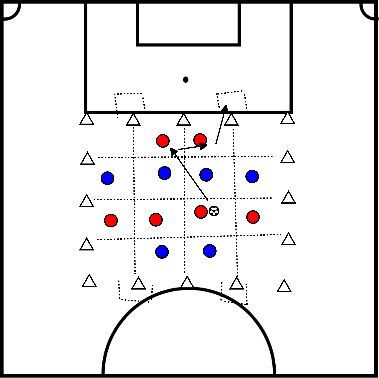
- Field of e.g. 30x30,
- Divided into 16 compartments.
- On the 2 sides
- 2 goals.
- 2 teams of 6.
- 2 players per team are divided over 4 boxes at the back,
- 4 players all have their own square.
- There is a box with defenders between the two parts of the team.
- Four must reach the duos, the duos can score in goals (see picture).
- More difficult:
- A maximum of 10 passes.
- See picture.
- 1.5 metres: boxes prevent players from duelling with each other or getting close to each other.
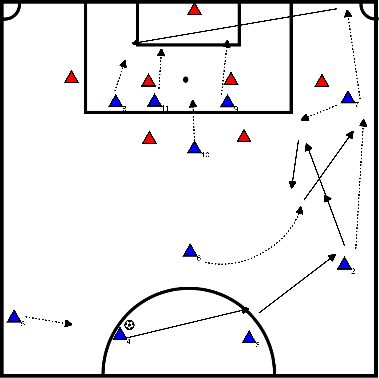
- Defence to attack in a 1-4-4-2.
- The running forms of the attack and defence are important here.
- Form two of the two where the focus is on the outfielder 7/8 creates space for the 2/5 .
- Here the six of the bb game is used to give the through ball.
- The exercise can be done without or with resistance.
- In the case of the ball owning party it is important that they do not play the ball directly on the 7/8 but first move the ball for some time between 3->4 4->5, where five gets up high as soon as the ball goes from two to three.
- When five receives the ball do not play directly to the eight but first back to the four.
- From four to three and from three to two.
- Allow the defence to pass the right running lines at the right time before they play the ball to the 7/8.
- As soon as the ball goes from the two to the seven, pay attention to the correct running lines of the seven.
- Creating space for the two is done by letting the seven get into the ball and bouncing the ball to the six.
- After bouncing from the two to the seven the two has to make a run in the deep.
- The seven bounces the ball onto the six that comes under the ball.
- The six then plays the ball deep on the two with the nine running to the first post, the eleven behind the nine and the eight around the second post in an oblique line behind the eleven and nine.
- Ten comes on the sixteen-metre line and the seven diagonally behind the two.
Drafting:
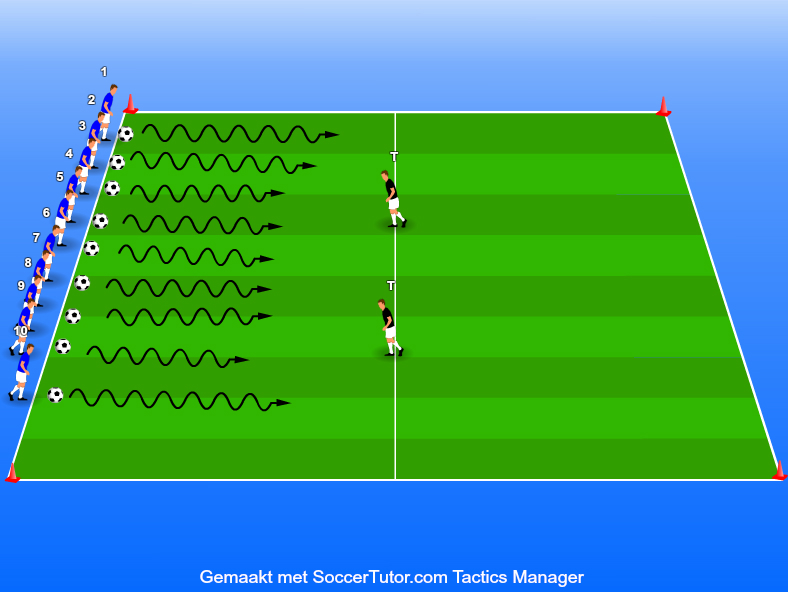
- Field of 10m by 10m
- 1 or 2 magic trees (trainers) in the middle.
- 1 ball per player.
- Task 1:
- Players walk from one side of the magic forest to the other.
- Without losing the ball.
- Task 2:
- Players walk from one side of the magic forest to the other.
- Without losing the ball.
- But watch out; the magic trees have woken up.
- And moving through the forest.
- Task 3:
- Players walk from one side of the forest to the other.
- Without losing the ball.
- But beware; the magic trees have woken up by a storm and are moving through the forest.
- But there are also branches and leaves everywhere.