

Soccerexercises for u9
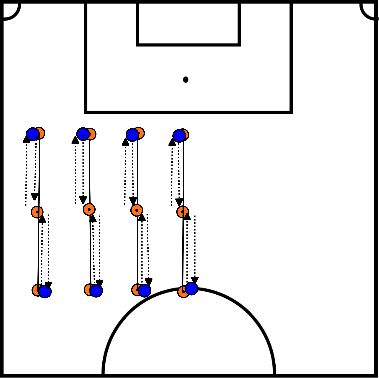
- Players work in groups of 4.
- Each quartet has a captain who says when the group leaves by shouting "go".
- Perform dribble exercises with foot and side indicated.
- First exercises 1, 3 and 5, then 2, 4 and 6
- 1: left quick float (hit a lot of ball)
- 2: right quick float (hit a lot of ball)
- 3: left fast float, in the middle stop and go (hit a lot of ball)
- 4: right fast float, in the middle stop and go (hit a lot of ball)
- 5: drag left, in the middle stop and go and drag right
- Note: at the end of each drill, players perform a drag to the next gate
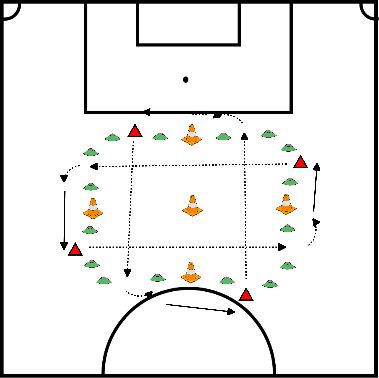
- Players are divided into equal groups.
- Each group tries to dribble the ball through the poles as fast as possible.
- The last one of each group must pick up the ball and stop it on the cone.
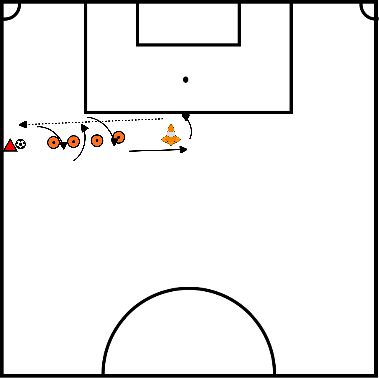
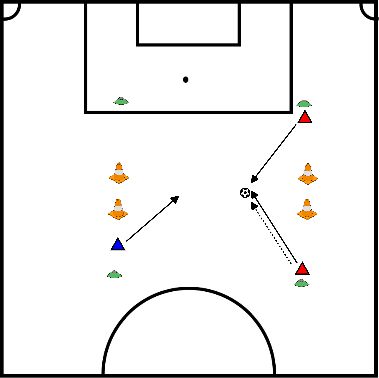
- Small field with small goals or cones.
- Player 1 moves with the ball from the corner point to a point on the field and leaves the ball there.
- Player 2 goes to pick up the ball and player 3 responds by defending.
- There is a 2v1
- At all outer pawns a player stands with ball
- At the signal of the coach they dribble to the pawn in the middle where they make a cutting move and dribble back again.
Variations
- 1. Dribble to the centre with the right and cut with the right
- dribble back with the left hand side and chop with the left hand side
- 2. Dribble to the centre with right hand and cut with right hand.
- Dribble back slowly
- 2nd time with left to the middle and right to cut,
- dribble back slowly,
- so alternate every time.
Trainer can indicate how many times he wants the players to do a certain cut (in both variations) or he can make the players dribble at the same time (in the 2nd variation)
Types of cutting movements:
Types of cutting movements:
- Inside foot tap
- Outside foot tap
- Stop turn
- Cruijff turn
- Pivot turn
- Step, following outside
- Step, follow on the inside
- Scissors, follow outside
- Double scissors, behind standing leg
- Elijah
- Reverse Elijah
- Roll-over
- Okocha cap
Explanation:
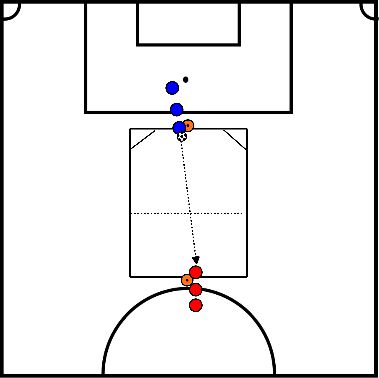
- The 2 slanting continuous lines are 2 mini goals
- The dotted line is the 'middle line' to get the right of attack.
- 4 to 8 players, in 2 teams or each player for himself
- Team/player with most points after a certain time/ number of points wins
Aim of the game:
- Blue plays the ball in to red
- Red has to dribble over the centre line to score in 1 of the 2 goals
- If he scores, he gets a point
- If blue takes the ball away, he can also score and thus gets a point
- When a point is scored or the ball is out both players join the other row and the next 1v1 starts.
Important:
- This exercise is about making an action.
- Therefore choose a certain move that the attackers can use to get past the defender
- If the attacker does this and scores from it: 2 points.
- The defender can never get more than 1 point when he scores.
- The attacker only gets 2 points if he passes the defender with this move
- if he already passed and then makes the move, he gets only 1 point
Variations:
Movements which can be trained are:
- Single scissors
- Double scissors
- Step over
- Zidane-turn
- Elastico/akka
- Reverse elastico/akka
- Iniesta/La croqueta
- Ball roll + Ronaldo chop
- Drag 'n roll
Focus points:
- Attacker's take: at least forward for speed in the attack
- Preferably sideways so that he is already running towards one goal and also creates space near the other goal
- Make sure that the defender applies pressure immediately after passing, so that the attacker has to react quickly
Explanation:
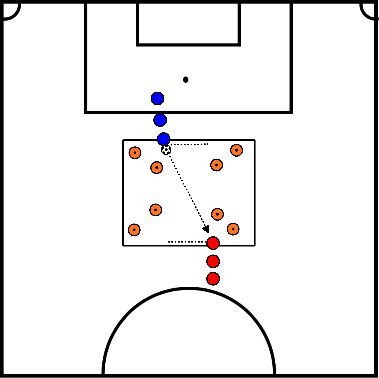
- Square is the playing field, marked out with pawns
- Horizontal dotted lines represent mini-gallies
- 2 teams of 3 to 4 players: set out several squares next to each other (also possible with 2 per team, but it is more fun with 2 or 4)
- Set out 4 gates of pawns
- Keep the playing field small so that you can act quickly.
Aim of the game:
- Blue plays a tight ball to red
- Red has to dribble through at least 2 gates and can score in 1 of the 2 goals.
- The ball can be taken away so that blue can also score
- When the ball is out both players join the back of the other row and the next 1v1 starts
Variations:
- When blue takes the ball he must dribble through at least 1 gate to be allowed to score
- same if ball is taken away again
- Red must dribble through 3 or even all 4 gates
- In 2 teams, the team that scores the most, wins.
- Make sure teammates do not bump into each other
- Everyone for himself
- The one with the most points after a certain time or with a certain number of points wins
Focus points:
- Good and tight 1st pass
- Good take off from red:
- forwards or sideways
- But do not deadlock it because you need to act quickly
- The man who passes the ball must apply pressure immediately so that this happens
- The ball must always be in motion and may not lie still
Ball movement:
- Player 1 plays the ball into player 2
- Player 2 turns with his furthest foot and passes to player 3
- Player 3 turns and makes action along the line, passes the ball
Running movement:
- Player 1 runs outside to the 2nd pole
- Player 2 slides in to support 1 and 4
- Player 3 makes action along the flank and crosses the ball
- Player 1 or 4 finish
Shifting: 1 - 4 - 3 -2 - 1
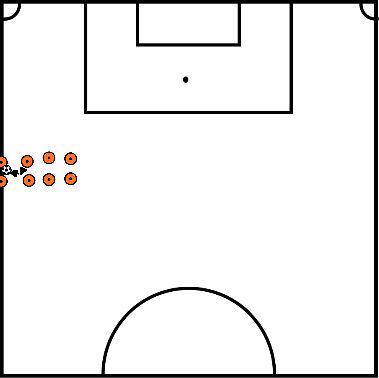
- Players stand in pairs, opposite of each other. 1 on the line and 1 between a gate
- Every 0,5m a new gate is set.
- Players pass to each other in 1 time
- P1 stops the ball after pass P2
- When the pass is good (between the gates) P2 can go backwards.
- Which duo is first at the back and back
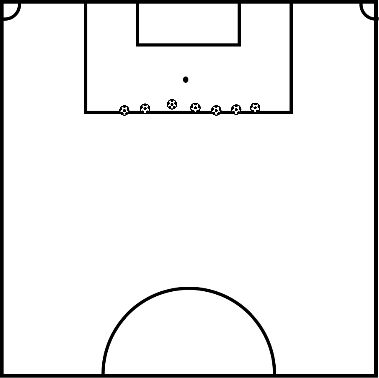
- Emphasize the correct approach, placement of the supporting foot, kicking foot and body position
- Every player places his own ball, thinks about what he can do better.
- Balls are retrieved when everyone has kicked the ball
Variant exercise:
- Put obstacles in the goal that must not or must not be kicked over.
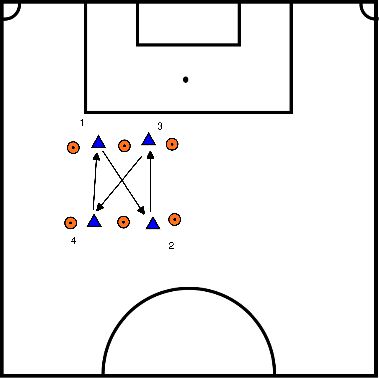
- Players trample on the front feet (ready to receive ball)
- Player 1 plays to 2 diagonally, 2 to 3 straight, 3 to 4 diagonally
- Play the ball cleanly with enough power but not too much. Keep moving
Variation:
- Players 2 and 4 switch places when ball leaves 2
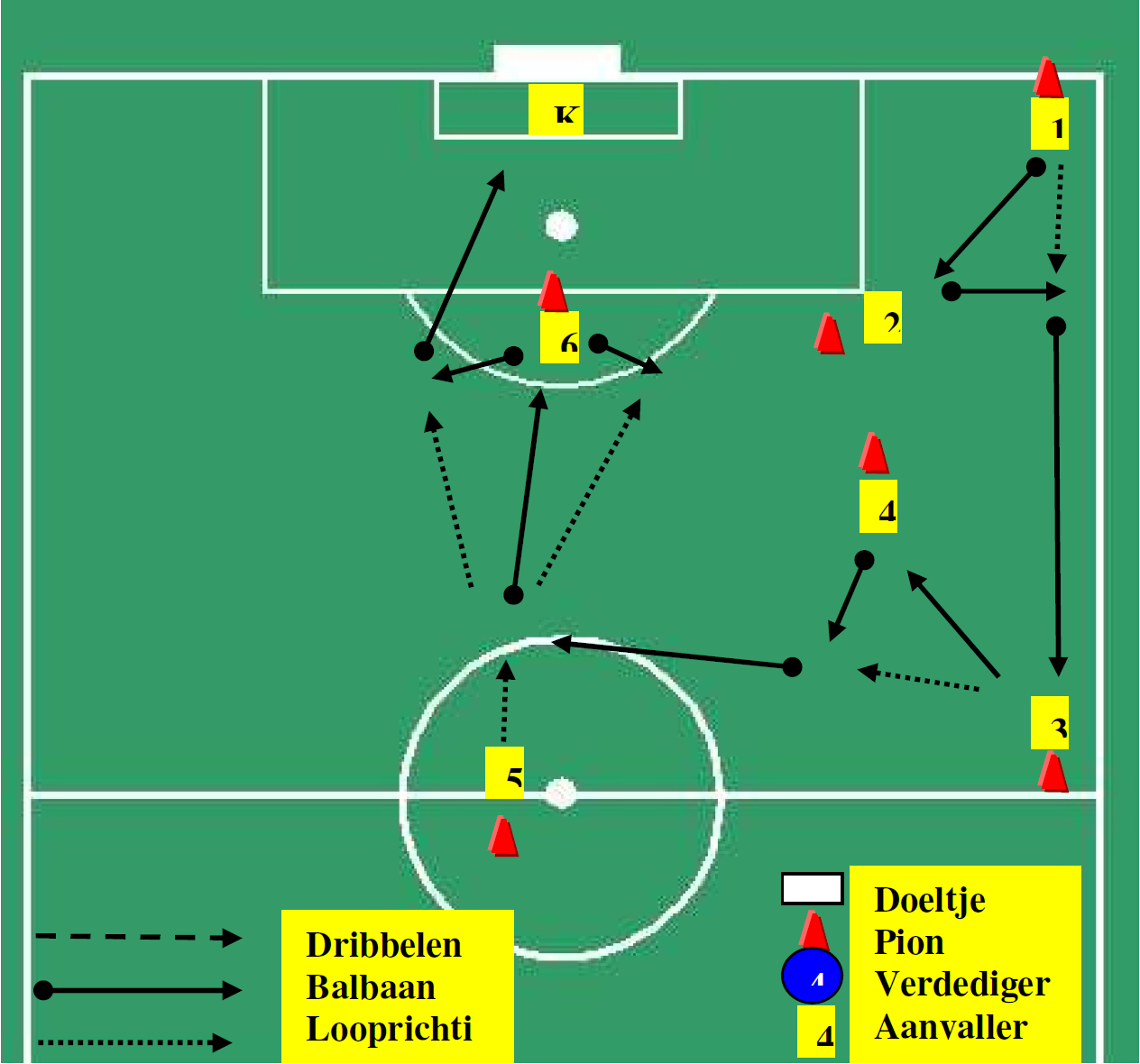
Contents
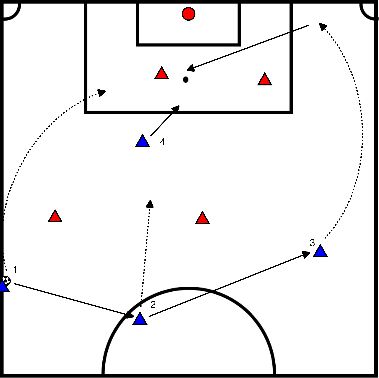
- Nr 1 enters into a 1 -2 with nr 2
- Nr 2 must get into the ball
- Nr 1 gives a depth pass to nr 3
- Nr 3 plays in to nr 4 who gets on the ball
- Nr 4 makes room for the incoming player
- Nr 3 plays to nr 5 in the width
- Nr 6 gets the ball and nr 5 determines by playing in whether he wants to have it to the left or to the right
- Nr 6 receives the ball and scores
Structure of the exercise form
- At number 1 players with one ball
- On nr 3 and nr 5 three players
- Move on from nr 1 to nr 6
- If no goalkeeper then nr 6 goes on target
- Increase/decrease the distances
- Play on the outside leg
- Make eye contact, create space and get on the ball.
- At position no. 2, 4 and 6 add a defender.
- Ball on the ground and/or through the air
Coaching
- At number 2, 4 and 6 first away from the ball and then get inside the ball.
- When nr 1 has control over the ball, then get inside the ball.
- Make sure that they do not play close to each other, because that is easy to defend
- No. 5 determines himself if he wants to have the ball l/re by the way he plays the ball.
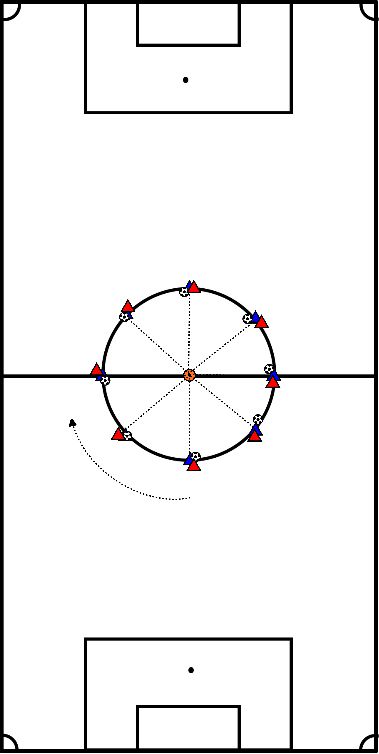
Divide the group in pairs and put each pair at a cone/hat, which you have divided on the centre circle:
- Leave the ball, which is at every cone, on the ground and let the whole group run around the circle;
- Make sure every pair is standing at a cone with the ball;
- Player 1 dribbles the ball to the centre spot and puts it down there;
- On the way back (without ball), Player 1 performs exercises (e.g. knee lifts);
- At the moment Player 1 returns, Player 2 starts the same exercises (e.g. knee lifts) and then retrieves the ball;
- Repeat and be creative with the exercises.