

Soccerexercises for u9
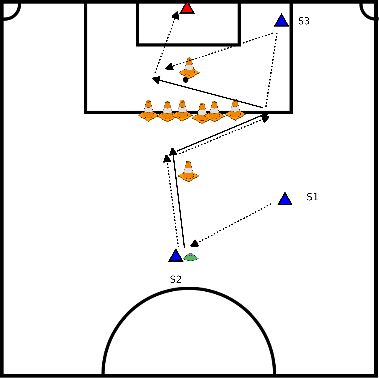
- S1 gives pass to S2.
- S2 dribbles to cones, makes 1x sharp angle, gives pass to S3.
- S3 runs free, gets ball and finishes on goal.
- With fixed goalkeeper then it stays, without goalkeeper then trapper takes the place of goalkeeper.
- Goalkeeper goes rebound and handler takes ball and slides on, S1 goes dribbling.
- Exercise can be done in two directions.
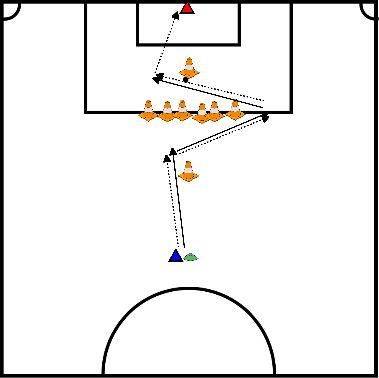
- S1 dribbles to cones. Makes 2x sharp angle and finishes on goal.
- With fixed goalkeeper it stays, without goalkeeper trapper takes the place of goalkeeper.
- Exercise can be done by free choice from 2 sides.
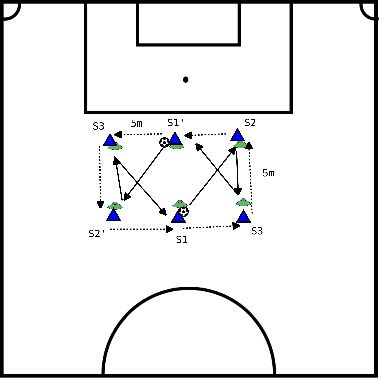
Exercise begins at the two middle cones.
- S1 passes diagonally to S2.
- S2 rebounds to S3.
- S3 rebounds diagonally to S2 who presents at middle cone.
Exercise then continues on the other side.
6 pots, 2 balls and 6 players.
6 pots, 2 balls and 6 players.
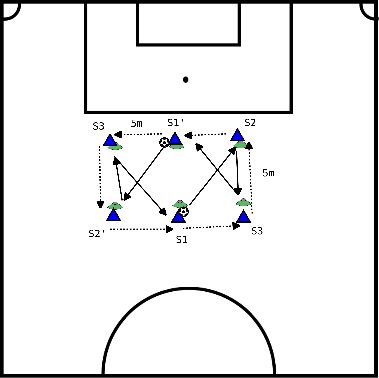
Exercise begins at the two middle cones.
- S1 passes diagonally to S2.
- S2 rebounds to S3.
- S3 rebounds diagonally to S2 who presents at middle cone.
Exercise then continues on the other side.
6 pots, 2 balls and 6 players.
6 pots, 2 balls and 6 players.
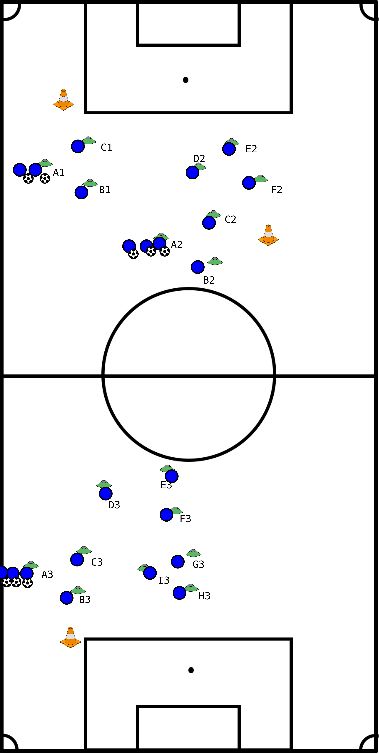
Distances 3 corners 10 meters to make it more difficult reduce the distances.
Distance next triangle 20 meters.
1st triangle:
Distance next triangle 20 meters.
1st triangle:
- A plays B in.
- B plays C in.
- C drops ball on A.
- A gives ball in runs with C towards Pawn.
- Running line A to B , B to C , C becomes A.
2nd triangle:
- A2 plays B2 in.
- B2 passes to C2.
- C2 drops ball on A2.
- A2 plays the ball to D2.
- D2 turns open, plays E2 in.
- E2 plays F2 in.
- F2 drops ball on D2.
- D2 hands ball in, runs with F2 towards Pawn.
- Running line A to B, B to C, C to D, D to E, E to F, F becomes A.
3rd triangle:
- A3 plays B3 in.
- B3 plays C3 in.
- C3 drops ball to A3.
- A3 plays the ball to D3.
- D3 turns open plays E3 in.
- E3 plays F3 in.
- F3 drops the ball on D3.
- D3 plays the ball to G3.
- G3 spins open plays H3 in.
- H3 plays I3 in.
- I3 drops the ball to G3.
- G3 gives ball in runs with I3 towards Pawn.
- Running line A to B . B to C. C to D. D to E. E to F. F to G. G to H. H to I. I becomes A.
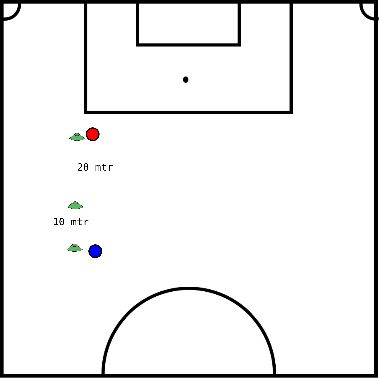
- At trainer's signal, both players start sprinting.
- Blue must run around first pawn and Red runs straight through to tap Blue.
- Red becomes Blue and flips over.
Organization:
Distance pawns A to B is 10 meters.
Distance pawns B to C is 5 meters.
Outward both 8 meters.
Goal of the exercise is A is going to coach B which way to turn open.
Distance pawns A to B is 10 meters.
Distance pawns B to C is 5 meters.
Outward both 8 meters.
Goal of the exercise is A is going to coach B which way to turn open.
- B gets loose from the pawn and asks A for the ball.
- A plays in at that point C points with his hand to the left or right.
- A coaches B to the side which C points to.
- B turns open and passes the ball to C who runs to the outer pawn he points to.
- A to B, B to C and C to A.
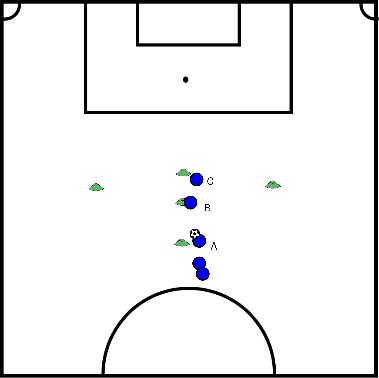
This type of exercise is a positional game in which the team with the excess number must press for the ball immediately after losing it.
The principle of play
What are your players supposed to do when the ball is lost somewhere on the field? If you want your team to put direct pressure on the ball in the transition from possession to loss of the ball, the following form of practice is very suitable to work on this. The playing principle that is central in this form of practice is 'putting pressure on the ball directly'. With 'putting pressure' I mean attacking the ball; actively moving towards the ball -and opponent- in an attempt to conquer it as soon as possible.
What are your players supposed to do when the ball is lost somewhere on the field? If you want your team to put direct pressure on the ball in the transition from possession to loss of the ball, the following form of practice is very suitable to work on this. The playing principle that is central in this form of practice is 'putting pressure on the ball directly'. With 'putting pressure' I mean attacking the ball; actively moving towards the ball -and opponent- in an attempt to conquer it as soon as possible.
The practice form
The red team plays the ball around or plays for possession. The yellow team tries to get rid of the ball.
When the yellow team is in possession of the ball, they must try to score as soon as possible in one of the four goals.
By keeping the size of the field relatively small, it is easy for the yellow team to attempt a goal from all positions on the field.
The red team is thus forced to put pressure on the ball immediately upon loss of possession to prevent a goal/attempt.
The red team plays the ball around or plays for possession. The yellow team tries to get rid of the ball.
When the yellow team is in possession of the ball, they must try to score as soon as possible in one of the four goals.
By keeping the size of the field relatively small, it is easy for the yellow team to attempt a goal from all positions on the field.
The red team is thus forced to put pressure on the ball immediately upon loss of possession to prevent a goal/attempt.
Coaching
What can you pay attention to in this exercise? Since pressure on the ball is central, it is logical to look mainly at this:
What can you pay attention to in this exercise? Since pressure on the ball is central, it is logical to look mainly at this:
- Is it pressured at all at ball loss?
- If yes, by whom and by whom not? If not, why not?
- If pressure is applied, how? Aggressively from the idea of capturing the ball immediately or from a shuffle pace?
Variations
Several variations are possible, some suggestions:
Several variations are possible, some suggestions:
- If you have no goalkeepers, you can also work with small goals only
- Let the under team score by dribbling out of the field (possibly in combination with the goals)
- Award points to the outnumbered team by playing around x number of times
- Award points to the outnumbered team if the ball is recaptured without a goal attempt by the underdog.
- More/less goals
- Count goals from the under number more heavily
Naturally, the form can also be played with other numbers, as long as there is an over- and undercount.
Direct pressure is very effective when it works. If it is not successful and the opponent can play under pressure, it is very likely that large spaces will be created, which is a risk. Correct adjustment of the pressure requires training.
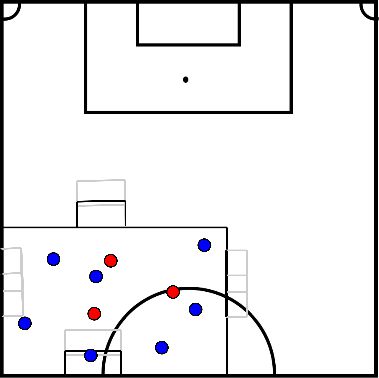
Distances:
- A-B 5 meters.
- A to goal 5 meters.
- Hat to line B 1 meter.
- Distance goal differs in age younger goal is bigger.
Player dribbles to line A, cuts the ball off, dribbles to line B, cuts off and shoots the ball at the goal, picks up the ball and runs around the outside back.
Variations:
Inside/outside foot cut off, cut off behind stand leg, dribble with left and right.
Coach moments:
Dribbling, touching the ball at each step, short turn off, cutting off line B and having the ball in such a way that you step through and shoot and not having the player first walk backwards for a run.
Variations:
Inside/outside foot cut off, cut off behind stand leg, dribble with left and right.
Coach moments:
Dribbling, touching the ball at each step, short turn off, cutting off line B and having the ball in such a way that you step through and shoot and not having the player first walk backwards for a run.
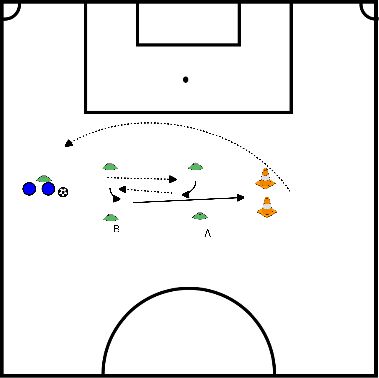
Check distances with the number of players.
- Have players dribble into the box.
- Trainer says 1: put players ball on foot.
- At 2: knee on foot.
- At 3: sit on ball.
- This one minute and then outside dribble through the goals in succession for about 2 minutes.
Game version 1: start in the box with dribbling at the sign of yes as fast as possible through a goal and dribble back into the box and finish with 1,2,3.
Game version 2: who will go through as many goals as possible within 1 minute.
Game version 2: who will go through as many goals as possible within 1 minute.
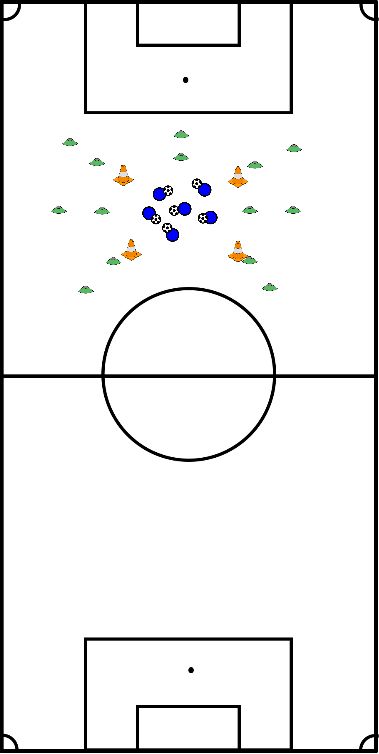
Distances pawns 10 L by 6 B Goals countdowns watch by age.
Hats not needed because 1 on 1.
Hats not needed because 1 on 1.
- Red dribbles into the box and plays the ball to blue.
- Blue tries to score on Red's goal, red takes the ball away and scores on blue's goal.
- On scoring or ball over the line out of box and join at the back on the other side where you were standing.
Coach moments:
Defence: make sure you stay between man and goal. be patient, bend your knees slightly, stand on your front feet.
Attack: keep speed in your game as soon as you are stationary, you are easy to defend, by body movements unbalance your opponent.
Tap the ball next to your opponent and then also accelerate. Then try to have your body between opponent and ball.
Defence: make sure you stay between man and goal. be patient, bend your knees slightly, stand on your front feet.
Attack: keep speed in your game as soon as you are stationary, you are easy to defend, by body movements unbalance your opponent.
Tap the ball next to your opponent and then also accelerate. Then try to have your body between opponent and ball.
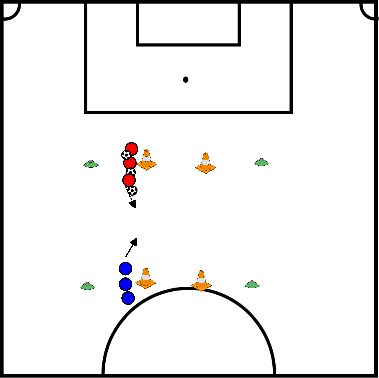
Distances: the orange pawns are the goal and are 2.5 meters apart,
use the red posts running training. The players stand 5 meters in front of the goal.
use the red posts running training. The players stand 5 meters in front of the goal.
- The blue team starts with goalkeeping, the trainers stand next to the goal and throw the ball.
- Red must try to score by heading, if he succeeds then it is 1 point.
- The player from red who has headed then goes to keep.
- The player of blue gets the ball, puts it back to the trainer and joins his group.
Notes: youngest groups can also try to shoot from the air. older not qua shoot too hard.
Coach moments:
Goalkeeper: stand on the front feet to react quickly.
Attacker: time, look where the ball is coming. Heading with the upper body not just your head, nodding to the ball. Hit the ball before the head not on the head.
Coach moments:
Goalkeeper: stand on the front feet to react quickly.
Attacker: time, look where the ball is coming. Heading with the upper body not just your head, nodding to the ball. Hit the ball before the head not on the head.