



Volleyballexercises for technique condition
Last update: january 2026
Positions:
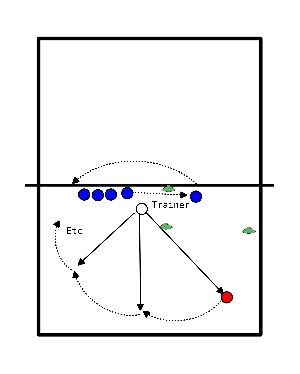
- Trainer at mid forward, to throw to, but do keep space to net so player can pass behind.
- 1 Player without ball on Setter spot = 1st catcher.
- Player is the passer who will pass 10 good balls
- Other players with ball next to trainer for passing and catching
- The exercise runs best with about 5-6 players.
Organization:
- Passer is given balls successively thrown at:
- P1, P6, P5, P4, P2 regardless of whether the ball is good => through to next position.
- Then balls at random position, trainer determines difficulty, until there have been 5 good passes.
- After 5th good pass => Player quickly to P6, ready on front feet.
- Last pass comes from P6 , on a 'beaten' ball.
- Continue until there is a 6th good pass.
Other player:
- Always give ball to trainer and straight to setter spot to catch off.
- Ball not good, quickly retrieve and join the line.
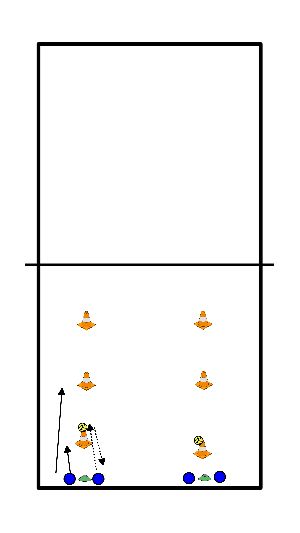
- 3 pawns in a row.
- Groups of two players.
- Goal is to move the ball further per pawn.
- On pawn 1 there is a ball.
- Player 1 brings the ball from the back line back to the base and gives it to player 2.
- The latter then runs with ball to pawn 2 and puts the ball there and runs back to the base.
- Player 1 then rushes to the 2nd pawn to pick up the ball there and pass it to player 2 who then takes the ball to the 3rd pawn.
- Then back from pion 3 to pion 2, to pion 1.
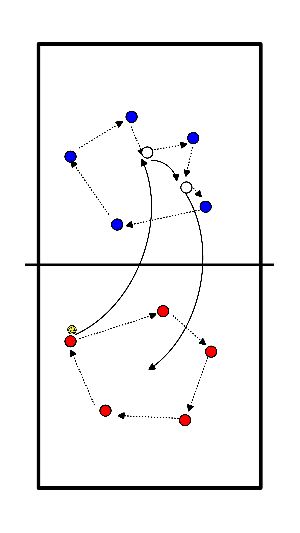
Organization:
Group divide over both courts.
Execution:
Group divide over both courts.
Execution:
- Play the ball in a maximum of 2 actions UNDERhand over the net.
- After each net passage the team rotates one position.
- If the ball falls on the floor or an opponent has to play the ball differently, the team that played the ball over the net scores.
- In principle, the game does not have to stop.
- Should this happen, the ball is brought back into play through an OH service from the backfield.
- Who has the first 15 points?
Optional:
Depending on the level, the 2nd ball out of position may be attacked from the backfield.
Depending on the level, the 2nd ball out of position may be attacked from the backfield.
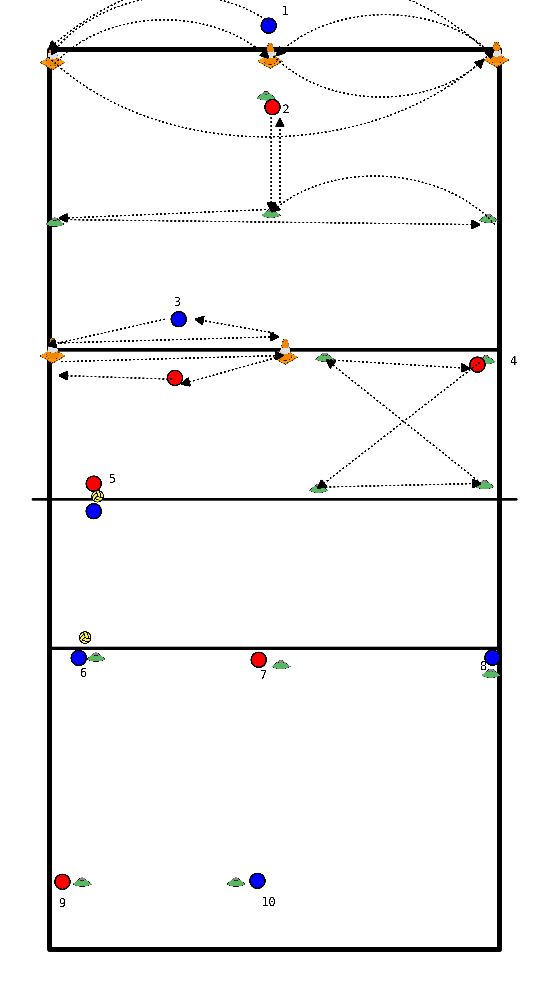
Multiple exercises with turnaround system.
- Everyone does each exercise 30" at 75% then 45" at 100%.
- Exercise 1: Side by side pull pass to left pylon, then alternate far and closest pylon. Each time back to center then far distance.
- Exercise 2: sprint straight ahead, then side short distance left and long distance right, back side to center and back to starting position.
- Exercise 3: player A tries to make it as difficult as possible for player B with side steps left and right. Player B tries to imitate player A.
- Exercise 4: player follows the lines with face always facing the net.
- Exercise 5: player A jumps and passes the ball to player B, important that the ball is not thrown but passed.
- Exercise 6: player sits down, with feet off the ground tap a ball on the ground with 2 hands left and right of the body.
- Exercise 7: player does a plank exercise the entire time.
- Exercise 8: player jumps 4x at 50% against the wall and then full through, repeating for the whole time.
- Exercise 9: player keys the ball to himself for the entire time. The ball must not fall!
- Exercise 10: player gets into squat position, he lifts the heels up to maximum, aggressively, and slowly lowers back down. Repeat and especially stay in squat position.
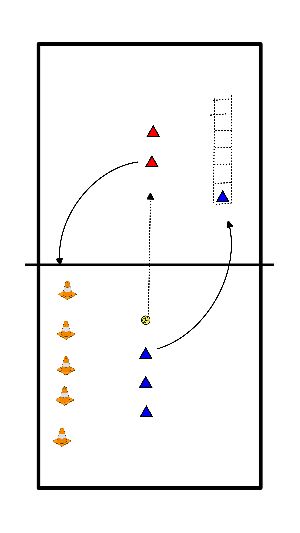
- Divide the team into two groups and have them form two rows facing each other on the 3-meter line.
- Have the players play over the net and then walk around the cone to join the other group.
- On 1 side, parallel to the sideline, place a speed ladder and before joining the line, have the players do a drill through the ladder.
- On the other side, place pawns where they have to slalom, turn around.
- Importantly, the ball should not fall to the ground, communication is important.
- Optionally add a penalty if the ball falls to the ground. Head roll, Back roll.
- First with underhand throwing and catching - then overhand. Catch and push change to toss up and over-key.
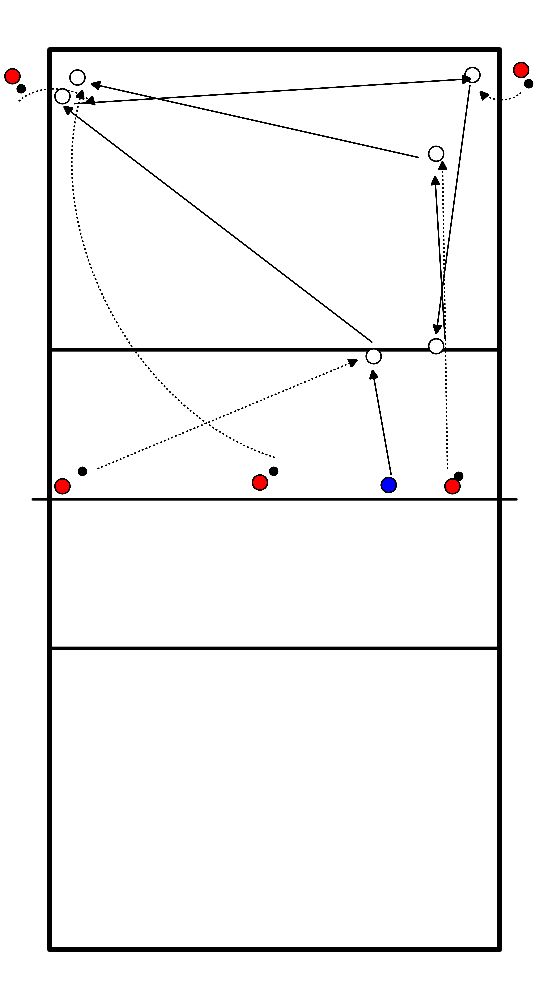
- Practice on quick movement and stationary play.
- 5 declarers red and 1 blue working player.
Starting position:
- 5 people with ball
- 1 player on both sides of the field at the back
- 1 player on 2
- 1 player on 3
- 1 player on 4
- Working player next to position 4 in block position
Exercise:
- Working player does block and comes out like free blocker and defends technical attack from position 2
- Ball is thrown in from position 3 to deep on 1. Working player does quick move to take out deep ball.
- Short ball is played deep at position 5.
- Attack from position 4. The working player does displacement to 3 meter line and defends.
- Short deep ball at position 1.
Repetition:
- 3 times intensively.
- After this move on until every player has had their turn.
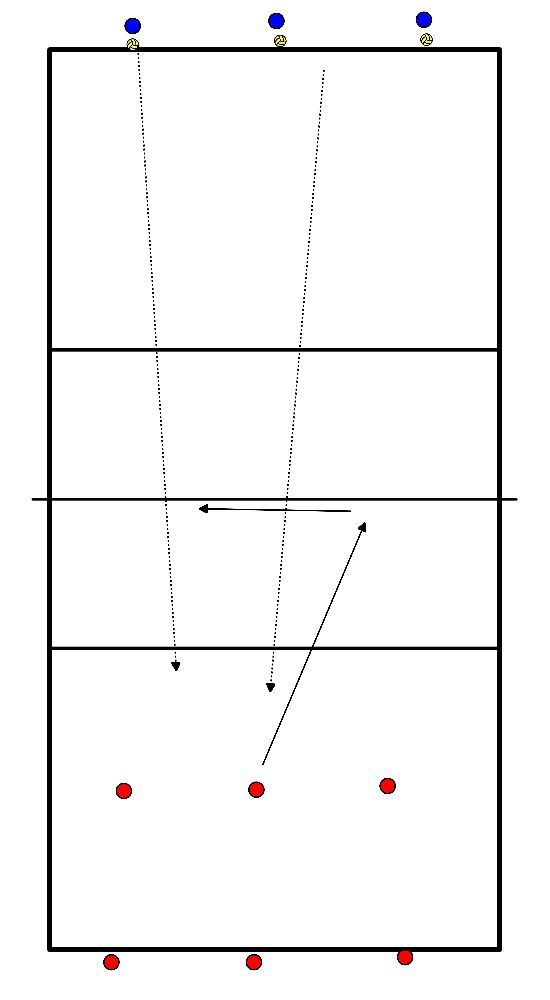
- Divide the group into 3 groups
- 1st group on 1 side of the net on the back line
- 2nd group other side at position 1-5-6
- 3rd group waiting room
EXERCISE:
- 1st group serves 3x on the same group
- 2nd group defends, must be in threes, these balls and attacks. All positions are allowed.
- 3rd group waiting room
ROTATION
- 1st group --> to the waiting room
- 2nd group --> serve
- 3rd group --> defend/attack
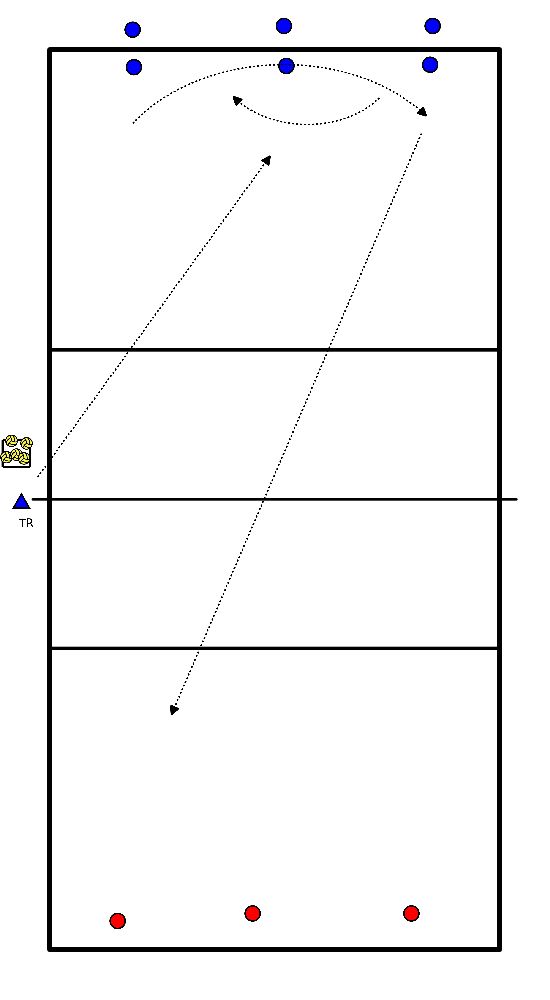
- 1x 3-team on back line 1 side of field
- 1x 3-team on back line other side of field
- 1x 3-squad --> waiting room
- TR --> gives slap on the ball, both 3-talks run to the net and TR throws the ball into the field where the waiting room players are also standing.
- Ball is defended, must be in threes, and then over the net
- This 3-tal passes immediately to the side where the ball was played to as waiting room
- Immediately the waiting room 3-squad enters the field.
- 3-tal other side also plays the ball in threes and over the net, also runs through to the other side chasing the ball to waiting room.
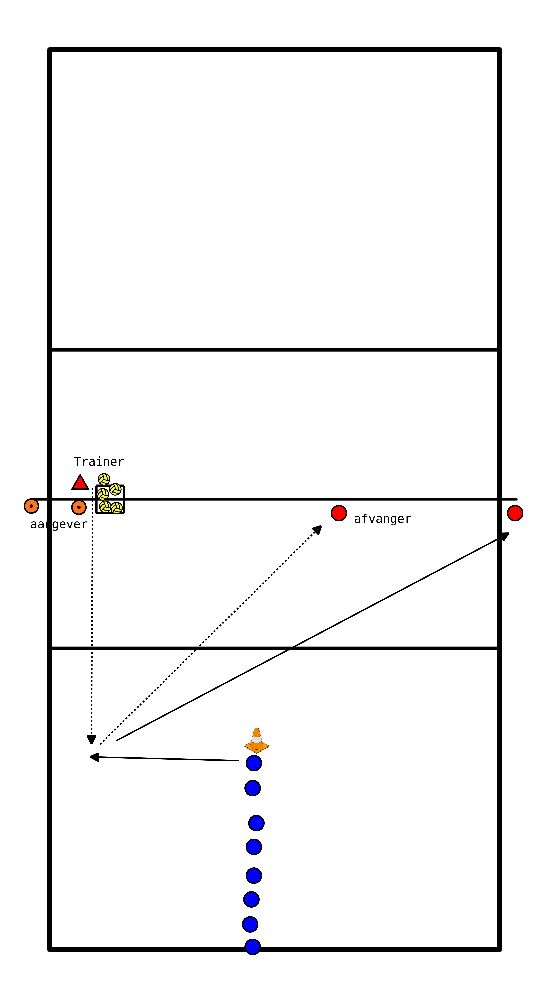
- TR stands on the other side of the net.
- Players stand in 1 row behind each other -position 6-.
- TR throws balls at pace and players pass them to 2/3 -catcher-.
- If there are enough players then one or 2 declarer-s- These give the ball to the trainer and then join the passers.
- Catcher ball in ball box --> becomes declarer.
- New catcher --> from waiting room in --.
- Passer --> out of waiting room catcher.
On pace!
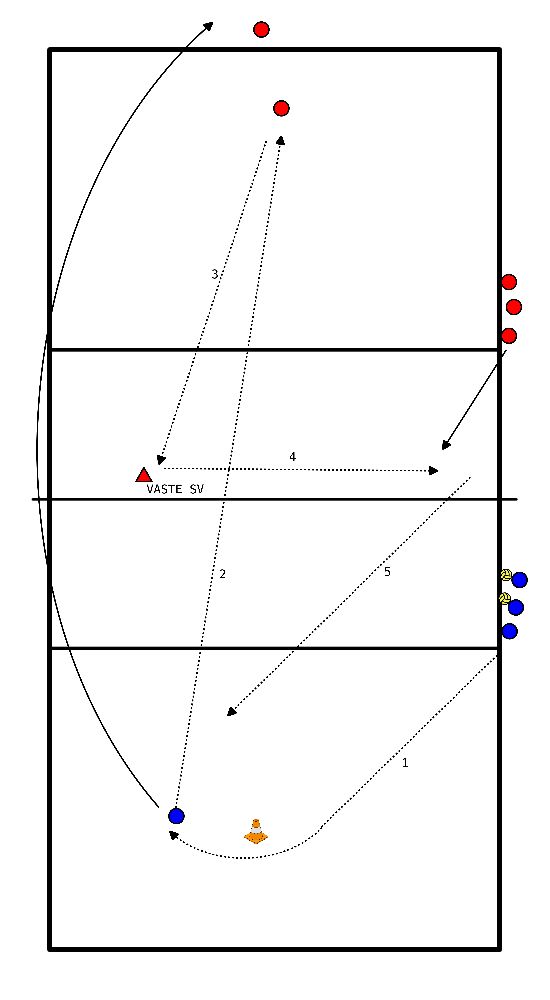
Divide the group into two.
- 1 SV on the side for attack
- 1st player blue has no ball the rest do
- 1st player blue sprints around the pawn, then gets one of va the 2nd players thrown on --> pass to the other side - red defender
- Red defender passes to SV
- SV gives setup an attack on 52
ROTATION
- Blue passer --> guard red
- Attacker gets the ball himself and joins behind line of blue
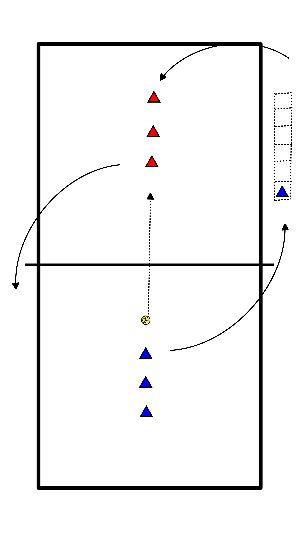
- Divide the team into two groups and have them form two rows facing each other on the 3 meter line.
- Have the players play over the net and then run around the net post to join the other group.
- On 1 side, parallel to the sideline, lay a speedfoot ladder and before joining the line have the players do a drill through the ladder.
- Possibly expand with block jumps, attack passes or strength exercises.
- Importantly, do not allow the ball to fall to the ground, communication is important.
- Possibly add a penalty if the ball falls to the ground.
- Alternate with underarm and overhand.
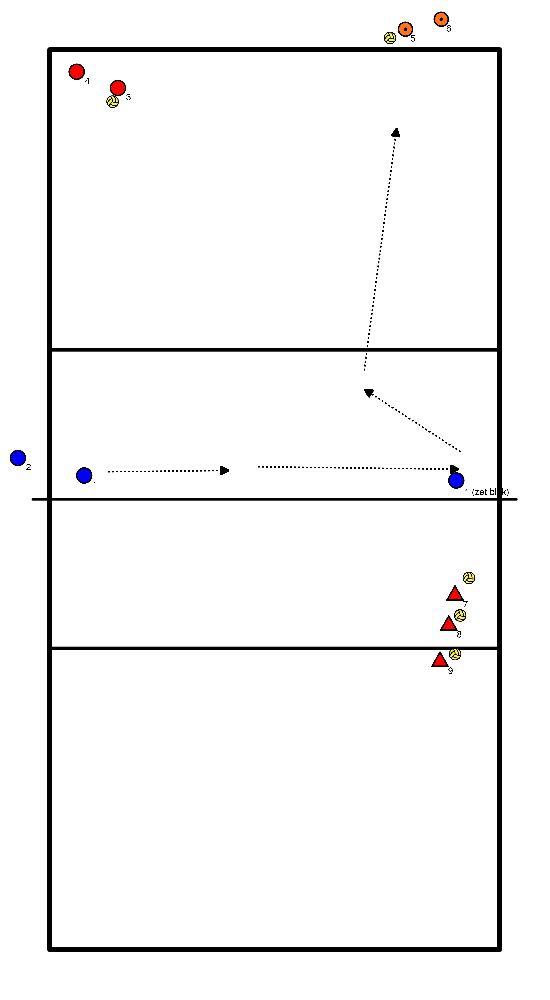
Defend block with dive
- 1 blocks first at the center and then at the front left. Here he gets a ball played to him by players 7, 8 and 9
.- After block turn around and defends attack of 3 back.
- Then defends in dive short ball from 5.
- 2 is next
Blocker must keep ball within the lines !!!!
Turn over:
- 1 after defending short ball --> connect behind 6 to-
3 to block --> connect behind 2 to-
5 after giving the short ball --> connect behind 4
- 1 blocks first at the center and then at the front left. Here he gets a ball played to him by players 7, 8 and 9
.- After block turn around and defends attack of 3 back.
- Then defends in dive short ball from 5.
- 2 is next
Blocker must keep ball within the lines !!!!
Turn over:
- 1 after defending short ball --> connect behind 6 to-
3 to block --> connect behind 2 to-
5 after giving the short ball --> connect behind 4
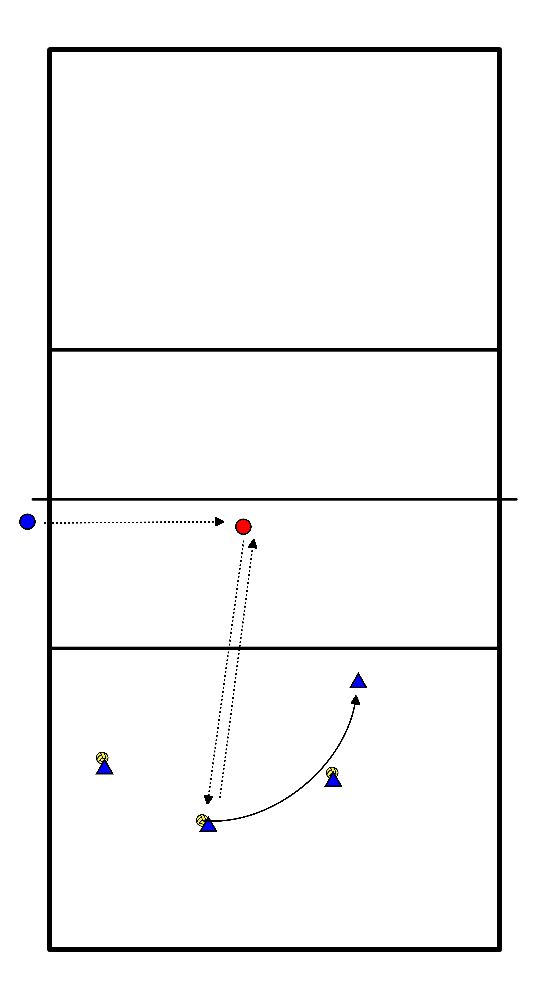
- Split the group in two
- Player with a couple of balls at the post
- 1 SV at the net who always distributes the ball
- Every defender has a ball EXCEPT FOR ONE
- so if there are 4 defenders on the field, 3 of them have the ball
- Player at the post puts the ball up to the SV, who plays the ball (first easy) to a random defender WITH A BALL !
- He throws his ball to another defender with no ball and passes to the SV,
- DIRECTLY the SV plays another ball to another player (defender) WITH A BALL.
- Regularly changing players/position
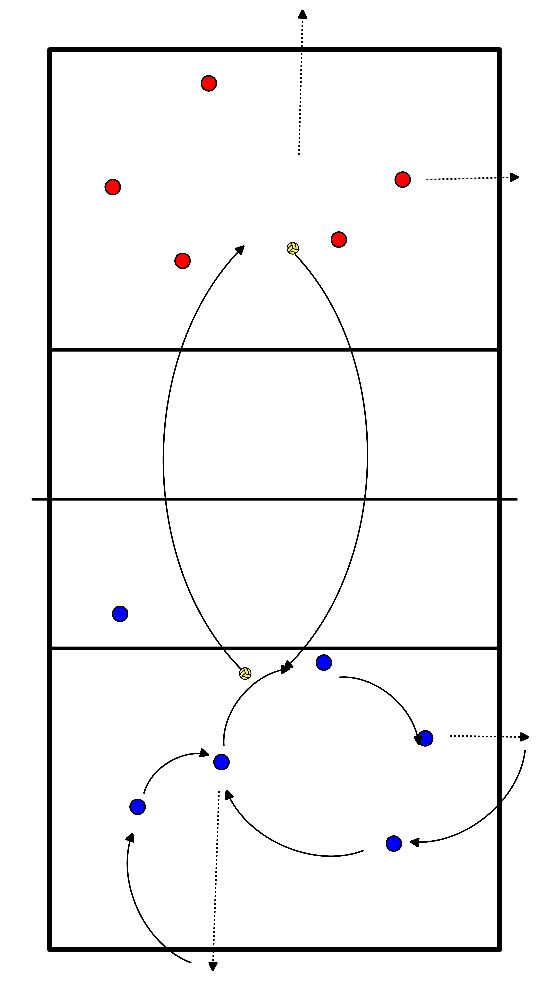
- Purpose of the exercise:
- To focus, communicate, master the task and persevere.
- At "A" and above, with fewer people on the field for more intensity.
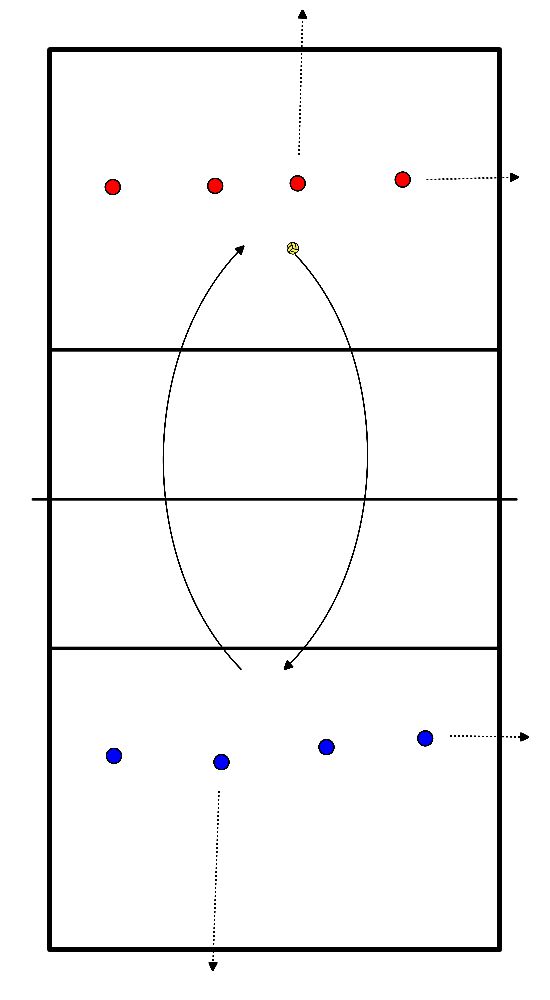
- Explanation of the exercise:
- 'Chaos Easy' starts as a warm-up, but ends as a true battle.
- The players are placed in the field (it doesn't matter where).
- The ball is caught and immediately thrown over the net (one play).
- As the player catches, he throws the ball. .
- The players on the team are turned over one spot.
- It is striking how difficult it is to score.
- When someone throws wrong (in net or out), they have to sprint around the opponent's field.
- Duration of the exercise:
- 5-10 minutes.
- Goal of the exercise:
- To focus, communicate, master the task and persevere.
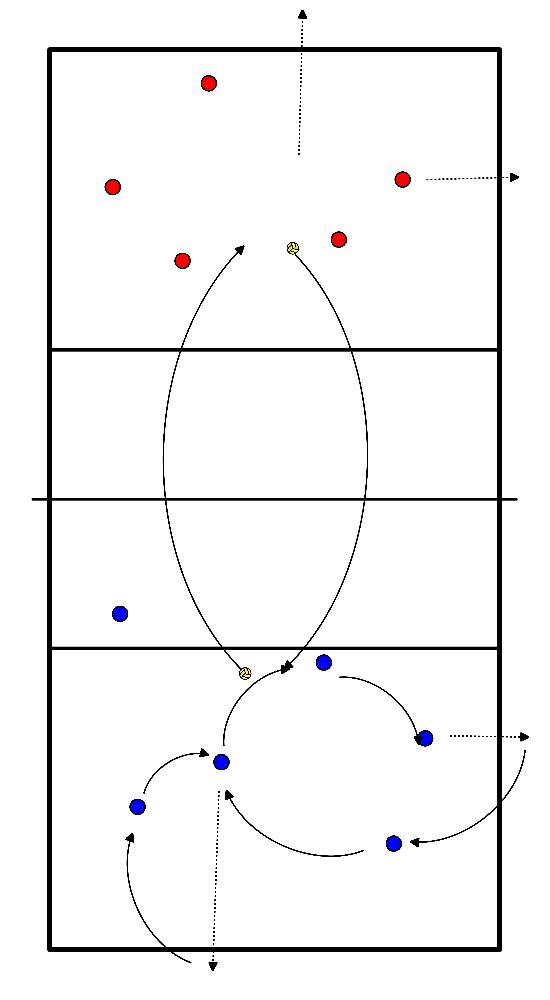
- Explanation of the exercise:
- 'Chaos Easy' starts as a warm-up, but ends as a real battle.
- The players are placed in the field (it does not matter where).
- The ball is caught and immediately thrown over the net (one play).
- As the player catches, he throws the ball.
- When a player has thrown the ball, he/she goes to a wall (back of the field or on the side) and taps it, then comes back into the field.
- The other players on the team have moved forward one spot.
- You notice how difficult it is to score.
- When someone throws the wrong ball (into the net or out), they have to sprint around the opponent's field.
- Duration of the exercise:
- 5-10 minutes.
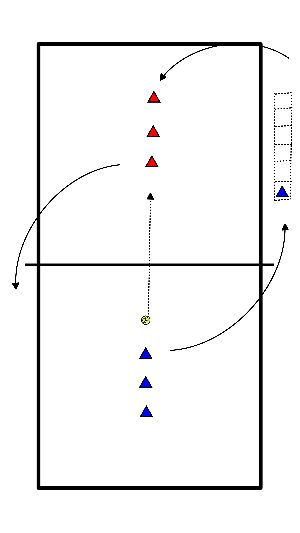
- Divide the team into two groups and have them form two rows facing each other on the 3 meter line.
- Have the players play over the net and then run around the net post to join the other group.
- Place a speedfoot ladder on one side, parallel to the sideline, and have the players do an exercise through the ladder before joining the row.
- It is possible to extend this with block jumps, attacking passes or strength exercises.
- Important is that the ball should not fall on the ground, communication is important.
- If necessary, add a sanction when the ball falls on the ground.
- Alternate between underhand and overhand.
- Purpose of the exercise:
- To focus, communicate, master the task and persevere.
- At "A" and above, with fewer people on the field for more intensity.
- Explanation of the exercise:
- 'Chaos Easy' starts as a warm-up, but ends in a true battle.
- The players are placed in the field (it doesn't matter where).
- The ball is caught and immediately thrown over the net (one play).
- As the player catches, he throws the ball.
- When a player has thrown the ball, he/she goes to a wall (back of the field or on the side) and taps it, then comes back into the field.
- The other players on the team have moved forward one spot.
- You notice how difficult it is to score.
- When someone throws the wrong ball (into the net or out), they have to sprint around the opponent's field.
- Duration of the exercise:
- 5-10 minutes.
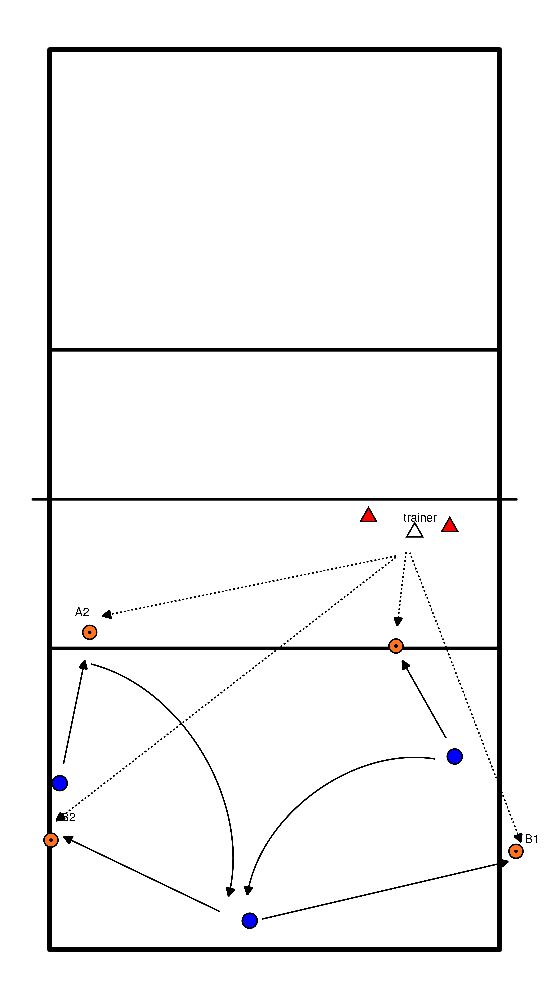
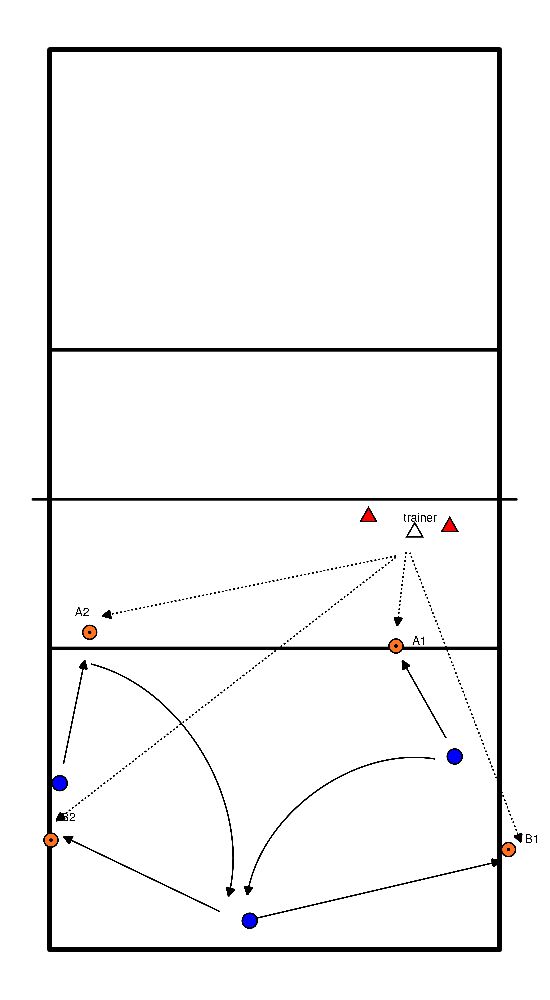
- Short/long.
- Trainer throws ball to position A1
- Player 1 passes the short ball and runs to the middle
- Trainer passes ball to position B1
- Player 2 tries to pass ball back from A2, and stands ready for the ball on A1.
- Then trainer switches to the other side
- Trainer throws ball on to A2
- Player 2 passes the short ball and walks to the middle.
- Trainer throws the ball on to B2
- Player 1 tries to pass ball on B2, and stands ready for ball on A2.
- Other players?
- 3 fetch balls
- 3 encourage
- After 10 balls change group.
- 2 trainers available?
- 1 trainer makes sure the player in the middle does not cheat by starting too fast (and keeps him/her in the middle)
- All exercises last two minutes.
- Exercise 1:
- Place the bench and step on the LEFT side and step off the RIGHT side.
- Exercise 2:
- Place a cupboard and walk over it and over it again.
- Exercise 3:
- Bench down here and With your hands LEFT and RIGHT.
- Exercise 4:
- Place the bench and do a sit-up with your feet under the bench.
- Exercise 5:
- Put a bench down and let your LEFT and RIGHT leg go along the bench. (so through your knees)
- Short/long.
- Trainer throws ball to position A1.
- Player 1 passes the short ball and runs to the middle.
- Trainer throws ball to position B1.
- Player 2 tries to pass ball back from A2, and gets ready for ball on A1.
- Then trainer switches to the other side.
- Trainer throws ball to A2.
- Player 2 passes the short ball and runs to the middle.
- Coach throws ball on to B2.
- Player 1 tries to pass ball on B2, and stands ready for ball on A2.
- Other players?
- Three get balls.
- 3 encourage.
- After 10 balls, change groups.
- 2 trainers available?
- 1 trainer makes sure the player in the middle does not cheat by starting too fast. (and keep him/her in the middle).
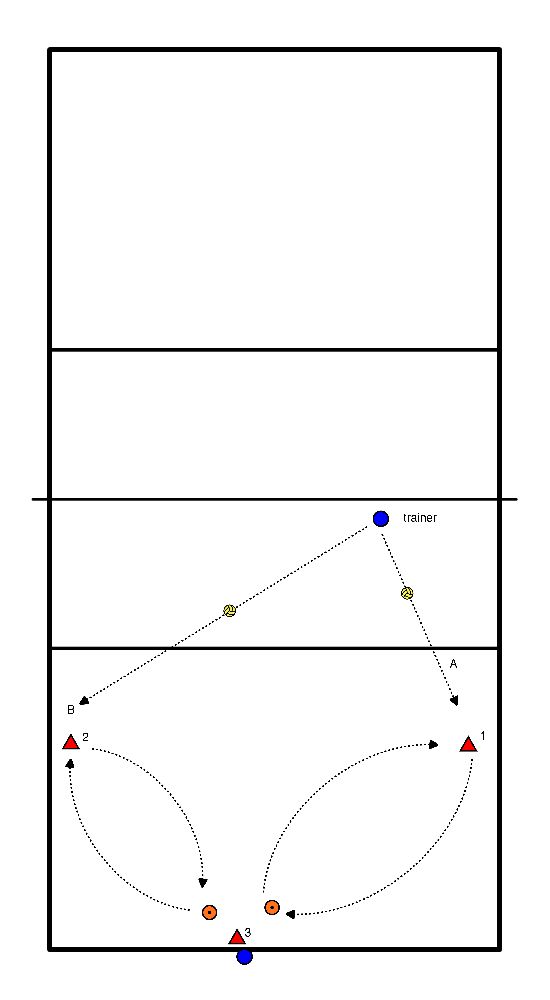
- Short/long.
- Trainer throws balls to the 3 meter line. (positions A + B)
- Player 1 passes the short ball and runs to the middle.
- Player 3 comes in to play the ball.
- Then trainer switches to the other side.
- Player 2 plays the short ball, and goes to the middle.
- Player 1 now goes for the ball on the other side.
- Other players?
- 3 get balls.
- 3 encourage.
- After 10 balls switch groups.
- 2 trainers available?
- 1 trainer makes sure the player in the middle does not cheat by starting too fast. (and keep him/her in the middle).