

Volleyballexercises for technique general
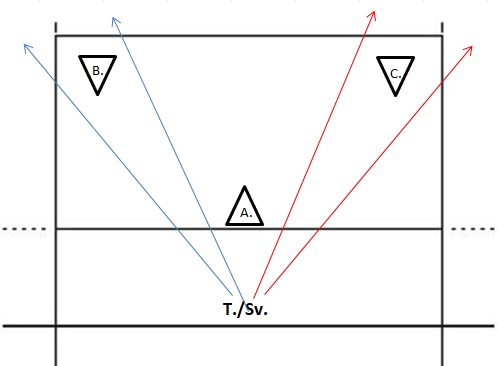
- The purpose of the exercise is to train the defender A in his reaction ability as well as to work together in handling the ball.
- Important for this exercise:
- EVERYTHING is touche!
- The ball that is played/tossed by the trainer (high and far; not hit!) is allowed to come well outside the lines, because the ball must be handled as if it jumped off the block.
- A. stands with his back to the net and concentrates on the defenders B/C.
- If the ball is played by T/Sv. then either B or C demands the ball ("LOS!") and moves to play the ball.
- A. sprints after B/C and offers himself vocally ("HERE!").
- B/C must be able to hear where A is before playing the ball.
- B/C plays the ball high to A and A plays the ball well inside the 3-metre box. T./Sv. makes the catch.
- If there are 8 or more players, this exercise can be done at both ends; if there are less than 8 players, it is played at one end and B/C rotate with players waiting outside the lines.
- In that case, work at a high tempo so that nobody stands still for too long.
- A. changes after 5 or 10 balls; every player takes the position A. twice.
- NOTE: The exercise goes at a high tempo!
- When A. has handled the ball, the next ball follows immediately.
- It is up to the player turning in the ball to get in position in time!
- Expansion:
- Place a basket on a spot of your choice within the 3-meter section.
- The second ball must touch the basket (top) or go through the basket.
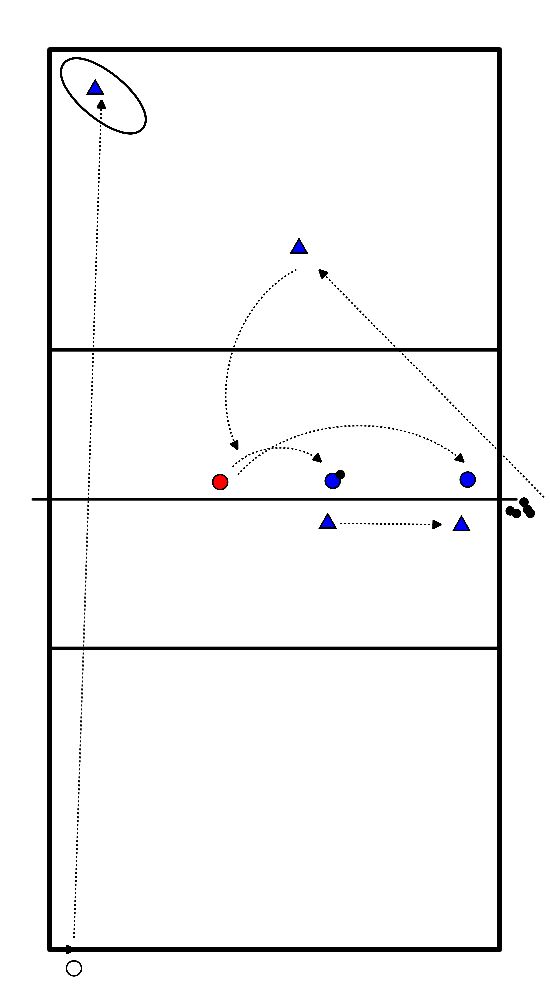
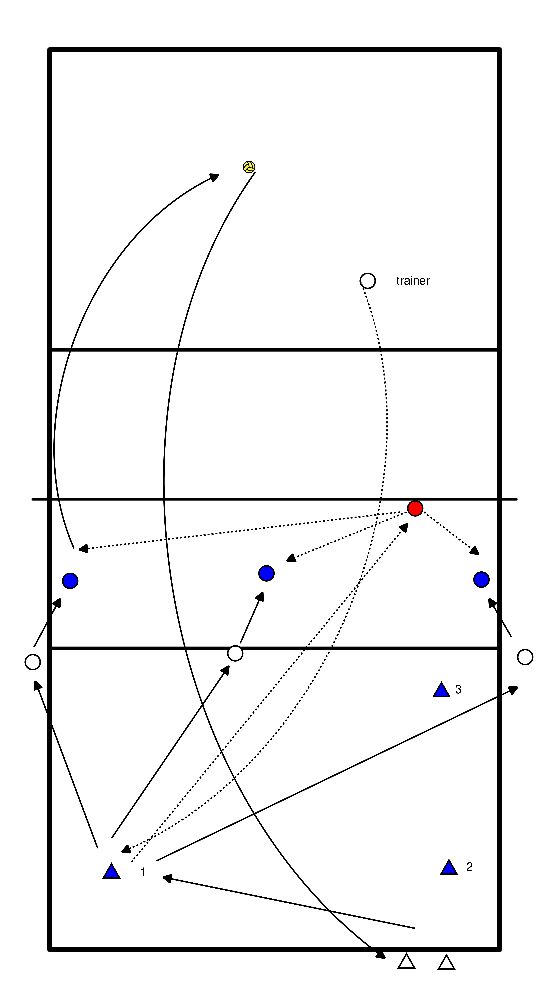
- T strikes ball to libero, 2 attackers start at the net.
- Pass, set-up and attack on position 3 or 4.
- Blocking:
- Outside, inside hand on ball, center joins in.
- Centre blocks with emphasis on shielding position 1/2.
- Then service (float) to position 1.
- Variant:
- Attack on positions 2 and 3 and service to position 5.
- In 2 pairs with 2 balls, do everything 8 times.
- Out of the neck, right, left, hit, OH, BH in 2x. (Penalty if ball on the ground)
- Next:
- Roll ball over from behind between the legs and stay low, keep moving sideways
- (1 ball) Mirroring sideways with 1 ball in left and 1 ball in right hand, pick up ball from floor.
- Goal of the exercise:
- To focus, communicate, master the task and persevere.
- Explanation of the exercise:
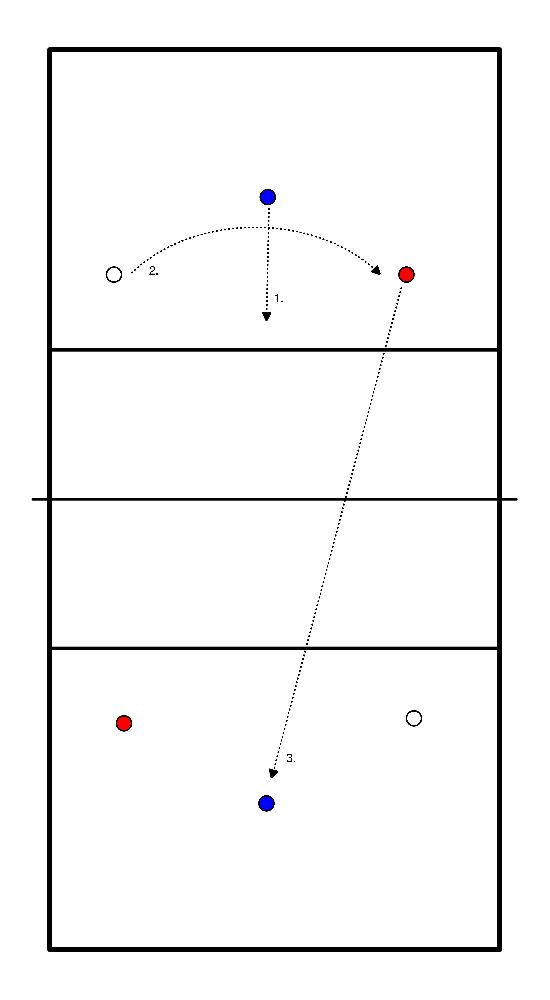
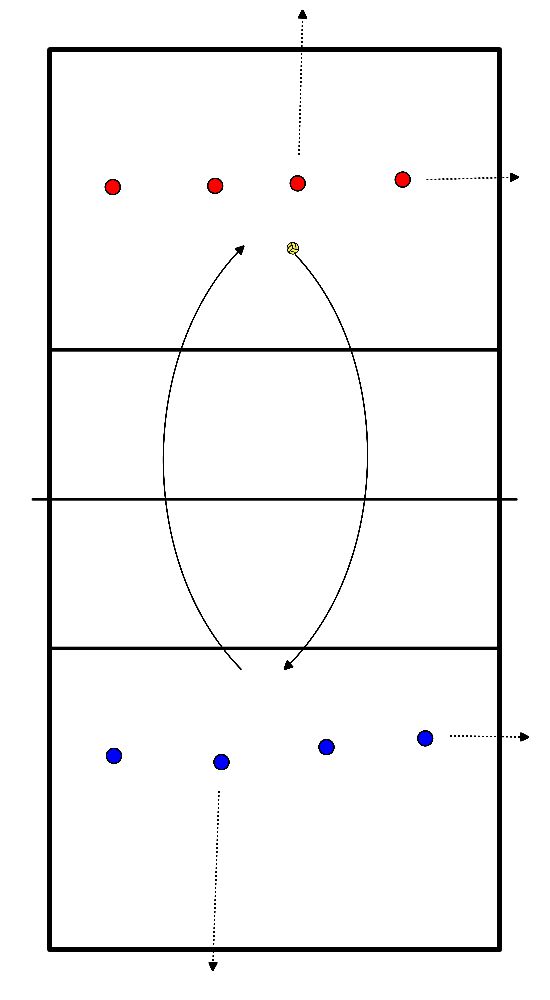
- 'Chaos Easy' starts as a warm-up, but ends as a real battle.
- The players are placed in the field (it does not matter where).
- The ball is caught and immediately thrown over the net (one play).
- As the player catches, he throws the ball.
- When a player has thrown the ball, he/she goes to a wall (back of the field or on the side) and taps it, then comes back into the field.
- The other players on the team have moved forward one spot.
- You notice how difficult it is to score.
- When someone throws the wrong ball (into the net or out), they have to sprint around the opponent's field.
- Duration of the exercise:
- 5-10 minutes.
- Purpose of exercise:
- Improve motor speed.
- Explanation of the exercise:
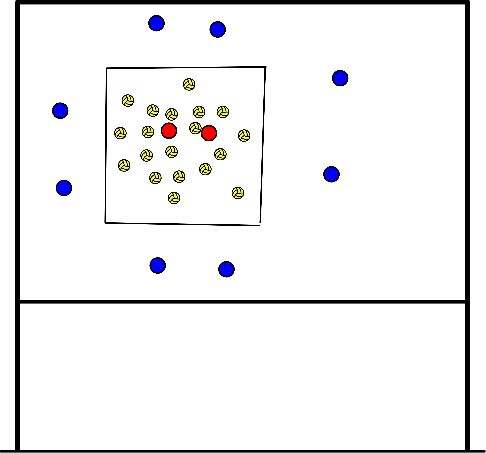
- Make a square of benches and throw in all the balls you have.
- Place two players in the square and the rest around them.
- At the sign of the trainer the two players will try to throw all balls out of the square.
- The rest of the players have to throw all the balls back into the square.
- After 60 seconds the exercises are stopped and the two players count the number of balls in the square.
- The winner is the one who has the least number of balls in the square.
- Everyone takes their turn.
- Duration of the exercise:
- 20-25 min.
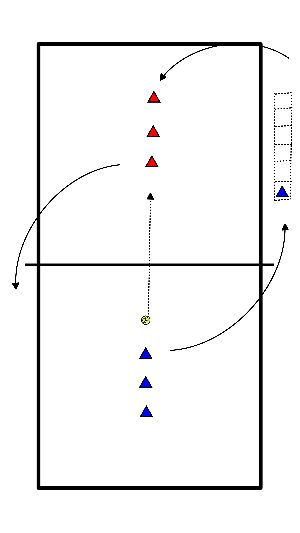
- Divide the team into two groups and have them form two rows facing each other on the 3 meter line.
- Have the players play over the net and then run around the net post to join the other group.
- Place a speedfoot ladder on one side, parallel to the sideline, and have the players do an exercise through the ladder before joining the row.
- It is possible to extend this with block jumps, attacking passes or strength exercises.
- Important is that the ball should not fall on the ground, communication is important.
- If necessary, add a sanction when the ball falls on the ground.
- Alternate between underhand and overhand.
- Purpose of the exercise:
- To focus, communicate, master the task and persevere.
- At "A" and above, with fewer people on the field for more intensity.
- Explanation of the exercise:
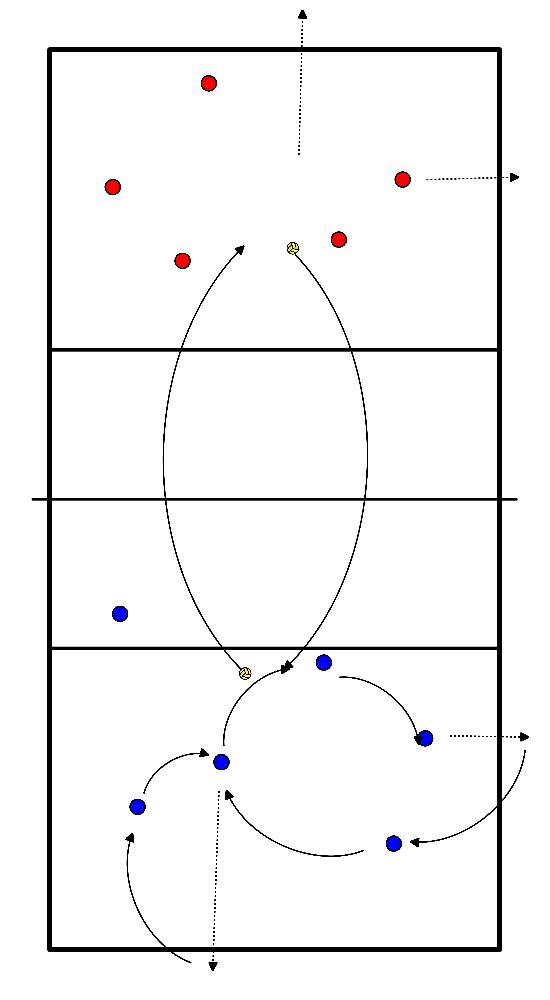
- 'Chaos Easy' starts as a warm-up, but ends in a true battle.
- The players are placed in the field (it doesn't matter where).
- The ball is caught and immediately thrown over the net (one play).
- As the player catches, he throws the ball.
- When a player has thrown the ball, he/she goes to a wall (back of the field or on the side) and taps it, then comes back into the field.
- The other players on the team have moved forward one spot.
- You notice how difficult it is to score.
- When someone throws the wrong ball (into the net or out), they have to sprint around the opponent's field.
- Duration of the exercise:
- 5-10 minutes.
- 1 player at position 2.
- 1 player on position 3.
- Coach or player on position 4.
- Rest of the players in a line behind the back line at position 1.
- Player at position 2 throws a deep ball.
- Player passes back.
- Player at position 3 throws a short ball inside the three meter line.
- Player passes back ball.
- Player/coach at position 4 hits or throws a deep ball.
- Player passes it back and joins the back of the row again.
- Don't forget to pass regularly!
- Coach stands in the middle by the net.
- Line of three players stand behind the back line.
- Trainer throws balls alternately to the right and then to the left.
- Players start walking in circles because they are in threes.
- Players who are not in line are collecting balls.
- Playmaker at the net.
- Two middle attackers, two outside and two diagonal.
- Other players line up to pass.
- Trainer puts ball in play from the other side of the net.
- Passer passes, playmaker chooses attacker and an attack is made.
- After the attack players get the ball and join the passers.
- After passing attack on your own position (or an empty position).
- There is one passer in the field at position [6].
- The trainer or a playmaker stands with the balls at the net at position [3].
- The ball is introduced by hitting or pricking and there is a variation in short/long and hard/soft.
- The passer keeps the ball from the ground (prio 1) and provides the pass to [2/3] (prio 2) where the ball is caught by a team mate.
- This exercise can be played in two variants.
- A. [suitable for large teams]
- After the pass, a new player is rotated into the field and the passer joins the back of the line.
- High tempo!
- The team can be split in two, so that one team always picks up the balls from the other team.
- B. [suitable for small teams]
- The passer remains standing.
- He quickly takes up his position again after the pass and processes a new ball (10 in total).
- The other players spread out to collect the balls.
- After 10 passes the passer takes off and the ball is passed.
- High tempo!
- Explanation:
- 2 teams of 3 players
- Per team 3 volleyballs (different balls so you can tell the difference, 2 'baby' and 1 'normal' ball)
- The team must play the 'normal' ball over the net in 3 times and meanwhile the 'babies' are thrown over.
- Each player may only touch the 'normal' ball once!
- (When a player has played the 'regular' ball, he gets a 'baby' thrown to him)
- Starting positions:
- Mid-back has no ball. Mid-back has no ball (he passes the ball to the distributor).
- Distributor gives a set-up on the outside.
- 3rd player plays the ball over the net. (At first do not attack, only if it goes well!)