

Volleyballexercises
Exercise 1
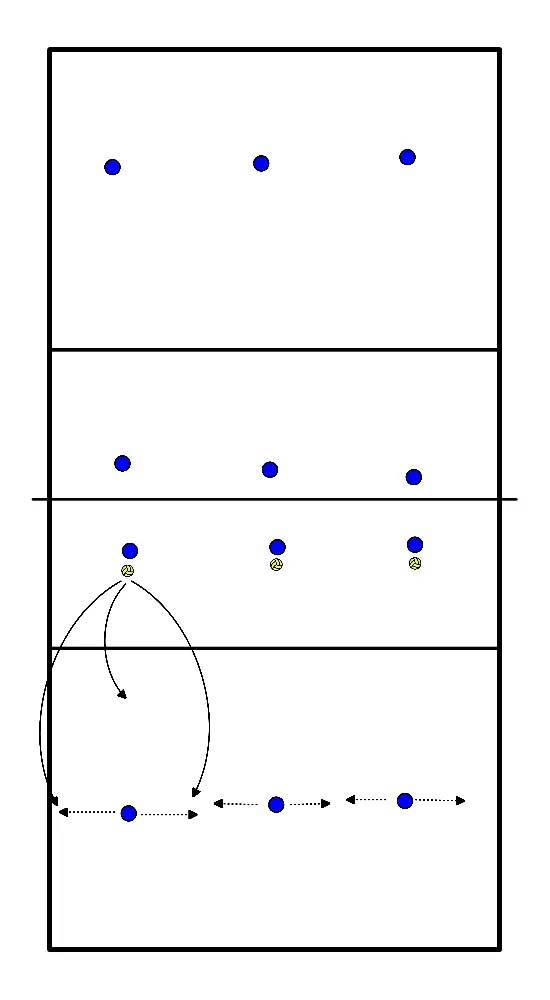
- Each group of three has two balls.
- Two players stand at the net, a few meters apart.
- The third player stands in the backcourt.
- Players at the net alternately throw the ball at a fast pace.
- The player in the backcourt returns the ball underhand.
- The first ball is thrown deep.
- The second ball is thrown short.
- Throwers stand further apart.
- The player on the sideline throws deep, the other player throws short.
- After a certain number of balls or time, players switch positions.
Execution
- Form pairs.
- Player 1 stands with the ball at the net.
- Player 2 lies flat on their stomach behind the end line without a ball.
- The attacker hits the ball.
- The defender defends at the 7-meter line.
- Then, the attacker plays a short ball at the 3-meter line.
Execution
- Player A throws or hits the ball towards Player C.
- Player C passes the ball to Player B.
- Player B provides a set-up.
- Player C attacks.
- Try to attack or play the third ball onto the mats, either straight or diagonally.
- After each ball, the players rotate one position within their own group.
- If there are enough players, a block can also be placed.
Game Progression
- There is one tagger.
- Approximately 2 to 3 balls per 6 players.
- The tagger tries to tag participants without a ball as quickly as possible.
- Individuals with a ball cannot be tagged.
- Players with a ball must be social and throw the ball to someone who is about to be tagged.
- If someone is tagged, they become the new tagger.
Goal
- Players learn to play smart by placing the ball just over the net or into the back corners.
- 6 players
- Row 1: 3 players with a ball behind the trainer
- Row 2: 2 players ready to attack on the left front
- On the other court, place 5 hoops: 1 in each corner and 1 in the center of the court.
- A player from row 1 pushes the ball into the trainer's hands and immediately moves to the reserve position of the setter.
- The trainer tosses the ball to the middle front.
- The setter plays the ball overhead to the right front or left front as a setup.
- The setter immediately moves to the line of attackers after playing the ball.
- The player runs in and tries to play the ball into a hoop. If successful, the setter and the player earn a point.
- The player retrieves their own ball and joins the line of servers.
- Throughout the exercise, it is important to move immediately after the play action.
Execution
- A serves to B.
- B passes the ball to the setter.
- The setter plays a high ball into the backcourt.
- B defends this ball back to the setter.
- The setter provides a setup for A.
- A attacks on this setup.
- After the attack, A takes B's position and B becomes a substitute.
- The setter remains in position.
- The outside hitters use the left half of the court with one setter.
- The middle hitters and opposite hitters use the right half with another setter.
- After the service, A picks up a second ball.
- After B's attack, A throws this ball into the court.
- B plays this ball to the setter.
- The setter provides a setup.
- B attacks once more.
Execution
- Player A throws the ball over the net.
- Player B or C passes the ball back over the net.
- The other player quickly runs under the net and sets the ball for the same player who passed it.
- This player tries to knock a cone off the bench using an overhead play or a hitting motion.
- Which pair or team has knocked the most cones off the bench after a certain number of minutes?
Execution
- Form groups of three and give each group one ball.
- The player in the middle continuously runs a figure eight.
- Each time the player in the middle arrives back, a ball is thrown.
- Player A throws or plays the ball overhead to Player B in the middle.
- Player B plays the ball back underhand to Player A and then runs a loop around Player A until they are back in the middle.
- Meanwhile, Player A plays the ball overhead to Player C.
- Player C plays the ball overhead back to Player B.
- Player B plays the ball back underhand to Player C and then runs a loop around Player C until they are back in the middle.
- Repeat this cycle.
- After 2-3 minutes, switch the player in the middle.
- To make it easier, Players A and C can also throw the ball instead of playing it overhead.
- Both underhand and overhead throwing and catching are allowed.
- To practice standing still while playing or throwing, Player B can throw and catch underhand.
Execution
- Perform ladder running at high speed. Step out of the ladder left-right with one or two feet.
- Slalom around the cones.
- Attack step towards the net and shuffle diagonally backwards (3x attack step and 2x shuffle).
- Step under the net.
- Move sideways along the net with your head under the net edge.
- Make a dive diagonally across the court.
- Run around the cone and sprint over the baseline.
- Jog back to the starting position.
Setup
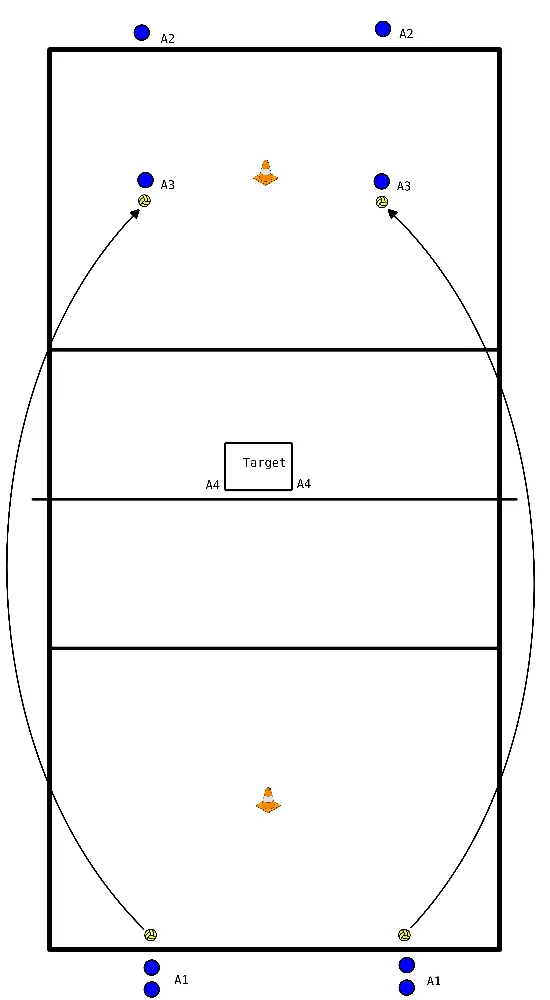
- Divide the court into two lanes.
- Organize players into two groups, each serving within their designated lane.
Execution
- Player serves to her partner on the opposite court and then passes to herself (3 minutes).
- Player passes to herself and sets to the target or her partner as a target in zone 3 (3 minutes).
- Player passes to the target or her partner as a target in zone 3 (3 minutes).
- Player performs an overhand pass only to the target or her partner as a target in zone 3 (3 minutes).
- Perform the same drills as above, but serve cross-court.
Game
- Server aims to serve to a group member on the opposite side.
- Passers must deliver the ball to a group member positioned at the net in zone 3.
- After serving, players rotate positions: server to passer, passer to target, and target to server.
- Scoring: Perfect pass = 3 points, Good pass = 2 points, Okay pass = 1 point, Service mistake = 0 points, Two consecutive service mistakes = -1 point.
- The first group to reach 30 points wins.
Rotation
- After actions, players rotate as follows: A1 to A2, A2 to A3, A3 to A4, and A4 to A1.
Variations
- Divide the game into sets and switch lanes after each set.
- Use a real target instead of players, with coaches judging the passes.
Introduction to the Jump Float Serve
- The Jump Float Serve is a technique where the server jumps before making contact with the ball, aiming for a flat trajectory with minimal spin.
Execution
- Serving to the Wall (3 minutes)
- Stand a few meters away from a wall.
- Practice your jump float serve by aiming to hit the wall at a consistent height.
- Focus on your form and the flat trajectory of the ball.
- Free Serve with Net Awareness (3 minutes)
- Serve freely, aiming to deliver your best jump float serve.
- Concentrate on not hitting the net, maintaining a good height and trajectory.
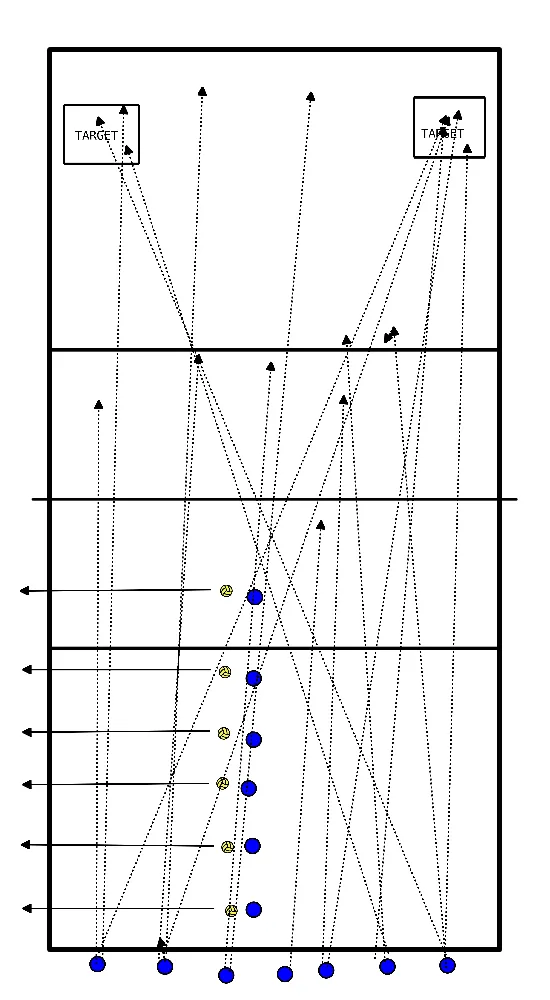
- Serving to the Target in Line (3 minutes)
- Set up a target straight ahead on the court.
- Practice serving directly to the target using the jump float serve technique.
- Serving to the Target in Cross (3 minutes)
- Position a target diagonally across the court.
- Focus on serving to this cross-court target, maintaining the jump float serve form.
Objective
- Improve ball control and coordination between partners.
Execution
- From the net, Player 1 hits a down ball to the left side. Partner sets the ball back to Player 1. Continue for 1 minute.
- From the net, Player 1 hits a down ball to the right side. Partner sets the ball back to Player 1. Continue for 1 minute.
- From the net, Player 1 hits a down ball to both the left and right sides. Partner passes the ball back to Player 1. Continue for 1 minute.
- Repeat the previous step, hitting a down ball to both the left and right sides. Partner passes the ball back to Player 1. Continue for 1 minute.
- From the net, Player 1 hits a down ball to both the left and right sides. Partner passes the ball back and goes to the tip. Continue for 2 minutes.