



Volleyballexercises
Objective
- Focus
- Communicate
- Master the task
- Persevere
- Start as a warm-up and end as a true battle.
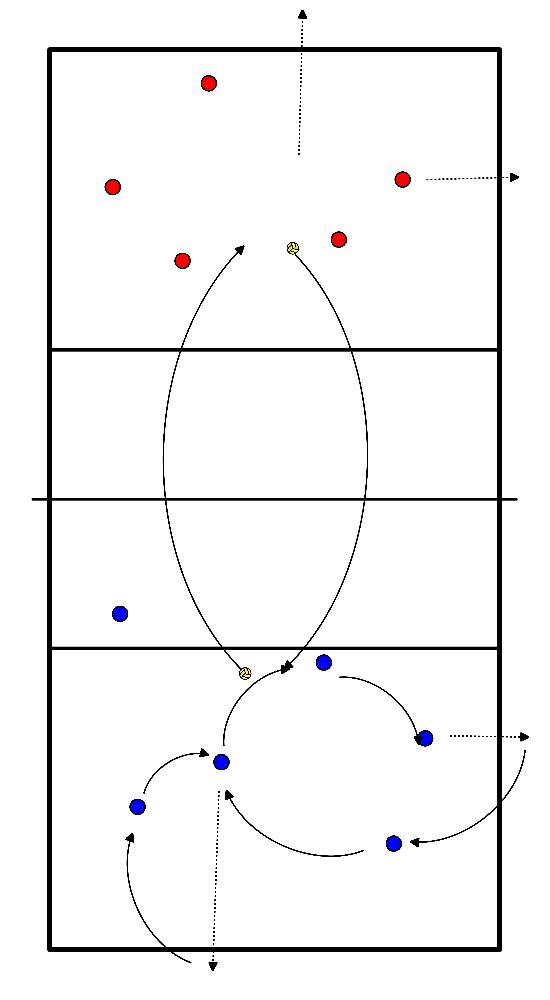
- Players are placed randomly on the court.
- The ball is caught and immediately thrown over the net (one-time play).
- After throwing the ball, the player runs to a wall (at the back or on the side) to touch it and returns to the court.
- The other players rotate one position.
- It is difficult to score.
- In case of a faulty throw (into the net or out), the player must sprint around the opponent's court.
- Duration: 5-10 minutes
- At level "A" and higher, fewer players on the court for more intensity.
Execution
- Player at the net throws the ball to the other player.
- The other player returns the ball underhand.
- Switch roles after 15 times.
- The ball is thrown to the left and right of the player.
- Player moves around the cone to play the ball.
- Switch roles after 20 times.
- Pay attention to the plank and the correct foot forward.
Execution
- Warm-up on both sides of the net.
- Expand with defence and individual blocking.
Objective
- Shift focus and quickly switch between actions.
- Create groups of three players with one regular volleyball and one tennis ball.
- The player with the tennis ball is the juggler and stands in the middle.
- Player 1 passes the volleyball to the juggler.
- The juggler throws the tennis ball to player 1.
- The juggler returns the volleyball to player 1, who throws the tennis ball back to the juggler.
- Player 1 passes the volleyball to player 3.
- Player 3 passes the volleyball to the juggler.
- The juggler throws the tennis ball to player 3.
- The juggler returns the volleyball to player 3 and receives the tennis ball back.
- Repeat this cycle.
- This requires concentration and quick switching from the players.
- If no tennis balls are available, two volleyballs can also be used.
Execution
- Work in pairs.
- Player 1 stands with the ball on the baseline.
- Player 2 stands without the ball at the net, facing the net.
- Player 2 performs a block jump at the net (ensure a straight landing).
- After landing, player 2 turns around and defends a short ball on the 6-metre line.
Execution
- Each player has a ball and continuously dribbles from right to left across the court.
- On the coach's signal: Throw the ball up, hit with the knee, and catch.
- Throw the ball up, head the ball, and catch.
- Throw the ball up, bump the ball, and catch.
- Throw the ball up, bump, head, and catch.
- Throw the ball up, bump, set, bump, and catch.
- Throw the ball up, hit with the right shoulder, and catch.
- Throw the ball up, hit with the left shoulder, and catch.
- Throw the ball up, hit with the right shoulder, left shoulder, and catch.
Setup
- Divide the team into two groups. Each group takes position on one side of the net.
- One side serves, while the other side positions three players as receivers.
- The receivers attempt to pass the ball upwards and catch it on their own side.
- Servers take turns serving.
- After each catch, a new receiver enters the field for the one who caught the ball.
- Play until 10 points are reached.
- The servers score a point if the ball is not caught.
- The receivers score a point if the ball is caught.
- An incorrect service does not count.
- After one round, the teams switch sides.
- In the second round, they play with two receivers instead of three.
Execution
- Start with passing the ball to each other.
- Play the ball 1 or 2 times to yourself.
- Then turn around and play the ball backwards.
- Ensure you stand close to each other.
- Focus on ball control.
Team Formation
- The trainer serves the ball.
- The team defends, sets up, and executes an attack.
- The trainer then throws another ball into the field.
- Players must therefore be ready quickly.
Execution
- The trainer stands at the net with a ball.
- Three players enter the court each time.
- The trainer hits the ball towards the defenders.
- The defenders pass the ball back to the trainer.
- The defenders immediately get ready again to defend the next ball.
- If the ball hits the ground, a new group of three players enters the court.
- The pace is high.
Execution Side A
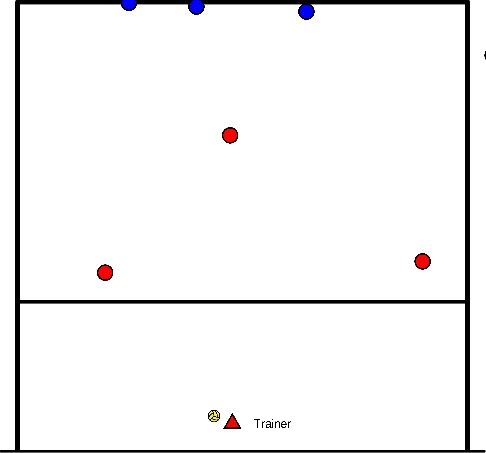
- Team formation, other players on the opposite side.
- Service from side A.
- Team on side B must tip the first two attacks.
- The third attack can only be hit.
- Tip to places that are critical in the defence.
Match Preparation
- The team that must play this coming Saturday will play a practice match against the rest of the players.