



Volleyballexercises
- Divide the team in pairs.
- Player 1 stands on the backline of the court and player 2 stands on a random spot on the other side of the net.
- The intention is that player 1 serves the ball into the hands of player 2.
- Player 2 is not allowed to step aside. If player 1 serves underarm into the hands of player 2 he gets 1 point.
- Overhand? --> 2 points.
- Change after 10 balls.
- The team with the most points wins.
- Player starts on the backline (C and higher)
- or behind the middle (CMV).
- Trainer serves high over the net
- Player runs as fast as possible and tries to catch
- Run back around the outside
- Per person 2 balls
- One ball between the legs/under the arm, other in two hands on a side of choice, throw ball straight up and catch with two hands
- When the ball is up on one side, throw the other ball up on the other side.
- Keep arms straight, throw as much as possible straight up
- Pairs 2 balls.
- One person throws a ball straight to the other person
- Meanwhile the other person throws his ball straight up and throws it back.
- Then catch your own ball
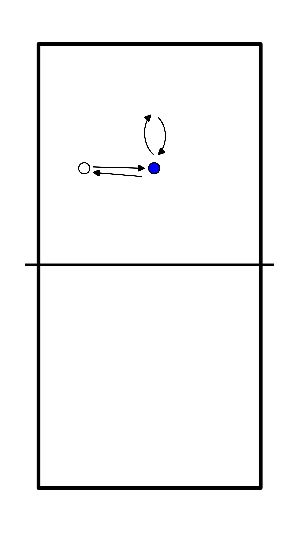
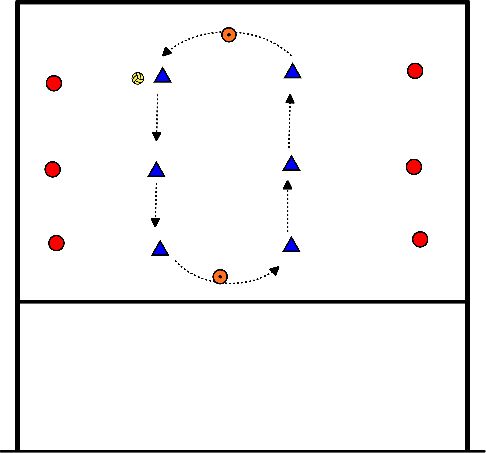
- Red players start from the middle (fists against each other).
- Walk/shuffle towards the sideline and pass the ball back to blue.
- Then return to starting position (match element who is first to be ready again).
- Fists together again and then the same round.
- 4/5 rounds then
- Blue -> red.
- Red -> blue.
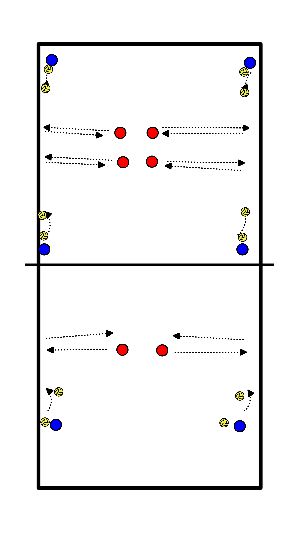
- 1 player at pos 5 throws in the ball to pos 3 (SV).
- 2 players take turns to walk in from pos 1 to pos 3 (SV).
- From here they take care of the setup to pos 4.
- At pos 4, one player stands on an elevation (e.g. plinth/cabinet) to catch the ball and pass it to pos 5.
https://www.youtube.com/watch?v=_qQZSwT531Y
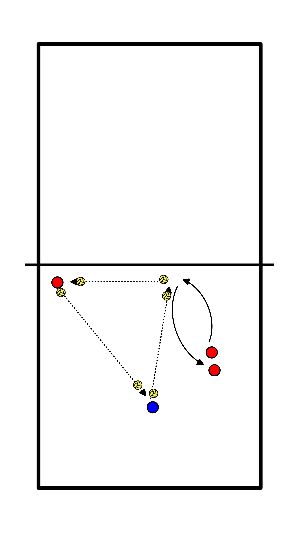
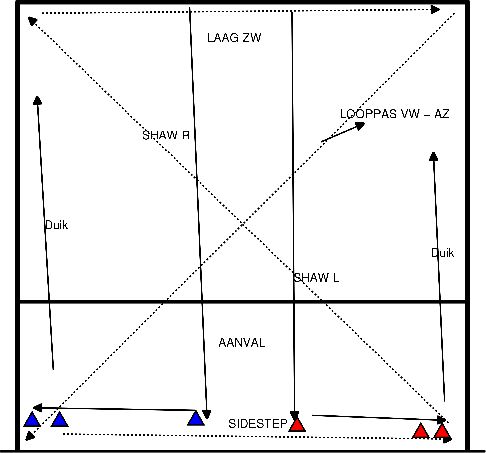
- 7 x diagonal run.
- 5 x to net with attack, 3 x block, dive to back line.
- 3 x sprint on the spot, followed by sprint to 3 m-line, AW back.
- 3 minutes in circle.
- Throw-in/play.
- Playing a game in a 4-2 system.
- Attaching red, yellow and green ribbon to the net.
- Go through all positions in service and reception.
- Make sure that the playmaker (S), outplayer (B) and medium attacker (M) are always positioned diagonally opposite each other.
- The order of lining up anti-clockwise is S, B, M.
- Half of the players stand in a line 2 metres apart.
- Preferably with a wall at their back.
- The other players pass this line in turn at 4 metres from the thrower.
- There is no net in between.
- They are given a ball to return overhead.
- Then they move sideways to the next starter.
- Go down the row and come back to the beginning.
- If there are enough players, a second row can be set up in mirror image.
- Then the players who return the ball go back along this row and have then walked a circle.
- (Row players 1 stand with their backs to row players 2, to throwers 1 and 2 stand with their faces to each other).
- After that you can alternate between the groups and do the same with underhand return.
- As a variation, use different throwing distances.
- Important points of attention: throwing the ball neatly, moving sideways, sitting low when playing OH, high ball tempo.
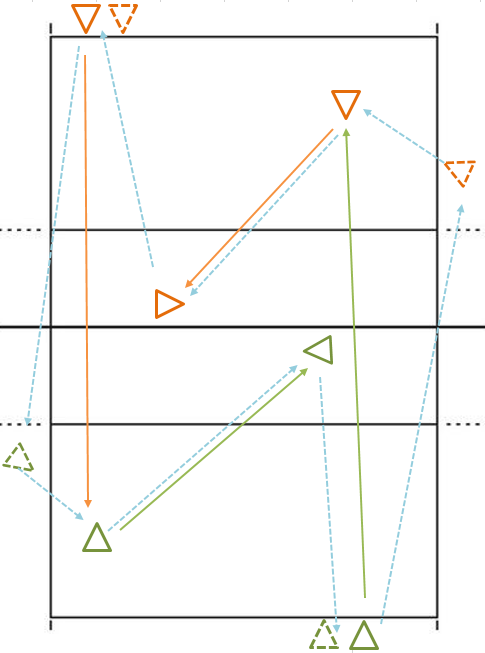
- Both sides serve at the same time (or as much as possible at the same time); the defender makes the pass to position [3] and at position [3] the ball is caught.
- The players run along the blue lines.
- With larger teams, players can be added in the waiting room.
- With more than 10 players the speed of the exercise is lost.
- Goal
- Serves pass well.
- Therefore, there MUST be straight serving, but the server must want to score.
- The passer will not be trained properly if during the training he only gets to play easy balls.
- Of course, the serving pressure can be increased during the training.
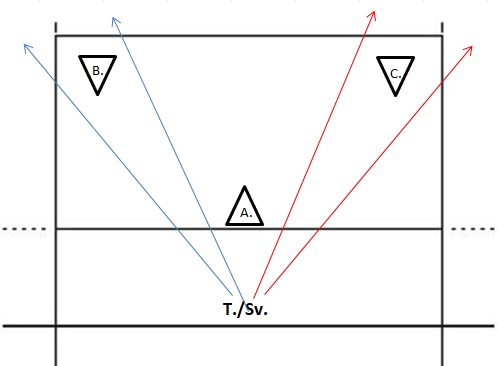
- The purpose of the exercise is to train the defender A in his reaction ability as well as to work together in handling the ball.
- Important for this exercise:
- EVERYTHING is touche!
- The ball that is played/tossed by the trainer (high and far; not hit!) is allowed to come well outside the lines, because the ball must be handled as if it jumped off the block.
- A. stands with his back to the net and concentrates on the defenders B/C.
- If the ball is played by T/Sv. then either B or C demands the ball ("LOS!") and moves to play the ball.
- A. sprints after B/C and offers himself vocally ("HERE!").
- B/C must be able to hear where A is before playing the ball.
- B/C plays the ball high to A and A plays the ball well inside the 3-metre box. T./Sv. makes the catch.
- If there are 8 or more players, this exercise can be done at both ends; if there are less than 8 players, it is played at one end and B/C rotate with players waiting outside the lines.
- In that case, work at a high tempo so that nobody stands still for too long.
- A. changes after 5 or 10 balls; every player takes the position A. twice.
- NOTE: The exercise goes at a high tempo!
- When A. has handled the ball, the next ball follows immediately.
- It is up to the player turning in the ball to get in position in time!
- Expansion:
- Place a basket on a spot of your choice within the 3-meter section.
- The second ball must touch the basket (top) or go through the basket.
- Goal
- Training 3-meter offense and defense.
- Handling hard balls by the defense.
- The exercise
- There are two teams facing each other.
- The teams are balanced in numbers as much as possible.
- The trainer introduces the first ball so that a back player can immediately (with pressure) execute a 3-meter attack, after that the rally is free.
- The team that wins the rally then receives the first ball from the trainer.
- If there are 8 players or less, only attacks from behind the 3-meter, with more players it can be chosen to place players at the net or to make it a King's Court exercise. (The losing side rotates out of the court; all attacks then continue to come from behind the 3-meter).
- The attack takes place on the position [2] at the net and [1] and [6] over the 3-meter.
- The libero always comes from position [5] to take over the Sv. (for instance because the playmaker in the rally took care of the pass) and to take care of the set-up.
- The 'pass' is introduced by the trainer at the height of the 3-meter at position [5].
- If the libero stays outside the 3-meter he may provide the set-up overhand, otherwise only underhand.