

Volleyballexercises
- 6-3 (or ideally 6-6)
- Build up calmly.
- If necessary, 2 attempts.
- Stroke not correct, trainer plays a ball.
- Play out the rally. (If there are too few players, you cannot play on that position).
- The side where the ball falls receives an attack from the trainer.
- Then the trainer throws a freeball to the other side.
- Freeball MUST be played to position 1.
- Series of 3 balls.
- 2/3 scored?
- Team gets a point.
- Up to 10.
- Half of the group works, other half passes balls and ensures ball safety.
- 2 trainers pass balls.
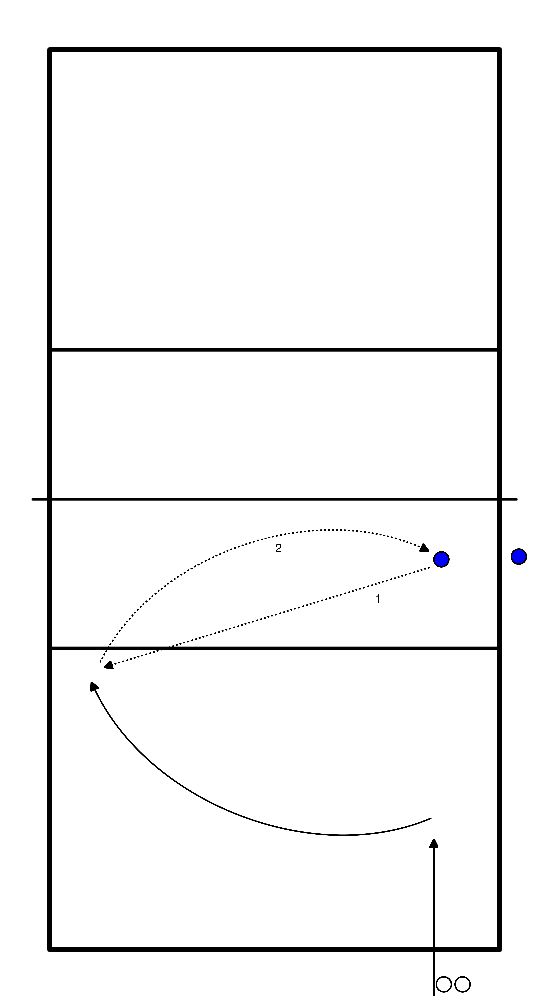
- Player enters court, does split-step and taps ground with 2 hands.
- T touches 1st ball which is defended to catch at position 2/3, T touches 2nd ball which the player defends again after moving and split-step.
- All this at position 5, 6 and 1.
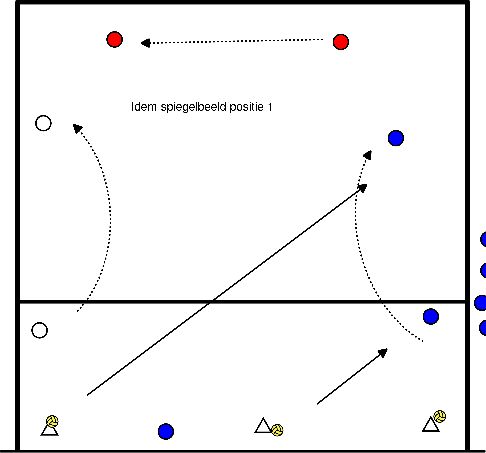
- 2 groups of 4 boys
- Per group 2 balls
- One is passing, one is catching and two are ready at the other side of the net.
- Everyone has to make 5 good passes, then change.
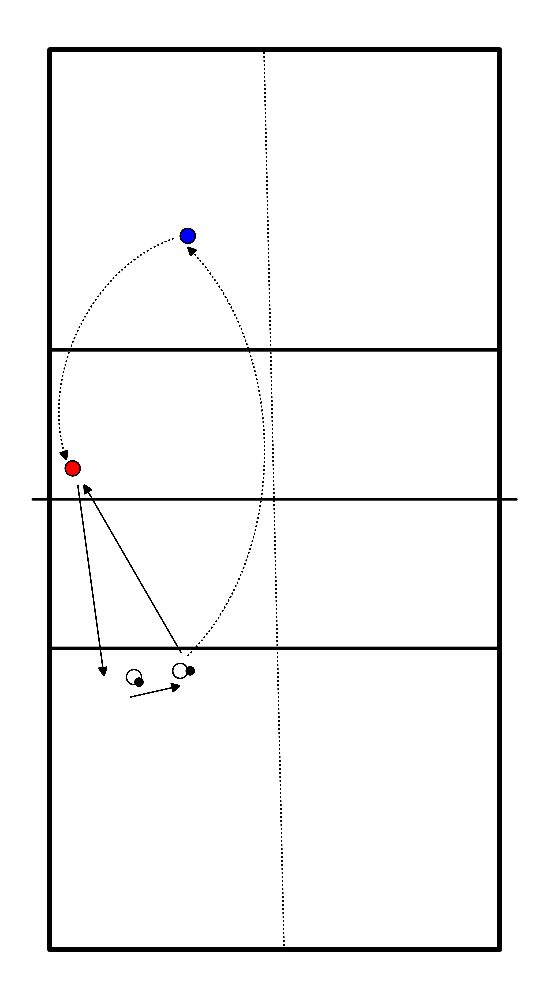
- Find out what the players can do.
- Organization:
- On field A 2 persons without the ball. 1 at the net and 1 at 3m. at position 4 and a SV at 2/3.
- Further on field A a row with ball on 6.
- On field B a defender on 6 and 5.
- Defending and (for now) catching and connecting on field A.
- Method of working:
- Player on 6 throws/plays the ball to SV.
- At the moment of set-up the player at 4 moves backwards at the net (a C-run) and attacks the passed ball.
- Both SV and player give attacking cover.
- The attacker takes the place of the passer.
- Later move attack to 3 and defenders to 1 and 5.
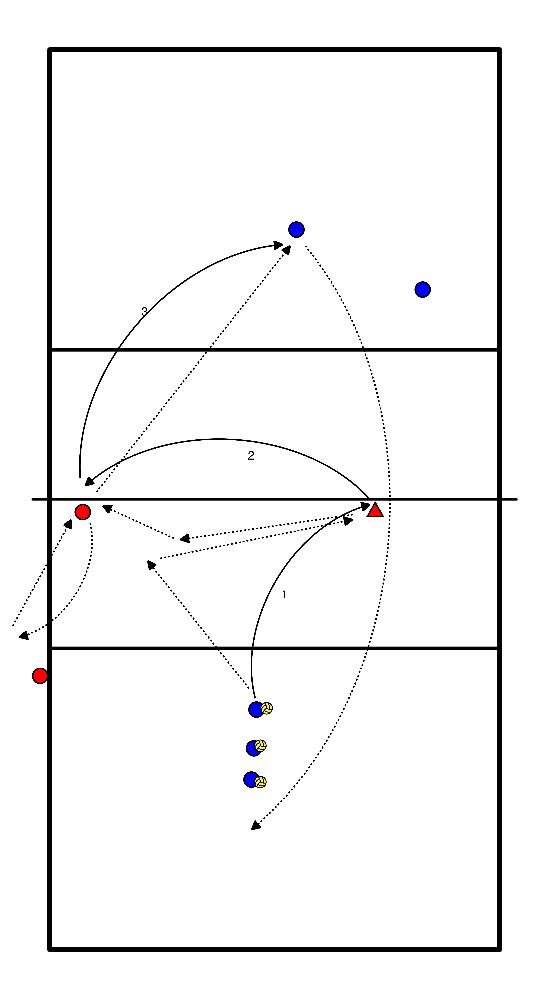
- Basically an exercise to play well BH, but also with an "attacking idea".
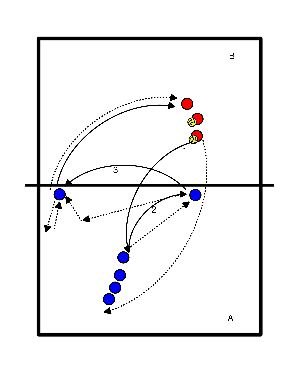
- Organisation:
- Line up 2 players with ball and 1 without ball on position 5/6 on field B.
- Line-up of 4 players on position 6 on field A.
- There is also a player on position 2/3 and at the net on position 4.
- Working method:
- On field B the player in front throws/strikes the ball to the first players on field A and then closes the gap on field A.
- The OH passes the ball high to the players on 2/3.
- The latter plays the ball BH to position 4, first going to "attack coverage" and then taking position 4.
- As soon as the ball leaves 2/3, the player on 4 moves to the 3m-line.
- Then, after a short "run", this player plays the ball BH to the player without the ball on field B.
- This player catches the ball and closes in at the back of field B.
- Goal of the exercise:
- To focus, communicate, master the task and persevere.
- Explanation of the exercise:
- 'Chaos Easy' starts as a warm-up, but ends as a real battle.
- The players are placed in the field (it does not matter where).
- The ball is caught and immediately thrown over the net (one play).
- As the player catches, he throws the ball.
- When a player has thrown the ball, he/she goes to a wall (back of the field or on the side) and taps it, then comes back into the field.
- The other players on the team have moved forward one spot.
- You notice how difficult it is to score.
- When someone throws the wrong ball (into the net or out), they have to sprint around the opponent's field.
- Duration of the exercise:
- 5-10 minutes.
- Purpose of exercise:
- Improve motor speed.
- Explanation of the exercise:
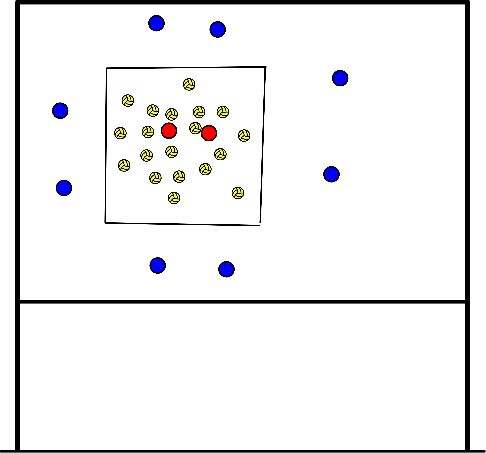
- Make a square of benches and throw in all the balls you have.
- Place two players in the square and the rest around them.
- At the sign of the trainer the two players will try to throw all balls out of the square.
- The rest of the players have to throw all the balls back into the square.
- After 60 seconds the exercises are stopped and the two players count the number of balls in the square.
- The winner is the one who has the least number of balls in the square.
- Everyone takes their turn.
- Duration of the exercise:
- 20-25 min.
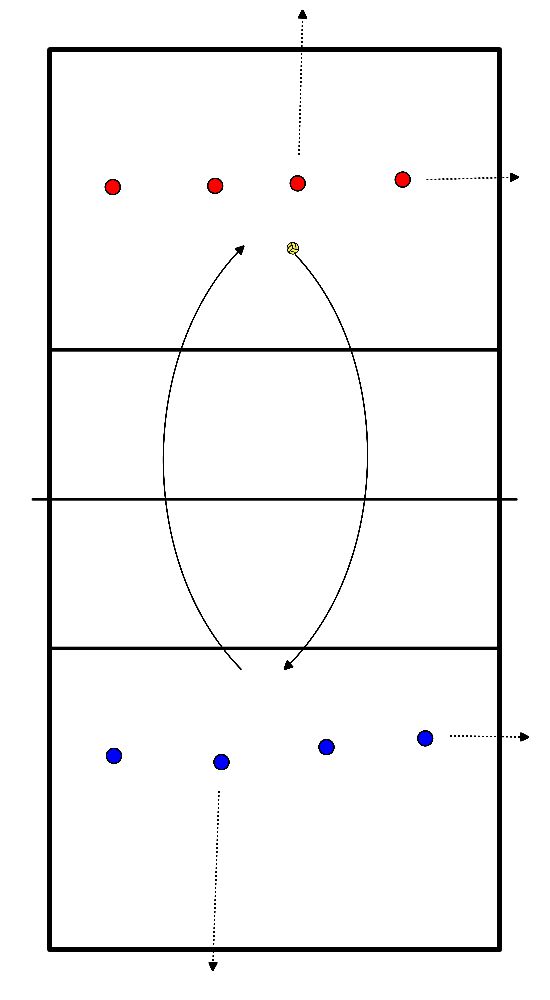
- Divide the team into two groups and have them form two rows facing each other on the 3 meter line.
- Have the players play over the net and then run around the net post to join the other group.
- Place a speedfoot ladder on one side, parallel to the sideline, and have the players do an exercise through the ladder before joining the row.
- It is possible to extend this with block jumps, attacking passes or strength exercises.
- Important is that the ball should not fall on the ground, communication is important.
- If necessary, add a sanction when the ball falls on the ground.
- Alternate between underhand and overhand.
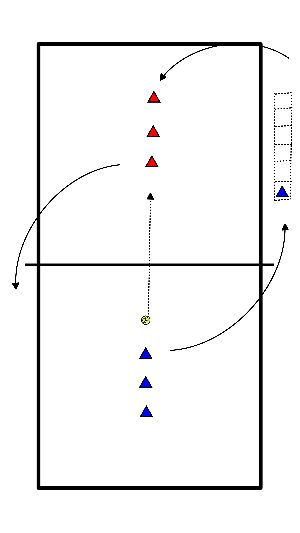
- Organization:
- 6 players per field.
- 2 on each side of the net in position 1.
- Pass to 5 or 6, build up and pass the ball to the server.
- The server defends to position 6, who executes the first contact, and the previous server sets the ball to position 2, the defence player.
- As long as there are 2 balls, keep going, if 1 is dropped, go for the point.
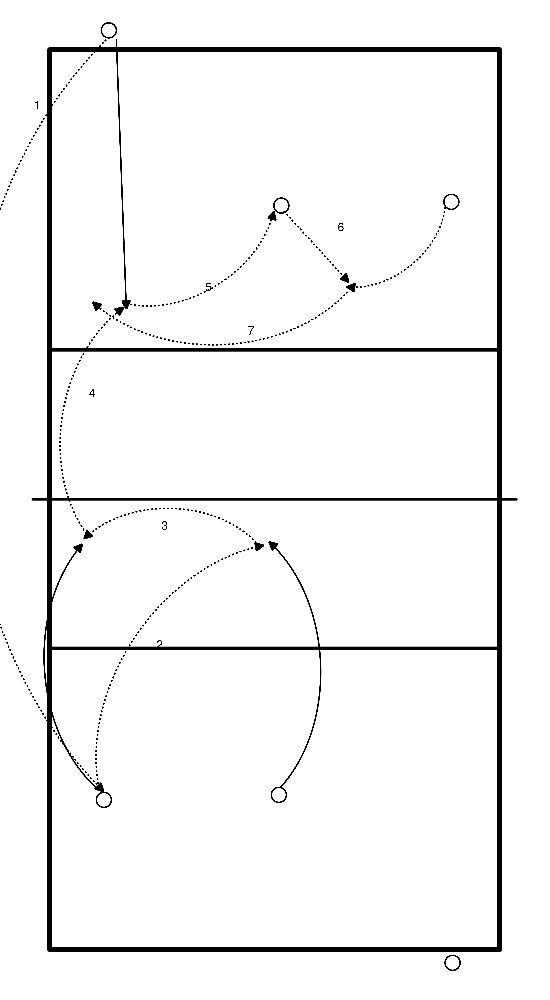
- The player moves left and right into the backfield.
- As soon as the ball is played, the defender stands still and passes the ball back to the player who introduced it.
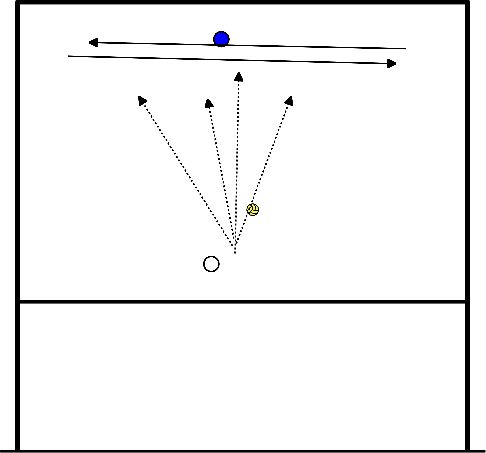
- The passer sits in a chair.
- The ball is thrown to this passer.
- As soon as the ball is thrown, the passer dives for the ball and the ball is played back to the thrower.
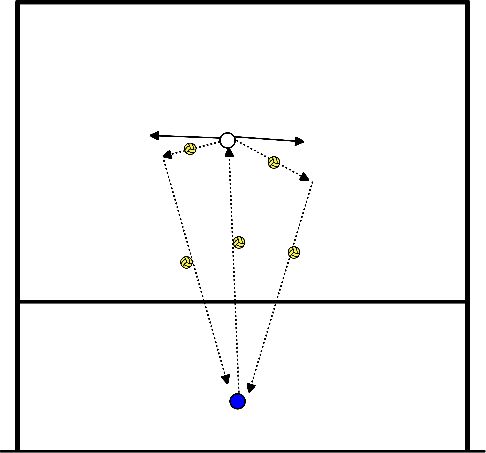
- Organization
- Ladder exercise.
- Sideways movement to between pos. 4 and 5, body turns towards attacker.
- Defence on attack.
- Variant ladder exercise:
- Variant:
- After defence, passer sets ball to pos 4 + attack.
- Pass can also go to blue player (attacker), white player then gets another free ball, on which she definitely gets the pass.
- After defence, the passer can play a move ball to either the white or the blue player, then pass to one of the two.
- Turn over:
- Defence => attack => ladder
- At least 2 reserve players on ladder and attack.
- In case of more players: add a block.