

Volleyballexercises for technique passing / defense / reception
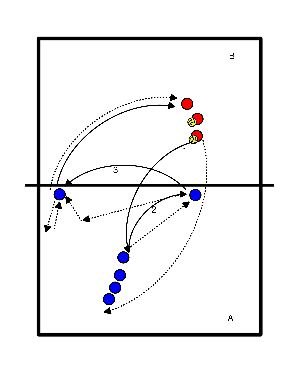
Organization:
- Trainers with ball cart on field B
- Players with hoop on field A on 7m-line
- Players hold the hoop with 2 hands
Execution:
- Trainer throws the ball in an arc over the net
- Player comes in and puts the hoop on the spot where the ball is going to fall
- Same as 1, but catches the ball with 2 hands at navel height
- Same as 2, but now plays the ball underhand.
- Light serve to a receiving player .
- The receiver must deliver the ball in a compact way (to a hoop) with the right technique and height .
- Players at the net give the ball back to the server .
- Change after 10 balls .
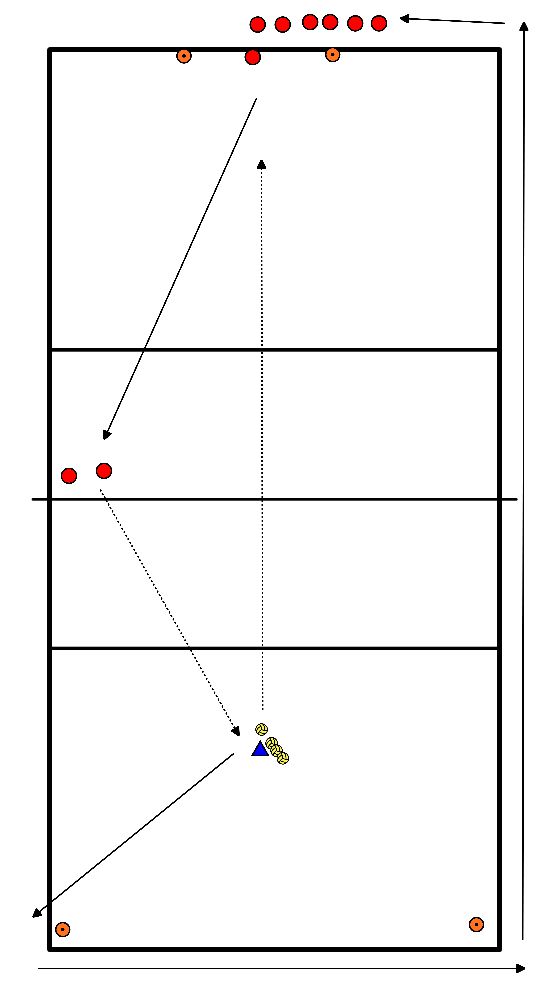
- TR brings in the ball at pace
- Players defend / pass this ball to 2/3 (catcher)
- Catcher catches the ball
- In ball pit near trainer
- Around the pawns and sprint to the other side
- Etcetera
Organization:
- Make 3 duos.
- 1 libero and 2 sv's
Execution:
- 1 duo on field B will serve 2x
- 1 duo on field B will block
- 1 duo passes on field A together with the libero
- On field A the sv's take turns to set up on P2
- Service-Pass-Setup-Attack on field 4, A or B
- On field B defend and catch the attack
- Coach stands in the middle, right at the net.
- Three players are standing in the field.
- Trainer throws/plays the ball to the players.
- It does not matter how they do it, but the ball must get to the trainer.
- Trainer may not take more than one step to get the ball.
- The ball can also be played to the trainer in two or three times.
- When there are 7 or more players the same thing can be done at the other side, but then instead of a trainer there is a player at the net.
- It is important to make sure that the ball is passed to the trainer.
- If there are extra players, someone can stand in the queue.
- If the ball falls to the ground, the substitute will take that spot. (In the case of a large difference in level of play the substitution can be made as well).
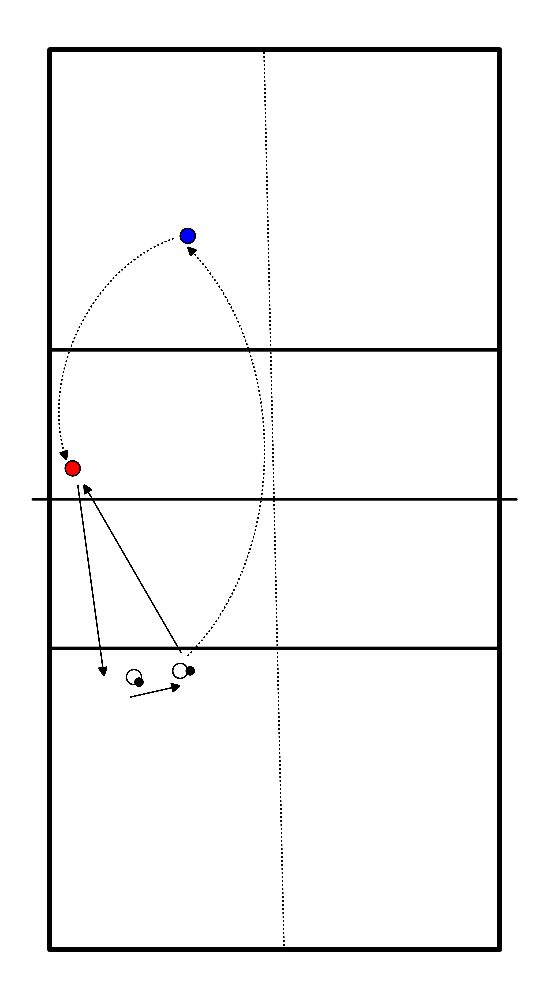
- Red players start from the middle (fists against each other).
- Walk/shuffle towards the sideline and pass the ball back to blue.
- Then return to starting position (match element who is first to be ready again).
- Fists together again and then the same round.
- 4/5 rounds then
- Blue -> red.
- Red -> blue.
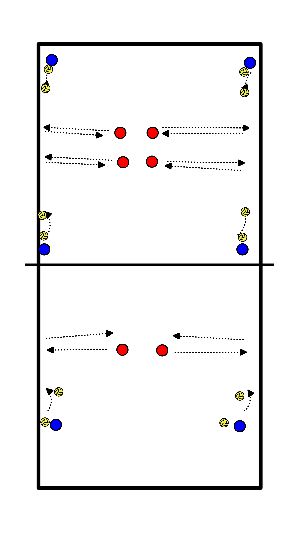
- Half of the players stand in a line 2 metres apart.
- Preferably with a wall at their back.
- The other players pass this line in turn at 4 metres from the thrower.
- There is no net in between.
- They are given a ball to return overhead.
- Then they move sideways to the next starter.
- Go down the row and come back to the beginning.
- If there are enough players, a second row can be set up in mirror image.
- Then the players who return the ball go back along this row and have then walked a circle.
- (Row players 1 stand with their backs to row players 2, to throwers 1 and 2 stand with their faces to each other).
- After that you can alternate between the groups and do the same with underhand return.
- As a variation, use different throwing distances.
- Important points of attention: throwing the ball neatly, moving sideways, sitting low when playing OH, high ball tempo.
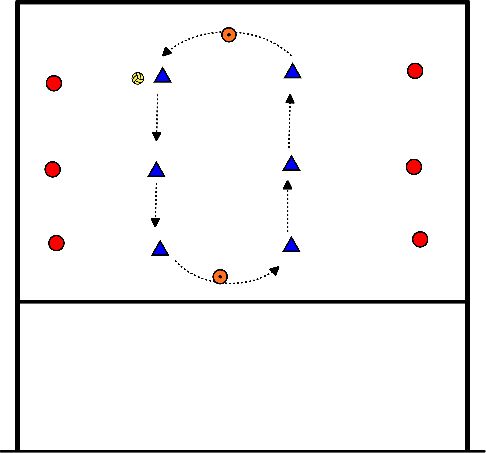
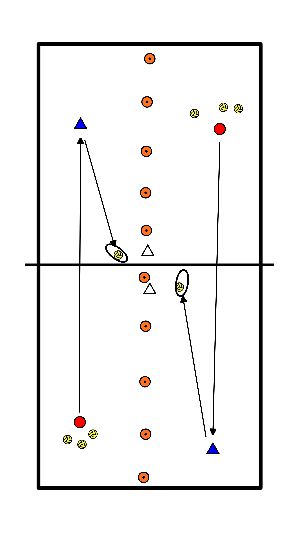
- Player A serves to player B, who receives for himself and catches.
- Player C passes to player D, D gives a pass so C can attack.
- Player E does defense on the attack of player C and plays the ball to player F on the mat.
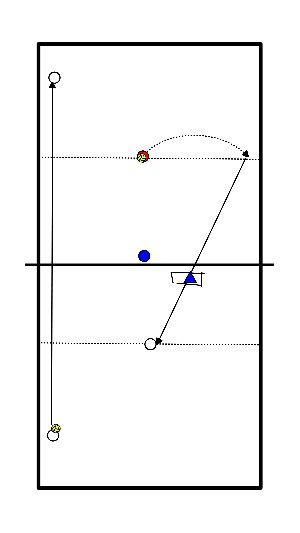
- Organisation:
- Serve from p1 on 2 or 3 players. (p1, p6)
- Sv on p2/3.
- Attacker on P4B opposite block P2A.
- Libero on P5A and defender on P6B.
- Execution:
- Process service pass into attack on 4.
- If score, serve again. (max 2x)
- If defended, pass to OH and attack again.
- Running:
- Passer becomes attacker, attacker becomes block, then defender, then server.
- Server goes to backup passer.
- Objective:
- To prevent miscommunication in the field by keeping appointments.
- Part:
- Pass setup with 4 passers.
- Left hand rule everything that comes right in front and left of you is yours.
- In addition, the outside passers have the short balls that fall in the middle of the field.
- Trainer stands at the other side of the net and starts throwing balls at conflicting places.
- If this goes well, the trainer will hit the balls.
- On the place of the defender there is a catcher who will be relieved after 3 minutes.
- Part 2:
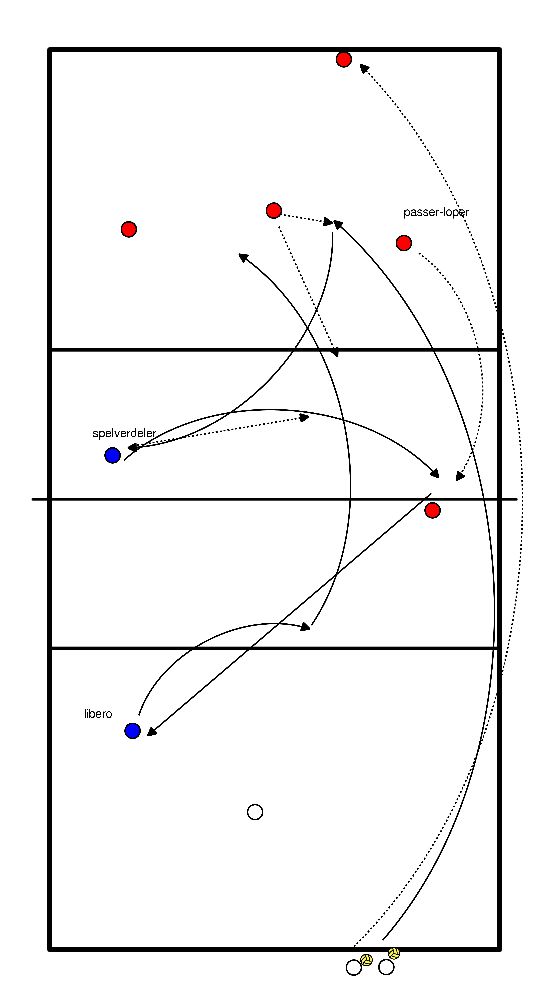
- There is a five-man line-up.
- So a playmaker, a center, a slide and 2 passers/runners.
- The playmaker comes from the right back.
- On the other side are 3 blockers and 1 defender.
- The coach serves to the fivesome.
- The playmaker of the fivesome is only allowed to pass to the attackers who are calling for the ball.(Goal: everyone asks for the ball)
- The rally is played out.
- 2 groups of 4 boys
- Per group 2 balls
- One is passing, one is catching and two are ready at the other side of the net.
- Everyone has to make 5 good passes, then change.
- Basically an exercise to play well BH, but also with an "attacking idea".
- Organisation:
- Line up 2 players with ball and 1 without ball on position 5/6 on field B.
- Line-up of 4 players on position 6 on field A.
- There is also a player on position 2/3 and at the net on position 4.
- Working method:
- On field B the player in front throws/strikes the ball to the first players on field A and then closes the gap on field A.
- The OH passes the ball high to the players on 2/3.
- The latter plays the ball BH to position 4, first going to "attack coverage" and then taking position 4.
- As soon as the ball leaves 2/3, the player on 4 moves to the 3m-line.
- Then, after a short "run", this player plays the ball BH to the player without the ball on field B.
- This player catches the ball and closes in at the back of field B.