



Volleyballexercises for technique system
Organization:
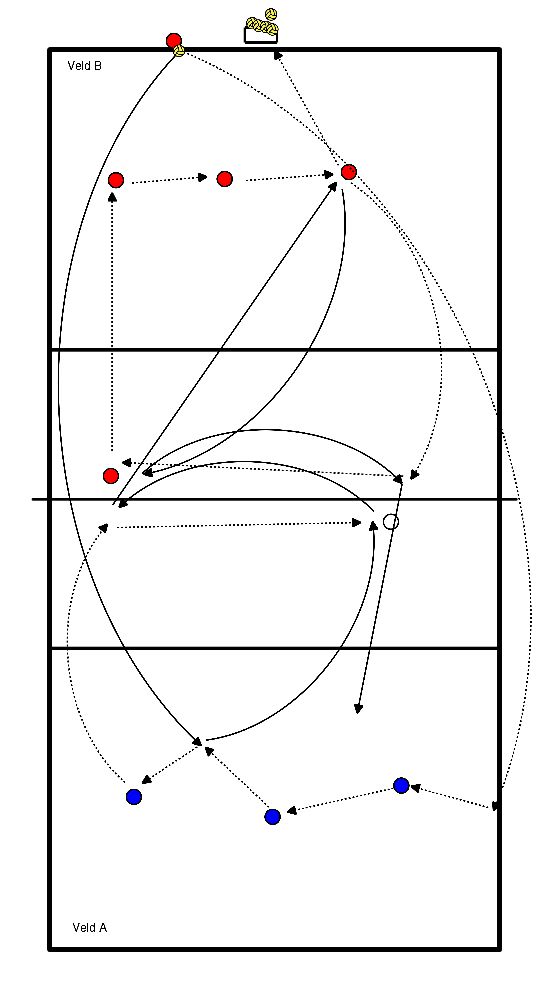
- 3 passers and "Sv" on 2 and reserve on 1
- 3 defenders and 1 sv/block on 2
Execution:
- Ball is served. First trainer, then players.
- Pass by 1, 5 or 6 to p2/3.
- "Sv" gives a setup to p4
- Player on p5 runs a "C" and attacks the ball.
- Possible rally play
- "Sv" goes to get ball and then serve
Runs:
- Field A:
- Reserve=>1=>6=>5=>2=>field B
- Field B:
- Reserve =>5=>2=>1=>6=>serve=>field A
NB: FOCUS IS ON SERVICE PASS
- 6 plays a number of rallies
- Where especially the movement in the field has to be good.
- Two fixed setters
- GREAT VARIATION:
- Set from 2.5 instead of 3.
- The setter indicates this himself.
- WHY?
- If the opponent has big blockers in the middle and on the left, the setter can play the ball to the outside to avoid the block.
- Setter indicates this with fingers (you can also agree on other signs).
- 2 fingers means pass to position 2,5.
- No sign means pass to 3.
- The other players have to move with the pass.
- Minimum service pass, with 3 players, preferably 4 players.
- Maybe practice with a setter from the right back.
2:4 system.
- Setter goes to midfield
- If the setter is on the right frontside he can indicate to stay there (pos. 2.5)
2:4 system
- Setter comes from the backfield to the right front.
- Setter starts at 1, protected by position 2.
- Setter goes to 2,5.
- Pos. 2 can attack on 2 and so can pos. 3 and 4.
- Setter starts at 6, protected by position 5.
- Position 5 goes to 6.
- Position 4 goes to 5.
- Position 2 can back off a bit, also applies to other setter on pos.
- Setter goes to 2.5.
- Setter starts on 5, is protected by position 6.
- Position 1 and position 4 are in the backfield.
- Position 2 and 3 can move back a bit.
- All passes go to 2.5.
- Setter comes out of the backfield
- And has 3 attackers each time.
- Playing a game in a 4-2 system.
- Attaching red, yellow and green ribbon to the net.
- Go through all positions in service and reception.
- Make sure that the playmaker (S), outplayer (B) and medium attacker (M) are always positioned diagonally opposite each other.
- The order of lining up anti-clockwise is S, B, M.
- The attack takes place on the position [2] at the net and [1] and [6] over the 3-meter.
- The libero always comes from position [5] to take over the Sv. (for instance because the playmaker in the rally took care of the pass) and to take care of the set-up.
- The 'pass' is introduced by the trainer at the height of the 3-meter at position [5].
- If the libero stays outside the 3-meter he may provide the set-up overhand, otherwise only underhand.
- T strikes ball to libero, 2 attackers start at the net.
- Pass, set-up and attack on position 3 or 4.
- Blocking:
- Outside, inside hand on ball, center joins in.
- Centre blocks with emphasis on shielding position 1/2.
- Then service (float) to position 1.
- Variant:
- Attack on positions 2 and 3 and service to position 5.
- 6-3 (or ideally 6-6)
- Build up calmly.
- If necessary, 2 attempts.
- Stroke not correct, trainer plays a ball.
- Play out the rally. (If there are too few players, you cannot play on that position).
- The side where the ball falls receives an attack from the trainer.
- Then the trainer throws a freeball to the other side.
- Freeball MUST be played to position 1.
- Series of 3 balls.
- 2/3 scored?
- Team gets a point.
- Up to 10.
- From standing position move backwards and roll to center of field.
- Starting position defense - outside foot in front, on the line.
- Move to 7M and then roll to center of field.
- A few times without the ball, then with the ball.
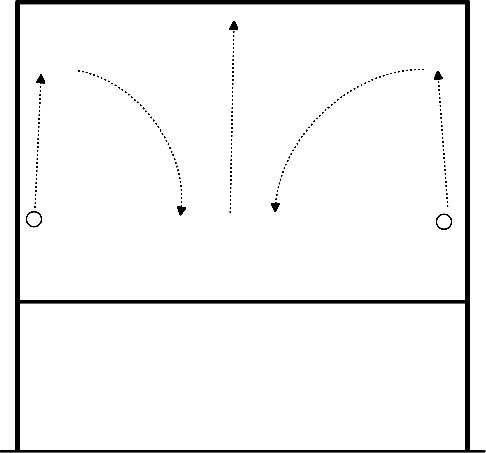
- Throwing/playing the ball and then chasing it
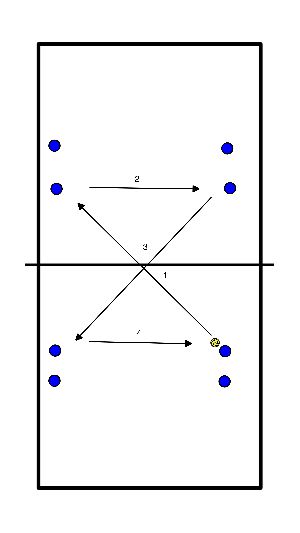
- Practice setup underhand because of emergency balls or ill fitting balls.
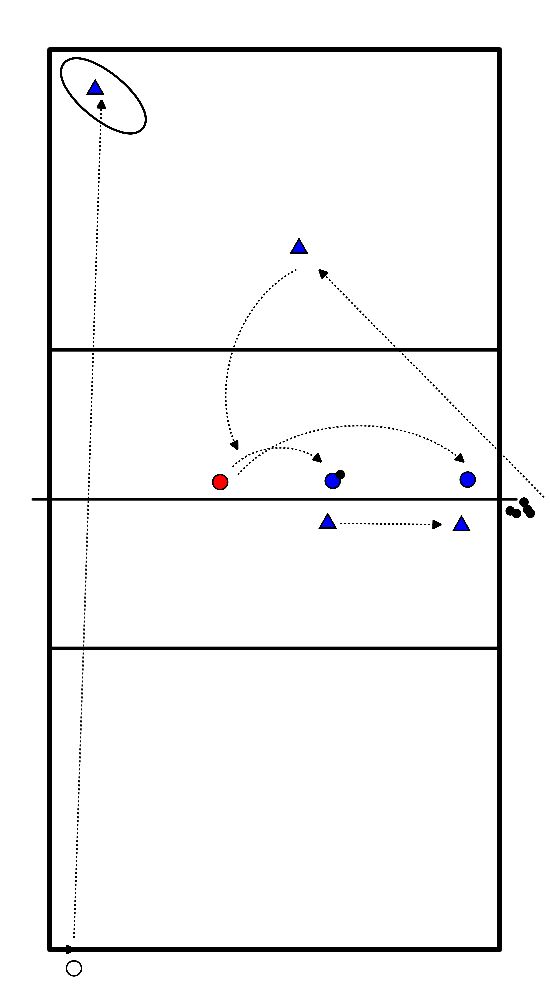
- The trainer throws the balls to player 2 who plays the ball underhand to the right front.
- Player 1 walks to this position and gives an underhand setup on the outside where player 2 attacks.
- After this action player 1 goes to position of player 2 and player 3 comes to position of player 1. etc.
- The attackers get the balls themselves and put them back in the ballcar.
- When the pass is going well you can increase the pace so that the exercise continues and people do not have to wait too long.
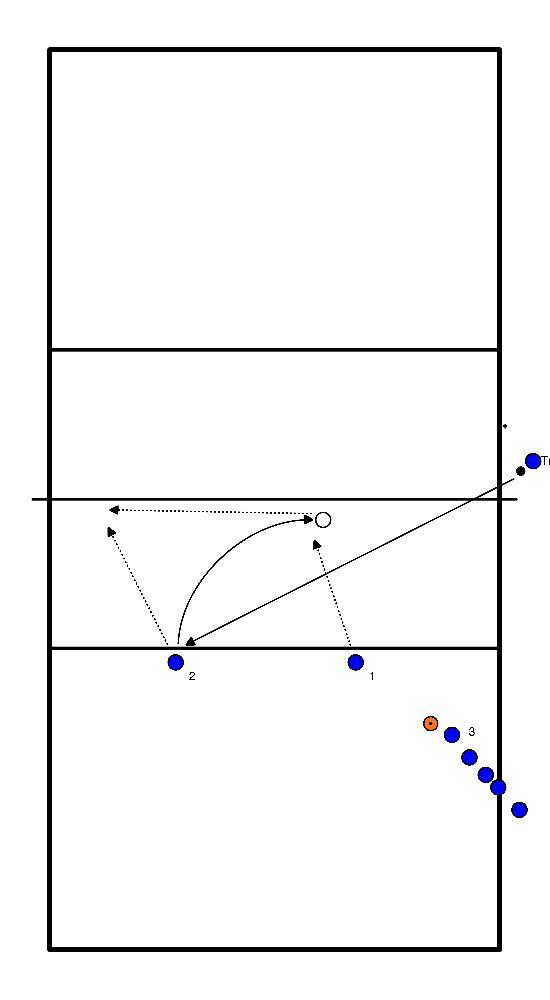
- Ball is played in at the 6m line.
- Defend ball to passer who chooses where to play !
- pos 4 or pos 3
- 1 blocker leaving on center pos. who tries to block
- pos 4 or pos 3
- Play 20 times, then switch
- Cover by passer + possibly defender on pos 5
- After handing in the ball, defend according to the blocker's signal.
- Hoops (goals) in front:
- Street, slide far & slide short (net)
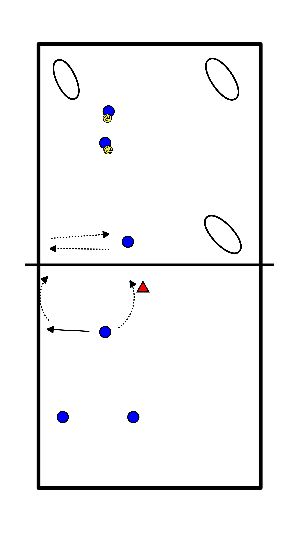
- The goal is to play the ball in threes. This requires the commitment of every player.
- So line up three players.
- They solve a thrown ball (by the trainer), by playing in threes.
- The first ball is passed to the upper-position.
- The 2nd player, who has the job of upper-player, runs to the upper-place.
- The 3rd player then prepares for the attack.
- At first keep the ball on one side of the net, by not actually hitting the 3rd ball, but catching it.
- Then 3 other players move in to do the same.
- On the other side of the net, the same is practiced with the other half of the team.
- After a while, when the ball is regularly played in threes, the ball is actually played to the other side.
- The team on the other side then plays the ball back in threes.
- And so on; play over as long as possible.
- No scoring, it's about playing in threes.