

Volleyballexercises for u10
Part 1:
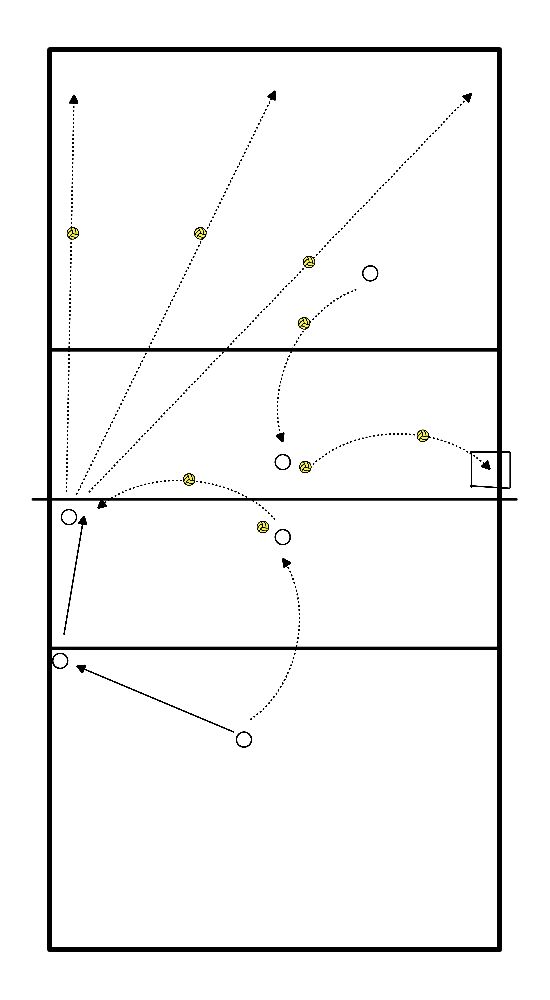
- At the position where the attacker would normally pass the ball over, a basket is placed.
- by means of a high key the ball is played into the basket
- make it more difficult by adding an extra pass BH or OH
Part 2:
- instead of the basket the attacker makes the move but does not hit!
- catching the ball overhead with the striking hand behind the ball
Part 3:
- pass and strike
Exercise on stroke
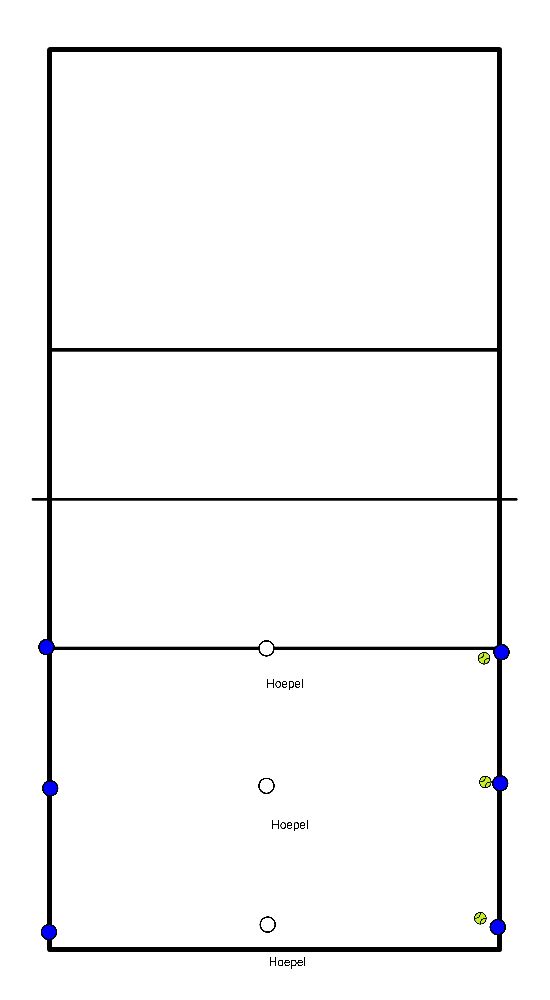
- per 2 players one hoop and one tennisball
- try to play the tennis ball into the hoop with an overhand throw, pay attention to the wrist movement
- the difficulty can be determined by increasing the distance to the hoop.
- afterwards with a volleyball
- next step throw and hit yourself
Basic exercise:
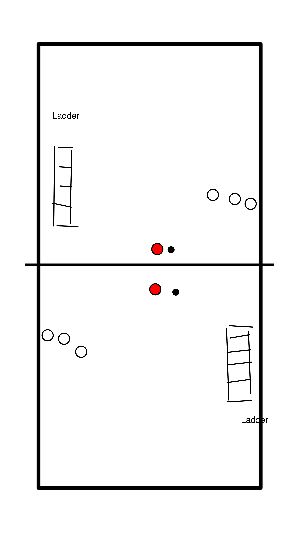
- Trainer throws ball, player catches ball and puts it in the cart.
- After this the player goes to the ladder. Here he goes through it and joins the next row.
Differentiation/Extension:
- Throwing the ball in a difficult way (left and right, front and back).
- Playing underhand and catching for themselves.
- Two players stand ready next to each other and have to call loose.
- A setupper comes on and has to catch the underhand ball.
- An attacker arrives and has to play the ball from the setupper over the net.
You go in the running pass to the net and back to the back line.
- To the net you swing your left arm forward and back to the baseline your left arm back.
- Now you do the same as step 1 but with your right arm.
- Now you go heel-toe, this means that your heels have to touch your buttocks, you do this with a straight back (chest out) and your hands behind against your buttocks. You do this with a straight back (chest out) and your hands against the back of your buttocks.
- Now you are going to lift your knee, this is when you lift your knees to 90 degrees, the height of your hips. You do this with a straight back (chest out), towards the net and back to the baseline.
- You are now going to do the sideways pass, this means that you look with your body to one side and move sideways. You do this in the same way as the shuffle. If you go from the net back to the baseline you turn around again.
- Finally you do the cross pass, this means that you look with your body to one side and cross your legs, your arms move with you from left to right.
- You stand about 3 meters from a wall, you do the attack run. (attack pass) Short-long- close pass (brake pass).
- If you get too close to the wall with the brake pass, you have to look at how big your 2 previous passes were.
- With the brake pass/ close pass you make sure your striking hand touches the wall (don't put too much force on it)
- You take your arms with you, so with the short arms to the front, with long arms to the back, with the brake pass bring your arms up.
- Pay attention:
- Make sure you don't end up too close to the wall.
- Or that you hit the wall with your face.
- Also keep an eye on your technique and how your feet end up.
You go in the running pass to the net and back to the back line.
- To the net you swing your left arm forward and back to the baseline your left arm back.
- Now you do the same as step 1 but with your right arm.
- Now you go heel-toe, this means that your heels have to touch your buttocks, you do this with a straight back (chest out) and your hands behind against your buttocks. You do this with a straight back (chest out) and your hands against the back of your buttocks.
- Now you are going to lift your knee, this is when you lift your knees to 90 degrees, the height of your hips. You do this with a straight back (chest out), towards the net and back to the baseline.
- You are now going to do the sideways pass, this means that you look with your body to one side and move sideways. You do this in the same way as the shuffle. When you go from the net back to the baseline you turn around again.
- Finally you do the cross pass, this means that you look with your body to one side and cross your legs, your arms move with you from left to right.
- player 1 at the net midfield
- number; players at mid-back with the ball
- row of players on the left (or right) side in front
- 2 corpses as disturbance/block on other side of the net
- 2 players as defence at the other side of the net
- player with ball throws to midfield
- midfield puts up HIGH
- left front attacks
- if hitting fails: play smart over the net
- if ball lands on the ground in the field you have a point
- Defenders try to prevent this.
- Everyone keeps on turning.
- Tackle becomes playmaker
- Defender joins the row of attackers
- Attacker passes under the net and becomes 1st defender.
- 2nd defender takes ball, passes under net and joins row of attackers
- 2 teams.
- Stand next to each other on all fours (rounded back).
- One player crawls under the others with the ball in front of him, at the end he rolls the ball back and stands on his own back.
- Then the next player etc. From sideline to sideline
- 2 opposite each other on the back line of both fields, 1 ball on the middle line.
- On signal of the trainer, sprint to the net, who has the ball first.
- This exercise can also be done with a dive first and then sprinting to the ball.
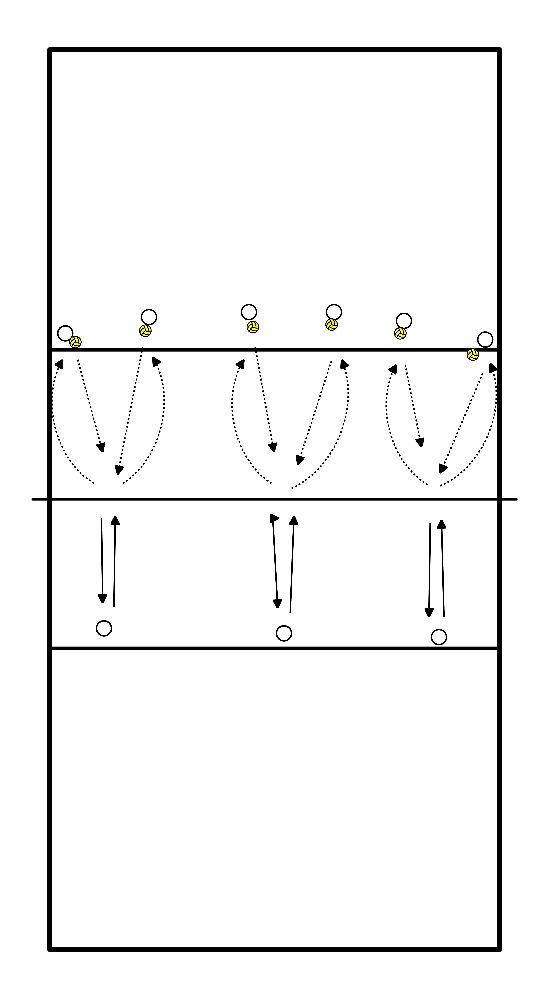
- 2 players with the ball at one side of the net on the 3 meter line, throw the ball in turn
- 1 player on the opposite side on the 3 meter line, this player makes the action
- walks to the net and plays the ball oh high to the player from whom the ball came
- runs backwards to the 3 metre line
- sessions of 10 movements and change
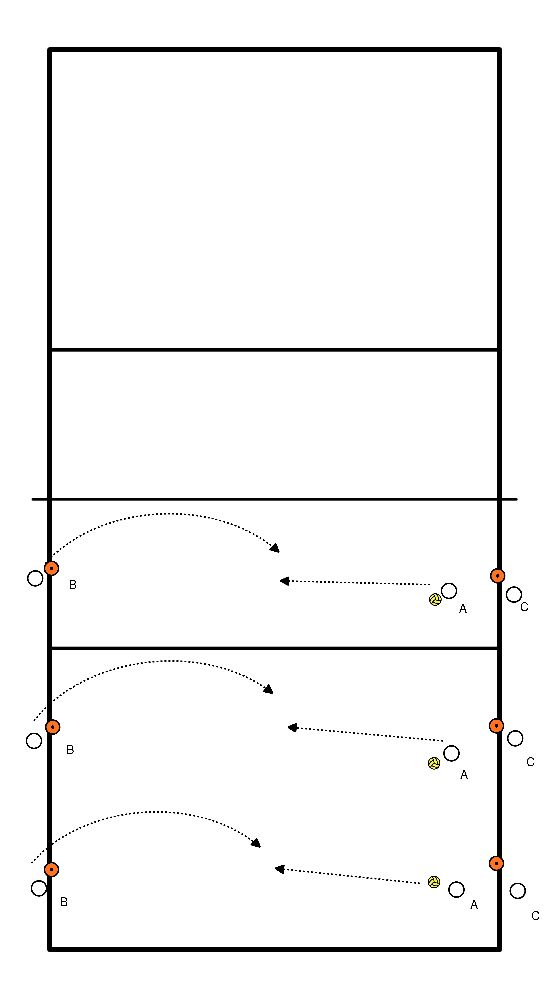
- per 3, 1 ball
- 2 cones per trio on the width of the volleyball field.
- player a runs in throws the ball high, player b runs in catches underhand and throws the ball high again, player c runs in and catches the ball underhand
- adjust to bra, reception or combinations of
This is always fun to do, especially the smaller kids like it.
- You have a monkey= This person is appointed by the trainer. This person must try to steal the coconut without getting caught.
- You have a coconut= This is basically just the volleyball, or another ball.
- You have a monkey hunter= This person is also assigned by the trainer, but the monkey hunter is ''undercover'', so he is just a palm tree but if the monkey has the ball in his hand, he may tap the monkey.
- And finally you have the Palm Trees= These are all the other players who are not the monkey or the monkey hunter.
You put all the players in a circle on one side of the field, in the middle of this circle you put the ''coconut''.
The trainer chooses the monkey in the presence of the whole team. The monkey then moves towards a wall or stands somewhere with its eyes and ears closed, facing the other way so it cannot see the team. You then say "The monkey hunter is....." (you point out the child, do not say the name of the child). If everyone knows who the monkey hunter is you say that the monkey can come back. The space between the palm trees where the monkey goes in the beginning, he must go back again.
For example, if the monkey goes between John and Peter in the direction of the coconut, it cannot go back between Hans and John.
If the monkey takes the coconut outside the circle without being tapped, the monkey wins.
If the monkey is tapped before it leaves the circle with the coconut, the monkey hunter has won.
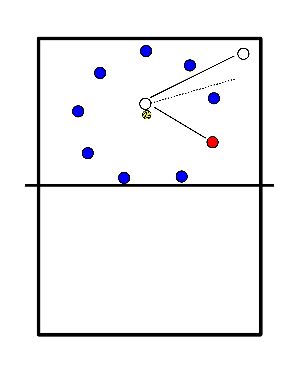
- The blue balls are the "palm trees" players.
- The red dot is the ''monkey hunter''. The monkey does not know who the monkey hunter is. The monkey hunter is trying to tap the monkey.
- The white ball is the ''monkey''. He is trying to get the coconut without being tapped.
- The yellow ball is the coconut.