

Volleyballexercises for u13
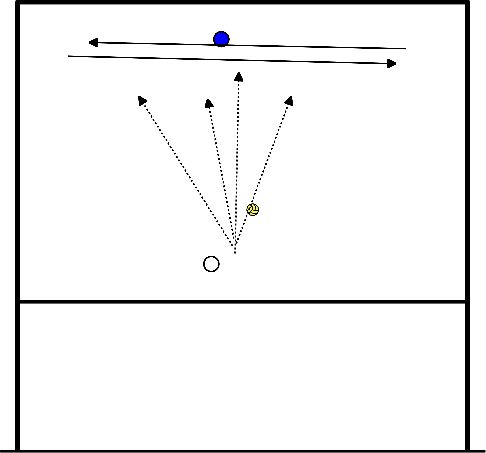
- Coach stands in the middle, right at the net.
- Three players are standing in the field.
- Trainer throws/plays the ball to the players.
- It does not matter how they do it, but the ball must get to the trainer.
- Trainer may not take more than one step to get the ball.
- The ball can also be played to the trainer in two or three times.
- When there are 7 or more players the same thing can be done at the other side, but then instead of a trainer there is a player at the net.
- It is important to make sure that the ball is passed to the trainer.
- If there are extra players, someone can stand in the queue.
- If the ball falls to the ground, the substitute will take that spot. (In the case of a large difference in level of play the substitution can be made as well).
- Divide the team in pairs.
- Player 1 stands on the backline of the court and player 2 stands on a random spot on the other side of the net.
- The intention is that player 1 serves the ball into the hands of player 2.
- Player 2 is not allowed to step aside. If player 1 serves underarm into the hands of player 2 he gets 1 point.
- Overhand? --> 2 points.
- Change after 10 balls.
- The team with the most points wins.
- Player starts on the backline (C and higher)
- or behind the middle (CMV).
- Trainer serves high over the net
- Player runs as fast as possible and tries to catch
- Run back around the outside
- Per person 2 balls
- One ball between the legs/under the arm, other in two hands on a side of choice, throw ball straight up and catch with two hands
- When the ball is up on one side, throw the other ball up on the other side.
- Keep arms straight, throw as much as possible straight up
- Pairs 2 balls.
- One person throws a ball straight to the other person
- Meanwhile the other person throws his ball straight up and throws it back.
- Then catch your own ball
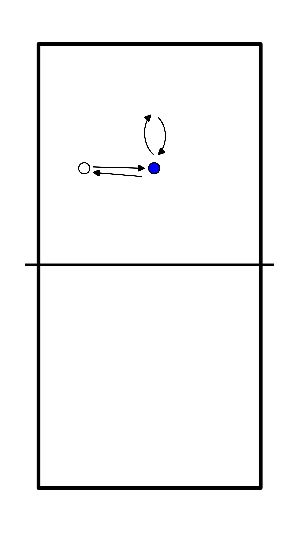
- 1 player at pos 5 throws in the ball to pos 3 (SV).
- 2 players take turns to walk in from pos 1 to pos 3 (SV).
- From here they take care of the setup to pos 4.
- At pos 4, one player stands on an elevation (e.g. plinth/cabinet) to catch the ball and pass it to pos 5.
https://www.youtube.com/watch?v=_qQZSwT531Y
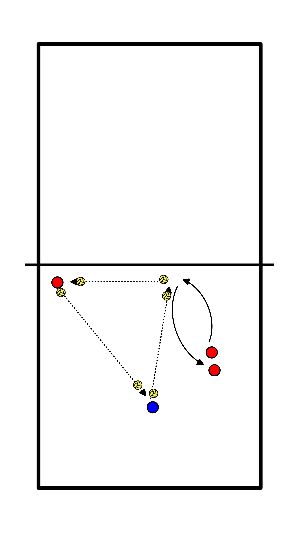
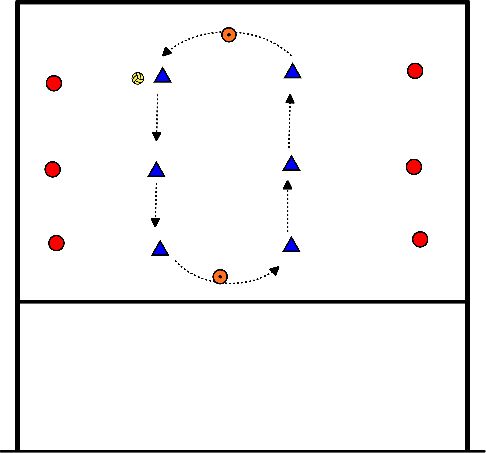
- Half of the players stand in a line 2 metres apart.
- Preferably with a wall at their back.
- The other players pass this line in turn at 4 metres from the thrower.
- There is no net in between.
- They are given a ball to return overhead.
- Then they move sideways to the next starter.
- Go down the row and come back to the beginning.
- If there are enough players, a second row can be set up in mirror image.
- Then the players who return the ball go back along this row and have then walked a circle.
- (Row players 1 stand with their backs to row players 2, to throwers 1 and 2 stand with their faces to each other).
- After that you can alternate between the groups and do the same with underhand return.
- As a variation, use different throwing distances.
- Important points of attention: throwing the ball neatly, moving sideways, sitting low when playing OH, high ball tempo.
- This activity promotes:
- Cooperation
- Communication
- Dealing with disappointments
- Fun
- Working method
- Make a circle of your players of maximal 12 players.
- If you are doing this with a large selection you could split the first team and second team or make a circle of men next to a circle of women.
- Give the following instruction:
- Hold out your hand to someone across the way and hold it tightly.
- Then give someone else your other hand.
- This creates the team knot.
- Make sure you get out of the knot without letting go of the hands.
- Variation
- Nobody can say anything.
- Everyone can say something.
- One person can say something.
- You can, after the group is out of the knot, have the group discuss what the best tactic is and then put them back "in the team knot".
- Evaluation
- Watch carefully what happens, who takes the lead, who gives up quickly?
- How does the group solve the problem?
- Player A serves to player B, who receives for himself and catches.
- Player C passes to player D, D gives a pass so C can attack.
- Player E does defense on the attack of player C and plays the ball to player F on the mat.
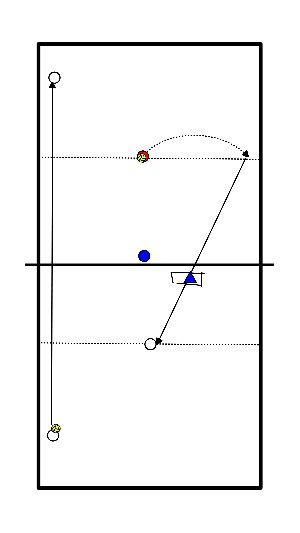
- Divide the field in 2 halves.
- 1st half of the field defending 10 balls thrown by the trainer.
- 2nd half of the field self setting training.

- 2 groups of 4 boys
- Per group 2 balls
- One is passing, one is catching and two are ready at the other side of the net.
- Everyone has to make 5 good passes, then change.
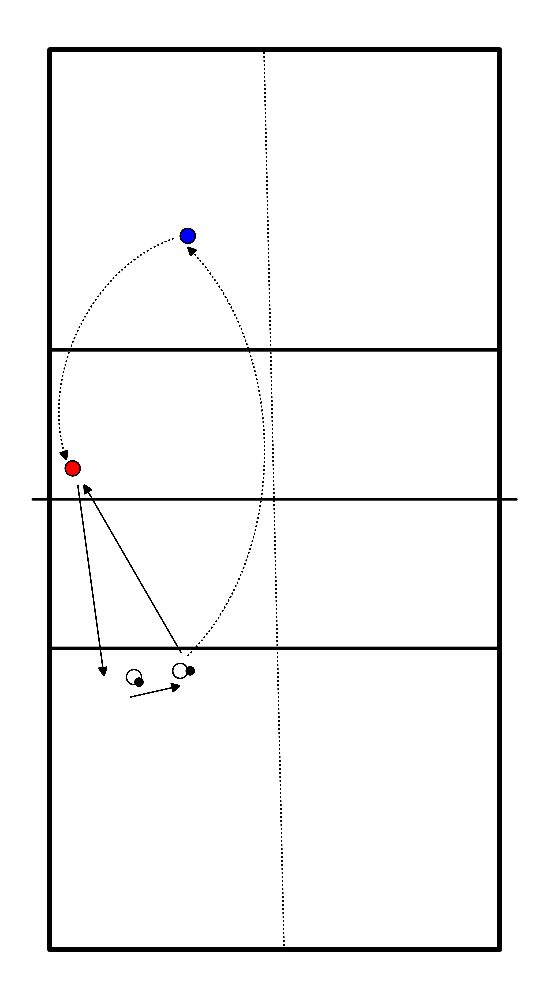
- Divide the team into two groups and have them form two rows facing each other on the 3 meter line.
- Have the players play over the net and then run around the net post to join the other group.
- Place a speedfoot ladder on one side, parallel to the sideline, and have the players do an exercise through the ladder before joining the row.
- It is possible to extend this with block jumps, attacking passes or strength exercises.
- Important is that the ball should not fall on the ground, communication is important.
- If necessary, add a sanction when the ball falls on the ground.
- Alternate between underhand and overhand.
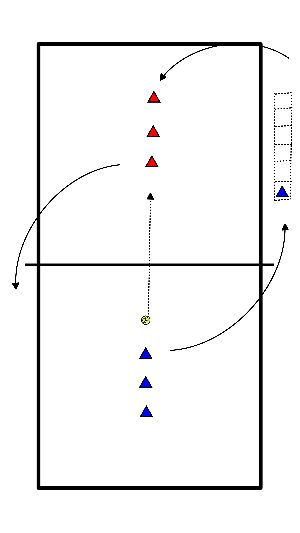
- The player moves left and right into the backfield.
- As soon as the ball is played, the defender stands still and passes the ball back to the player who introduced it.