



Volleyballexercises for u15
Objective
- Shift focus and quickly switch between actions.
- Create groups of three players with one regular volleyball and one tennis ball.
- The player with the tennis ball is the juggler and stands in the middle.
- Player 1 passes the volleyball to the juggler.
- The juggler throws the tennis ball to player 1.
- The juggler returns the volleyball to player 1, who throws the tennis ball back to the juggler.
- Player 1 passes the volleyball to player 3.
- Player 3 passes the volleyball to the juggler.
- The juggler throws the tennis ball to player 3.
- The juggler returns the volleyball to player 3 and receives the tennis ball back.
- Repeat this cycle.
- This requires concentration and quick switching from the players.
- If no tennis balls are available, two volleyballs can also be used.
Execution
- Work in pairs.
- Player 1 stands with the ball on the baseline.
- Player 2 stands without the ball at the net, facing the net.
- Player 2 performs a block jump at the net (ensure a straight landing).
- After landing, player 2 turns around and defends a short ball on the 6-metre line.
Execution
- Start with passing the ball to each other.
- Play the ball 1 or 2 times to yourself.
- Then turn around and play the ball backwards.
- Ensure you stand close to each other.
- Focus on ball control.
Execution
- Play with a partner, passing the ball overhead and underhand.
- Add tasks after passing:
- Touch a line.
- Put one knee on the ground.
- Place both hands on the ground.
- Turn around in a circle.
Execution
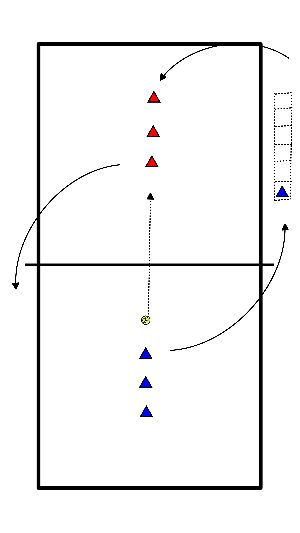
- Serving is done simultaneously on both sides (or as simultaneously as possible).
- The defender provides the pass towards the setter position (position 3).
- At the setter position (position 3), the ball is caught.
- Players move along the blue lines.
- For larger teams, players can be added to the waiting area.
- With more than 10 players, the speed of the exercise is lost.
- Ensure good serve reception.
- Serves must be straight, but the server should aim to score.
- The passer is not well-trained if they only receive easy balls during training.
- The serving pressure can naturally be increased during the exercise.
Execution
- Work in pairs and play with enthusiasm.
- Player 1 stands with a ball at the net.
- Player 2 lies flat on their stomach behind the baseline without a ball.
- The attacker hits the ball.
- The defender defends at the 7-metre line.
- Then, a short ball follows at the 3-metre line.
Execution
- Two teams stand behind the three-metre line.
- Defend the ball, perform a set-up, and attack from the three-metre line.
- After playing the ball, sprint to the net.
- Instead of a sprint: block at the net, dive to the back line, and perform an attack jump.
Execution
- The entire team sits against the wall.
- The first player runs from the wall to the net and back, then sits against the wall again.
- Only then can the next player start running.
- They may only stop once the entire team has run back and forth once.
- Repeat the exercise, but replace sitting against the wall with planking.
Objective
- Improve fitness and strength
- Warm-up
- Crack a code by completing different tasks
- Divide the group into two teams.
- The trainer creates a code consisting of ten digits, for example, (24 32 14 21 33).
- The players perform the devised exercises in a specific order. For instance, if they think the first digit is 3, they do exercise 3.
- After completing the exercise, they go to the trainer, who indicates whether the digit is correct or incorrect.
- If the digit is correct, they attempt to guess the next digit. If the digit is incorrect, they must perform another exercise, for example, exercise 4, to guess the correct digit.
- Exercise 1: 5 push-ups
- Exercise 2: Run the distance between the backline and the centreline three times
- Exercise 3: Block in different places/positions 5 times
- Exercise 4: 1 sliding dive towards the centreline, another sliding dive towards the backline
- The team that cracks the code first wins.
Execution
- Divide the team into two groups. Have the players form two lines facing each other at the 3-meter line.
- Players pass the ball over the net and then run around the net post to join the other group.
- On one side, parallel to the sideline, there is an agility ladder. Players perform an exercise through the ladder before joining the line.
- Expand with block jumps, attack approach, or strength exercises.
- Alternate between underhand and overhand passing.
- The ball must not fall to the ground.
- Communication is crucial.
- Optionally, add a penalty if the ball falls to the ground.
Execution
- Line up about 4 players in the middle of the court with a ball.
- Player 1 stands at the centre front and receives a good toss from the first player in line A.
- Player 1 passes the ball overhead into the basket.
- Note: bend the knees, extend the elbows, and follow through with the ball.
- The player at the basket catches the ball and joins the end of line A.
Execution
- Divide the players into pairs, facing each other at a marker.
- On command, players move sideways to the sideline, each in a different direction.
- Return to the opposite sideline and then back to the marker.
- The player who touches the marker first wins.
- The next pair starts immediately after the first round.
- Ensure rotation within the pairs after each round.
- If there are more than 9 players, set up the game in duplicate.
- This activity is also suitable for independent execution while preparing the next activity.