



Volleyballexercises for u15
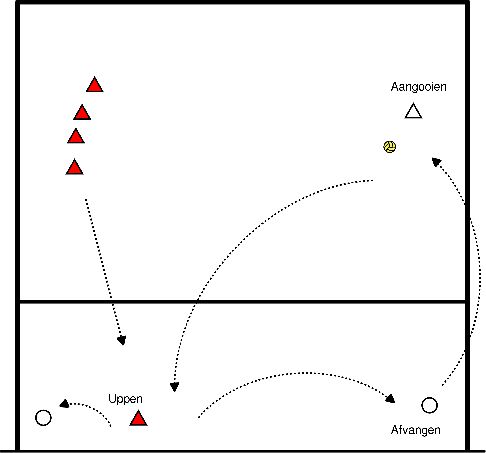
- Training for upping
- At position 4 (outside attack) korfball pole with hooptied . (with sturdy velcro)
- Upper at position 2get ready. (lay down dot)
- Reserve uppers in a line on position.
- Trainer at position 5, throws the ball to upper.
- He picks up the ball through the hoop.
- Behind that, an attacker is ready to catch the ball and puts it in the trainer's ballcar.
- Catch is in the line at position 6.
- Upper is going to catch.
- Variation:
- Uppercut back to outside position.
- Throw the ball from the other side and pass to position 2.
- Have the distributor step in from position 1.
- Points of attention when upping:
- Getting under the ball, the ball should fall on your forehead.
- Hands in the shape of the ball (make sure the hands are not too far to the side; like catching an inu)
- Right foot more forward than the left.
- Face towards position 4.
- At ball contact, slightly bend the knees and push out the ball, stretching the legs.
- When playing, the ball must remain in front of the upper. (Be careful not to arch your back)
- When uppercutting backwards, bend the back along with the uppercut.
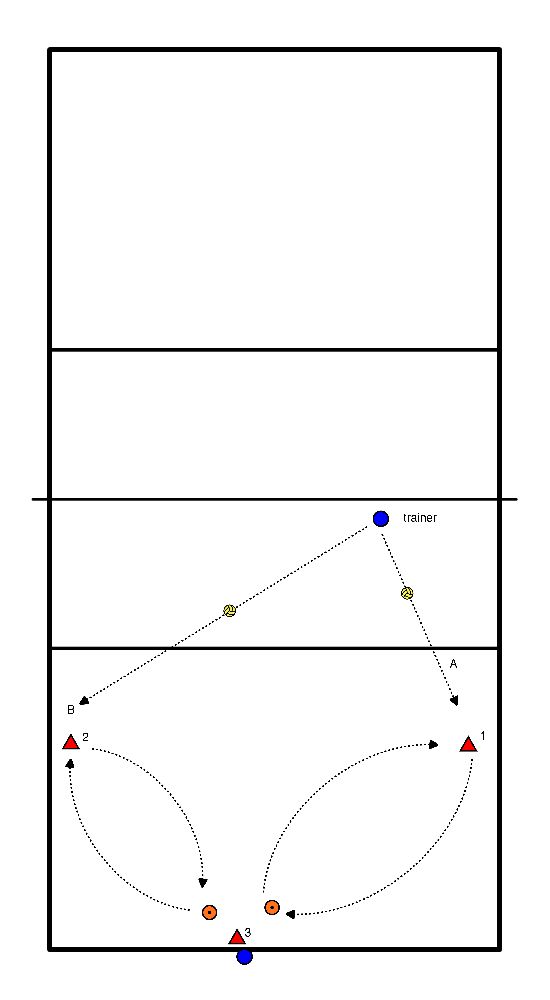
- Team is divided into two groups:
- On one side of the field they play 2/2 or 3/3, passing the ball up and down.
- On the other side of the court the trainer starts with the other group.
- Trainer throws in balls, before the rally/service 3-4 handle the ball to position 3.
- On 3 catch and put the ball in the ball bin.
- Short/long.
- Trainer throws balls to the 3 meter line. (positions A + B)
- Player 1 passes the short ball and runs to the middle.
- Player 3 comes in to play the ball.
- Then trainer switches to the other side.
- Player 2 plays the short ball, and goes to the middle.
- Player 1 now goes for the ball on the other side.
- Other players?
- 3 get balls.
- 3 encourage.
- After 10 balls switch groups.
- 2 trainers available?
- 1 trainer makes sure the player in the middle does not cheat by starting too fast. (and keep him/her in the middle).
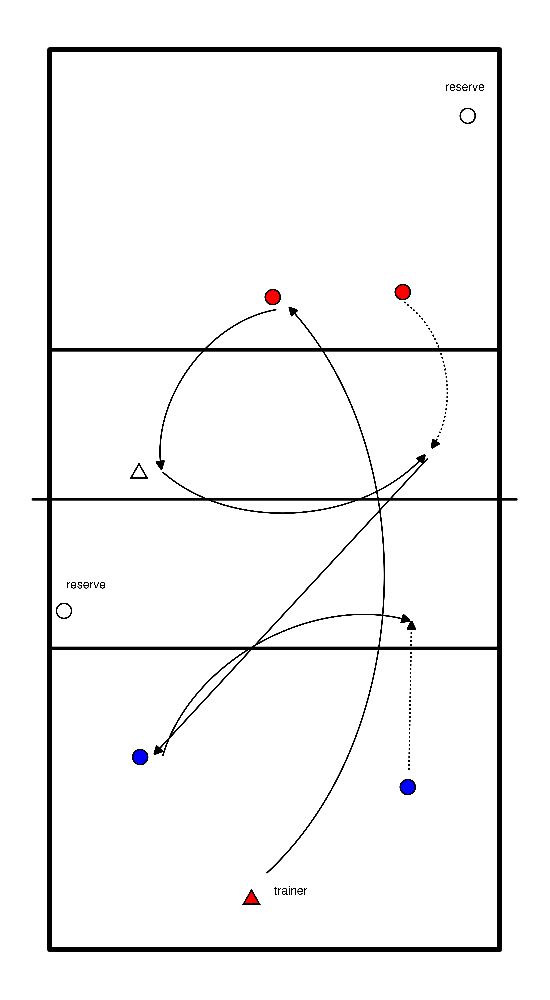
- Organization:
- Field B:
- 2 passers and 1 reserve.
- 1 playmaker on p2/3.
- Field A:
- Defender on 5 and 1.
- Reserve on p5.
- Coach serves.
- Field B:
- Execution:
- Trainer serves.
- Pass and setup to the non-passer.
- Attack thus on p3 or p4.
- Attacker becomes playmaker, passer stays.
- Spare becomes passer and playmaker becomes spare on p5.
- P5 passes to p1 and p1 becomes reserve passer.
- Defended ball is passed to p2.
- Three teams.
- Trainer. (white triangle)
- Players. (red triangle)
- Trainer throws balls towards the backfield.
- Players do not run from the net until the trainer throws.
- Players try to get the ball over the net 3 times.
- Change with 3 new players.

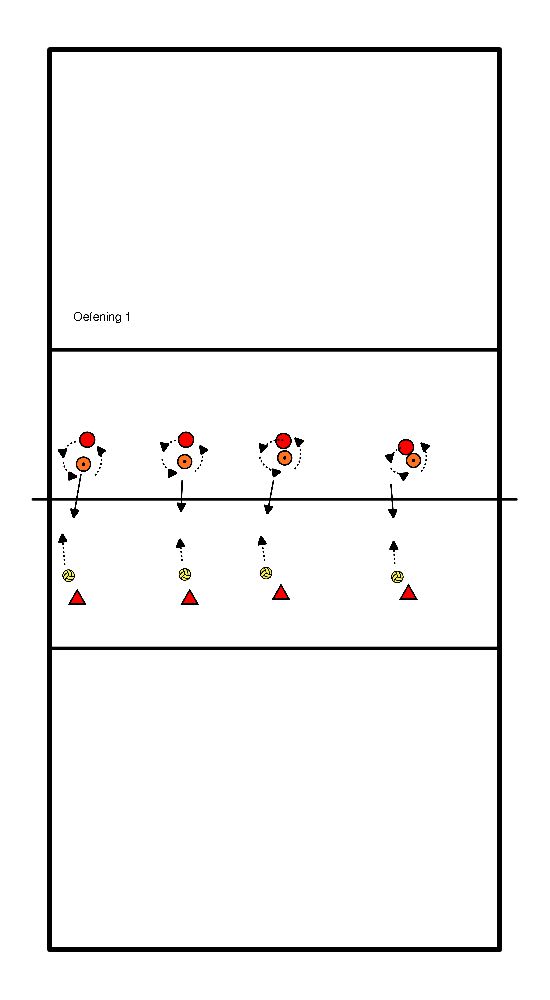
- Exercise to practice posture and movement when playing underhand.
- Players (red circle) shuffle stepping around the pawn in position for underhand play.
- Players then go under the net and play the ball back.
- 10x then change.
- 2 tals.
- Two teams throw the balls over the net.
- On the other side of the net stand 3 teams, and play alternately.
- The ball is thrown to the ball, and is caught by the passing arms, but not yet played.
- Roll the ball back.
- After 2 times change to the next 2 team.
- Variation:
- Try to play the ball in the box on pos. 3.
- Stand low, feeling in your arms, play quietly.
- Organisation:
- Training ring on p4.
- Players in line on P1 and 1 player on p4.
- Tr with ball pit on p5.
- Execution:
- Tr throws on at P2.
- Player runs in off p1 and plays the ball through the hoop on P4.
- Catch and put in the bin.
- Variation:
- Tr on the other side and pass on p5.
- Now after the pass a setup through the hoop.
- 2 teams make sure you throw the players of the other team.
- You are not allowed to run with the ball, fend off the volleyball way or head on.
- Hitting someone on the ground is not allowed.
- If you are the only player left, you may dribble the ball.
- 2 teams, whoever can move the mat the fastest across the field to the other side.
- They must all stay on the mat.
- Pass the ball overhead.
- A to C.
- C to B. (A runs to the front),
- B to D. (or A, depends on team size),
- D to A. (or C)
- The team that reaches the other side first wins.
- 1 row behind the left or right buildup.
- Everyone with ball.
- Player 1 left or right structure in start with ball diagonally towards pawn for penalty line.
- 1 pawn on the middle of the build-up with 1 player without the ball behind it.
- Player 2 runs diagonally behind player 1 and receives the ball.
- Player 1 makes a 0 pass if player 2 doesn't pass in time otherwise make the change on speed.
- Player 2 shoots at goal.
- Player 1 walks backwards to the pawn in the middle of the build-up to receive the ball and shoot at the goal.
- Repeat until everyone has been there.
- Two against three.
- The third player stands at the back line ready to serve.
- Serving is alternating. Two players agree on who will change in the team to serve.
- One player stays.
- Or if they want to and can keep up with it they can go full steam ahead with the serve.
- The service receiving side has fixed setter.
- Setter goes under the net to switch teams.
- Pace of serving may be increased if it is going well.
- Preference, full smash, and full defend.