



Volleyballexercises for u16
Setup
- Line up attackers and blockers at the 3-meter line.
- The coach plays a rally ball to attacker 1.
- Blocker 4 moves to the net.
- Attacker 1 passes to the setter and calls where he wants the set-up (left, middle, or right).
- The blocker follows the attacker and attempts to block.
- The attacker retrieves the ball and joins the back of his own line.
- If the attackers score 10 times, attackers and blockers switch roles.
Execution
- Place a mat randomly in each court.
- A group is ready to serve on both sides.
- Serve the ball onto the mat.
- Follow your ball and join the line on the opposite side.
- Try to hit the mat as often as possible.
- Players should try to stand as close to the backline as possible.
- If they are unsuccessful, they may stand closer to the net.
Execution
- Estimate the ball trajectory.
- Shuffle backwards.
- Stand still and position shoulders correctly.
- Pass accurately to the catcher.
- 3 players stand at the net or on the 3-metre line.
- 1 player acts as the catcher.
- The trainer serves the ball.
- Players shuffle backwards and pass the ball to the catcher at position 2/3.
- The catcher catches the ball and places it in the bin.
- The passer becomes the new catcher, and the empty spot is filled by another player.
Game Setup
- The objective is to get three in a row.
- There are two teams per game.
- Use nine hoops arranged in a square (3x3).
- Each team has three ribbons in their own colour.
- The first player from each team runs to the hoops and places a ribbon.
- The player quickly runs back and tags the next player.
- When a player has no more ribbons, they may move a ribbon.
- The team that first gets three in a row wins the game.
Execution
- Pass the ball in pairs.
- Use both overhand and underhand techniques.
Execution
- Divide the team into two groups.
- Have the players form two lines facing each other at the 3-meter line.
- Players pass the ball over the net and then run around the net post to join the other group.
- Place a speed ladder parallel to the sideline.
- Have the players perform a drill through the ladder before joining the line.
- Optionally extend with block jumps, attack passes, or strength exercises.
- The ball must not fall to the ground.
- Communication is essential.
- Optionally add a penalty if the ball falls to the ground.
- Alternate between underhand and overhand passing.
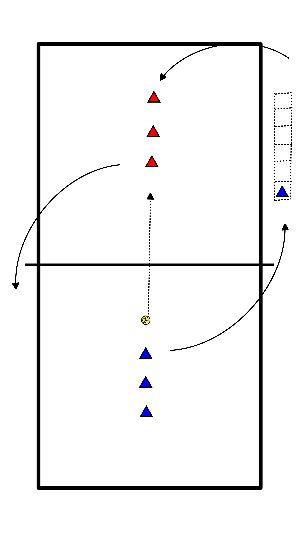
Execution
- Pay close attention to the execution: the pass must be high so that the player can catch the ball overhead.
- For a pass to the right, place the right foot forward.
- For a pass to the left, place the left foot forward.
- Keep the eyes and shoulders in the direction of play.
- The exercise is performed in groups of three with one ball.
- Player 1 and Player 2 stand next to each other, not too close to the net.
- Player 3 stands opposite Player 1 at the back of the court.
- Player 1 throws the ball straight to Player 3.
- Player 3 plays the ball diagonally to Player 2.
- Player 2 catches the ball and throws it straight back to Player 3.
- Player 3 plays the ball diagonally to Player 1.
- Player 3 moves after each action.
Execution
- Distribute the teams across both halves of the court.
- The coach throws the ball into play.
- The teams pass the ball to each other.
- Every player who has played the ball must touch the backline and then return to the court.
- Start first with catching and throwing. Once that goes well, proceed to real play using an overhead technique or underhand technique.
Four Players Static
- Two servers at the service area, one receiver, one catcher.
- The server serves, the receiver passes the ball to the catcher, who catches the ball and rolls it back to the server.
- Same as static, but the player follows the ball.
- The server becomes the receiver, the receiver becomes the catcher, and so on.
- See four players.
- The server serves the ball and follows it.
- The receiver passes the ball to the catcher.
- The rightmost player becomes the catcher.
- The server shifts to the left.
- The catcher becomes the server.
- If this does not work, one receiver becomes a reserve.
Part 1
- 30 step-ups (step up and down from a bench)
- 15 push-ups (feet on the bench)
- 30 step-ups
- 15 Spiderman push-ups (pull one leg up like a frog while doing push-ups)
- 30 east-west step-ups (right foot on the bench, left foot next to it, then left foot on the bench, right foot next to it)
- 10 squat jumps (bend knees and jump as high as possible when extending)
- 30 east-west step-ups
- 10 squat jumps
- 20 lateral shuffles over 4 meters
- 10 split-squat jumps (jump and bend one knee, alternating knees each time)
- 20 forward and backward sprints over 4 meters
- 10 squat jumps
- After each part, take a short rest and then continue.
Execution
- Set up two gymnastics boxes, starting as low as possible (one layer).
- Place the boxes at a distance equivalent to an attack approach apart.
- Optionally, place marker mats for the approach.
- Jump with both feet onto the first box and land with both hands raised off the box.
- Perform an attack approach to the second box: short, long, connect, take off (rhythm: 1...2.3).
- Note: take off with both feet and swing the arms backward during the large step.
- End on the box with both hands in the air (optionally clap hands).
- Then perform two block jumps at the net. Pay attention to lateral steps and move around the cone.
- The trainer throws a dive ball: slide on the stomach, retrieve the ball, and place it in the bin.
- Join the end of the line for the next jump.
Execution
- Everyone stands in a line with the ball between their feet.
- Jump continuously with the ball between the legs.
- Variant 1: Jump with both feet towards another line.
- Variant 2: Perform a jump forward, turn half a rotation, jump backward, turn half a rotation, and so on.
- Variant 3: Place cones or markers and zigzag sideways without turning the face. Make it a competition.