



Volleyballexercises for u16
- playmaker, attackers, 1 ball
- SV only plays the ball high outside
- Attacker hits and retrieves own ball
- SV only plays the ball fairly flat outside
- Attacker hits and retrieves own ball
- SV only plays the ball far outside
- attacker hits and fetches own ball
- SV only plays the ball high midfield
- attacker hits the ball and fetches own ball
- SV only plays the ball fairly flat at mid
- attacker hits the fast ball and fetches own ball
- SV plays the ball just before the 3-metre line
- attacker hits the ball and picks up own ball
- SV only plays the ball high outside
Part 1
- The players are divided into two equal teams.
- The balls are distributed equally on both sides of the net.
- The aim is to have as few balls on your own side as possible.
The way to pass the balls / course of play:
- Roll
- Throwing (overhand, underhand, one arm)
- Storage (underhand, overhand)
Part 2
- The trainer places a ball on the half way line.
- On either side of the net, a line of players stands at the back line.
- At the signal of the trainer they run to the ball, whoever has it may keep it.
Which team collects the most balls?
Variations:
- The players on both sides of the net are numbered (so that 2 players of the 2 different teams have the same number)
- Storm at sea: if your number is called, you must try to get the ball as quickly as possible and get back behind your line (= point + safety for the opponent).
- If you are tapped by your opponent when you have the ball in your hands, you have to drop the ball (you can pick it up immediately afterwards and continue playing).
- The trainer puts several balls on the middle line and everyone plays against everyone else and tries to collect as many balls as possible. (Several times, not as many balls as players, can also be played with a time limit, ...)
- The whole team sits against the wall
- The first one runs from the wall to the net and back and then sits against the wall again,
- Then the next player can run.
- They are not allowed to stop until the whole team has walked back and forth once.
- Afterwards the same exercise but with planks instead of sitting against the wall.
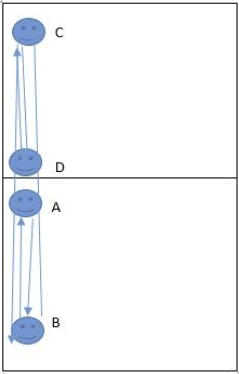
- 4 teams of which 2 at the net and the other 2 at the back of the field
- B throws the ball to A
- A plays the ball back to B
- B plays ball UPHANDS to C
- C plays the ball UNDER HANDS to D
- D catches the ball
- D throws the ball to C
- C plays the ball UP to B
- B plays the ball UNDER HANDS to A
- A catches the ball
- etc
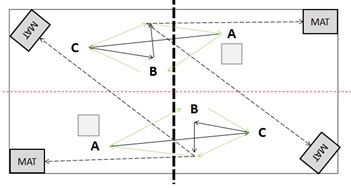
- Player A throws/strikes the ball towards player C.
- Player C serves the ball to player B.
- Player B gives a pass to c.
- Player C passes to the mats.
Goal: try to attack/play 3rd ball on the mats (straight or diagonal).
After each ball move one place in your own group.
Extension: When there are enough players one could also choose to place a block.
This exercise starts reasonably simple and is then gradually expanded (can be done in 1 training session or spread over several sessions). An exercise in which everyone must defend, set and attack.
It is a long piece of text, but it is easier than the length of the text suggests. Just do it!
Requirements:
It is a long piece of text, but it is easier than the length of the text suggests. Just do it!
Requirements:
- at least 2 ballsminimum
- 8 players (preferably an even number)
Part 1
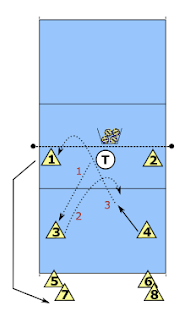
It starts with two players at the net (1 and 2), two players in the backfield (3 and 4) and the rest behind the backline. The trainer stands at the net in the middle position with two balls.
Once the players know the patterns, this exercise can be done at a fast pace.
- The trainer throws or hits the ball towards player 3 (1 ). Player
- 3 passes the ball to the middle of the field about on the 3 meter line (2).
- Player 4 runs in and gives a setup to the left front (3 ).
- Player 1 catches the ball, throws the ball in the ballcarrier and runs to the backline and connects with the back.
- The trainer throws or punches the ball towards player 4. Player
- 4 passes the ball to the middle of the field about on the 3 meter line.
- Player 3 runs in and gives a setup to the right front.
- Player 2 catches the ball, throws the ball in the ballcarrier and runs to the backline and connects with the back.
- Player 3 goes to the left front and player 4 turns to the right front.
Once the players know the patterns, this exercise can be done at a fast pace.
Part 2
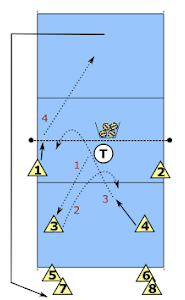
- The trainer throws or hits the ball towards player 3 (1 ). This is the moment that players 1 and 2 run backwards to make an attack.
- Player 3 passes the ball to the middle of the field about on the 3 meter line (2 ).
- Player 4 runs in and gives a setup to the left front (3 ).
- Player 1 smashes the ball over the net (4
- The trainer throws or hits the ball towards player 4. Player
- 4 passes the ball to the middle of the field about on the 3 meter line.
- Player 3 runs in and gives a setup to the right front.
- Player 2 smashes the ball over the net, picks it up and puts it in the ballcarrier of the trainer. Then player 2 runs to the backline and joins the backline.
- Player 3 goes to the left front and player 4 turns to the right front.
Part 3
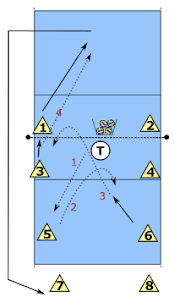
The exercise now starts with 6 players in the field. There are now two more blockers, who stand at the other side of the net.
- The trainer throws or hits the ball towards player 5 (1 ). This is the moment that players 3 and 4 run backwards to make an attack.
- Player 5 passes the ball to the middle of the field about on the 3 meter line (2 ).
- Player 6 runs in and gives a setup to the left front (3 ).
- Player 3 smashes the ball over the net (4 ).
- Player 1 tries to block the smash.
- The trainer throws or hits the ball towards player 6. Player
- 6 passes the ball to the middle of the field about on the 3 meter line.
- Player 5 runs in and gives a setup to the right front.
- Player 4 smashes the ball over the net. Player
- 2 tries to block the smash.
- Player 5 moves to the left front and player 6 turns to the right front.
- Player 3 and 4 move to the blocking positions.
- Player 1 and 2 get the ball in the ballcar and go to the backline.
Part 4
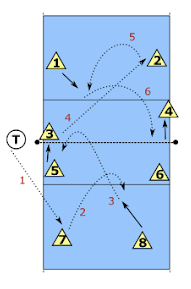
There are now 8 players in the field. The trainer only throws the first ball, then the game continues.
The same patterns as in the previous sections are executed: the players in the backfield take care of the pass and the setup. The players at the net smashem and block.
If there are more than 8 players, the game continues after, say, 10 attacks or so.
The same patterns as in the previous sections are executed: the players in the backfield take care of the pass and the setup. The players at the net smashem and block.
If there are more than 8 players, the game continues after, say, 10 attacks or so.
Goal of the exercise:
Ball carrier must learn to act quickly after set-up and find new ball
Explanation of the exercise:
- Playmaker exercise.
- Five on one side of the net.
- On the other side, you could also have 5.
- Front left and front right both have a ball.
- Playmaker stands in the middle.
- The left back and right back bring the pass.
- The first ball is thrown by the left back towards the left back.
- At the moment the left back touches the ball, the right back throws the ball to the right back.
- If you have more players, you can choose to change the one who passed with the one who is on hold.
- In this way, the passes reach the defender immediately after each other.
- The pass from the left back is played by the distributor to the left front.
- Immediately after the set-up, do not follow the ball but look for the other pass from the right back and set-up the set-up for the right front.
- Many ball contacts for the playmaker.
- Pairs facing each other with a net in between
- Overhead smash,
- start on the 3,
- with every good ball 1 step back,
- to the backline
- Everyone lines up in a plank position.
- The first person in the row
- rolls the ball under the others,
- goes to the other end of the line,
- rolls the ball back and joins them in plank position.
- The new first person takes the ball and does the same.
- In this way the different groups have to cover a certain distance as quickly as possible.
- player1 throws in from behind the net:(3players)
- 2 teams on the back line on the stomach
- Player1 hits the ball, 2 players stand up and coach attacks one of the pair defends, nr. 2 sets up and nr. 3 attacks
- after that next 2 team player1 with player 2 etc.
ON 1 FIELD:
- groups of3/4/5
- 2 groups per field
- 1 group bats, after the serve the person who bats starts to run around the bases around the field (baseball)
- the other group is on the opposite side: 3 persons defend, 1 person catches on position 3
- the defenders have to get the ball to the receiver as soon as possible, when the receiver has the ball in his hands, he will call loudly stop and everybody has to stop walking
- when the server lands in the net or the runners have not reached a base in time, they are out and must wait until the changeover to play again
- when the server hits an ace, this is a homerun: the same goes for when the defenders punt the ball away
- the catcher of the defending team must stand on a mat and may not leave the mat to catch the ball
- when the attacking team has 3 players out, it is a change.
- if you are playing with 3 people, the substitution takes place when 2 people are out, if you are playing with 5 people, the substitution takes place when 3 people are out.
Everyone has a ball.
Various exercises:
- Playing ball for themselves underhand.
- Play ball for oneself overhead.
- Play ball for oneself underhand with only the left arm.
- Play ball for yourself underhand with only the right arm.
- Play ball for self overhead with only the left hand.
- Play ball for oneself overhead with only the right hand.
- Play ball for oneself overhead and underhand alternately.