

Volleyballexercises for u20
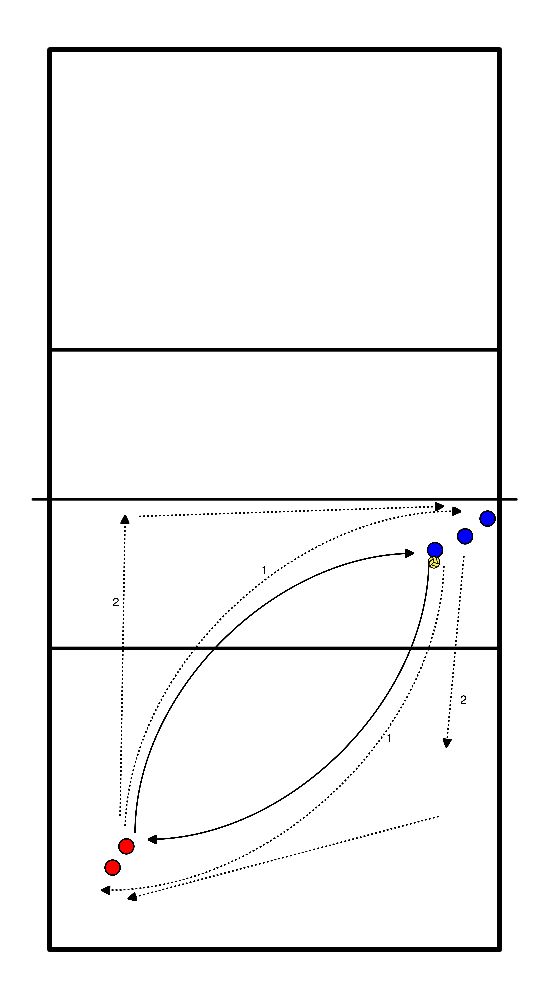
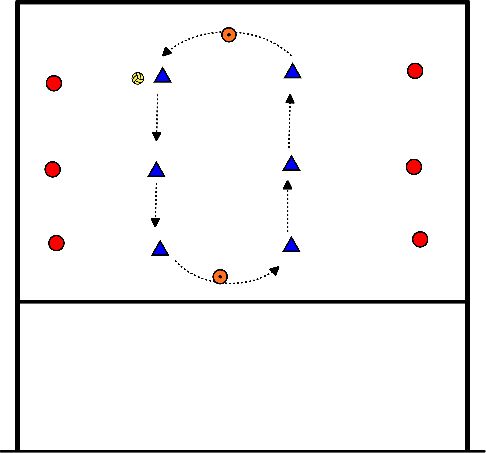
- Half of the players stand in a line 2 metres apart.
- Preferably with a wall at their back.
- The other players pass this line in turn at 4 metres from the thrower.
- There is no net in between.
- They are given a ball to return overhead.
- Then they move sideways to the next starter.
- Go down the row and come back to the beginning.
- If there are enough players, a second row can be set up in mirror image.
- Then the players who return the ball go back along this row and have then walked a circle.
- (Row players 1 stand with their backs to row players 2, to throwers 1 and 2 stand with their faces to each other).
- After that you can alternate between the groups and do the same with underhand return.
- As a variation, use different throwing distances.
- Important points of attention: throwing the ball neatly, moving sideways, sitting low when playing OH, high ball tempo.
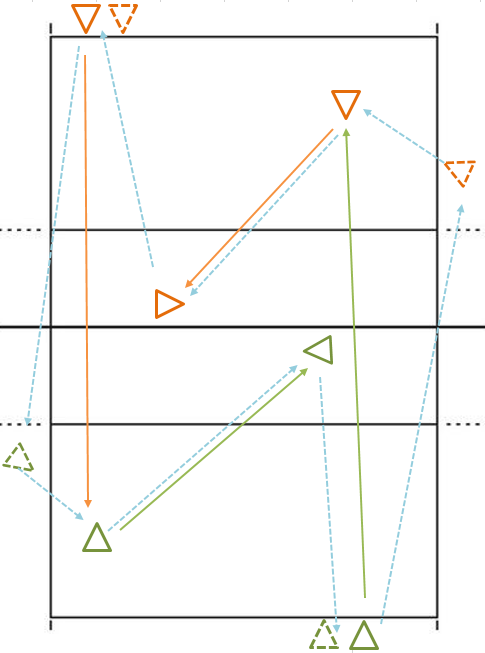
- Both sides serve at the same time (or as much as possible at the same time); the defender makes the pass to position [3] and at position [3] the ball is caught.
- The players run along the blue lines.
- With larger teams, players can be added in the waiting room.
- With more than 10 players the speed of the exercise is lost.
- Goal
- Serves pass well.
- Therefore, there MUST be straight serving, but the server must want to score.
- The passer will not be trained properly if during the training he only gets to play easy balls.
- Of course, the serving pressure can be increased during the training.
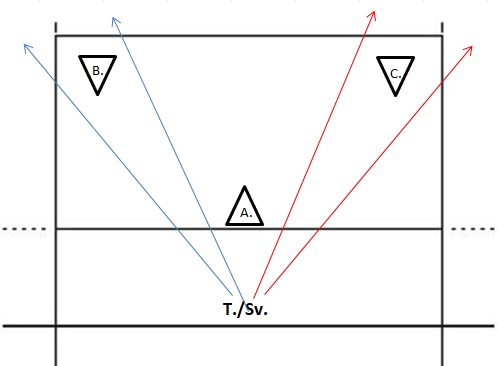
- The purpose of the exercise is to train the defender A in his reaction ability as well as to work together in handling the ball.
- Important for this exercise:
- EVERYTHING is touche!
- The ball that is played/tossed by the trainer (high and far; not hit!) is allowed to come well outside the lines, because the ball must be handled as if it jumped off the block.
- A. stands with his back to the net and concentrates on the defenders B/C.
- If the ball is played by T/Sv. then either B or C demands the ball ("LOS!") and moves to play the ball.
- A. sprints after B/C and offers himself vocally ("HERE!").
- B/C must be able to hear where A is before playing the ball.
- B/C plays the ball high to A and A plays the ball well inside the 3-metre box. T./Sv. makes the catch.
- If there are 8 or more players, this exercise can be done at both ends; if there are less than 8 players, it is played at one end and B/C rotate with players waiting outside the lines.
- In that case, work at a high tempo so that nobody stands still for too long.
- A. changes after 5 or 10 balls; every player takes the position A. twice.
- NOTE: The exercise goes at a high tempo!
- When A. has handled the ball, the next ball follows immediately.
- It is up to the player turning in the ball to get in position in time!
- Expansion:
- Place a basket on a spot of your choice within the 3-meter section.
- The second ball must touch the basket (top) or go through the basket.
- Goal
- Training 3-meter offense and defense.
- Handling hard balls by the defense.
- The exercise
- There are two teams facing each other.
- The teams are balanced in numbers as much as possible.
- The trainer introduces the first ball so that a back player can immediately (with pressure) execute a 3-meter attack, after that the rally is free.
- The team that wins the rally then receives the first ball from the trainer.
- If there are 8 players or less, only attacks from behind the 3-meter, with more players it can be chosen to place players at the net or to make it a King's Court exercise. (The losing side rotates out of the court; all attacks then continue to come from behind the 3-meter).
- The attack takes place on the position [2] at the net and [1] and [6] over the 3-meter.
- The libero always comes from position [5] to take over the Sv. (for instance because the playmaker in the rally took care of the pass) and to take care of the set-up.
- The 'pass' is introduced by the trainer at the height of the 3-meter at position [5].
- If the libero stays outside the 3-meter he may provide the set-up overhand, otherwise only underhand.
- This activity promotes:
- Cooperation
- Communication
- Dealing with disappointments
- Fun
- Working method
- Make a circle of your players of maximal 12 players.
- If you are doing this with a large selection you could split the first team and second team or make a circle of men next to a circle of women.
- Give the following instruction:
- Hold out your hand to someone across the way and hold it tightly.
- Then give someone else your other hand.
- This creates the team knot.
- Make sure you get out of the knot without letting go of the hands.
- Variation
- Nobody can say anything.
- Everyone can say something.
- One person can say something.
- You can, after the group is out of the knot, have the group discuss what the best tactic is and then put them back "in the team knot".
- Evaluation
- Watch carefully what happens, who takes the lead, who gives up quickly?
- How does the group solve the problem?
- 3 persons hold 1 ball in the air and cross to the other side.
- Then throw in and run after the ball to the opposite side.
- Change into OH and BH play and pepper. (departure after set-up, departure after attack)
- Eventually fixed player in the middle who moves from left to right after each action.
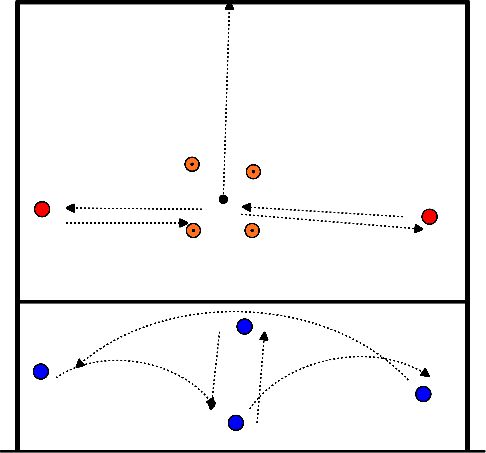
- T strikes ball to libero, 2 attackers start at the net.
- Pass, set-up and attack on position 3 or 4.
- Blocking:
- Outside, inside hand on ball, center joins in.
- Centre blocks with emphasis on shielding position 1/2.
- Then service (float) to position 1.
- Variant:
- Attack on positions 2 and 3 and service to position 5.
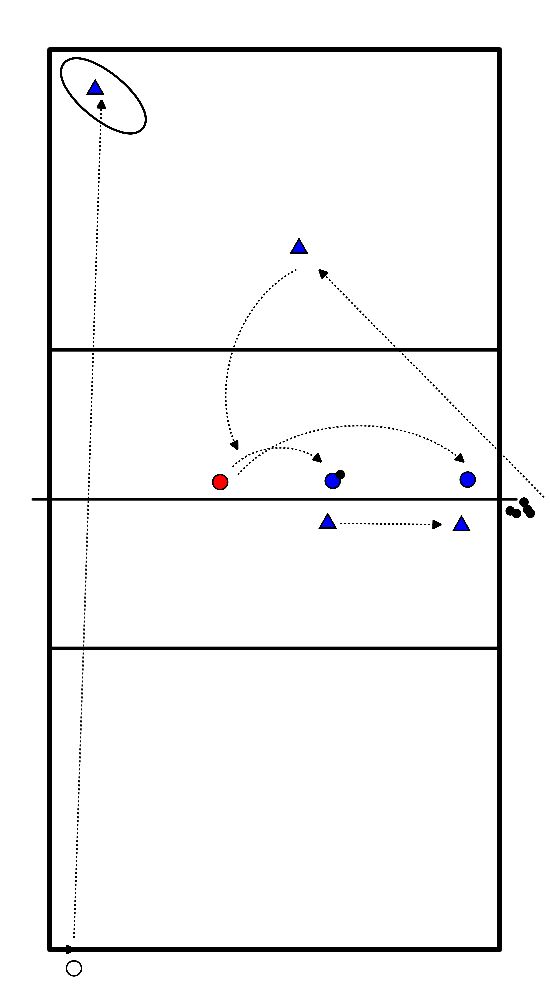
- In 2 pairs with 2 balls, do everything 8 times.
- Out of the neck, right, left, hit, OH, BH in 2x. (Penalty if ball on the ground)
- Next:
- Roll ball over from behind between the legs and stay low, keep moving sideways
- (1 ball) Mirroring sideways with 1 ball in left and 1 ball in right hand, pick up ball from floor.
- Organisation:
- Serve from p1 on 2 or 3 players. (p1, p6)
- Sv on p2/3.
- Attacker on P4B opposite block P2A.
- Libero on P5A and defender on P6B.
- Execution:
- Process service pass into attack on 4.
- If score, serve again. (max 2x)
- If defended, pass to OH and attack again.
- Running:
- Passer becomes attacker, attacker becomes block, then defender, then server.
- Server goes to backup passer.
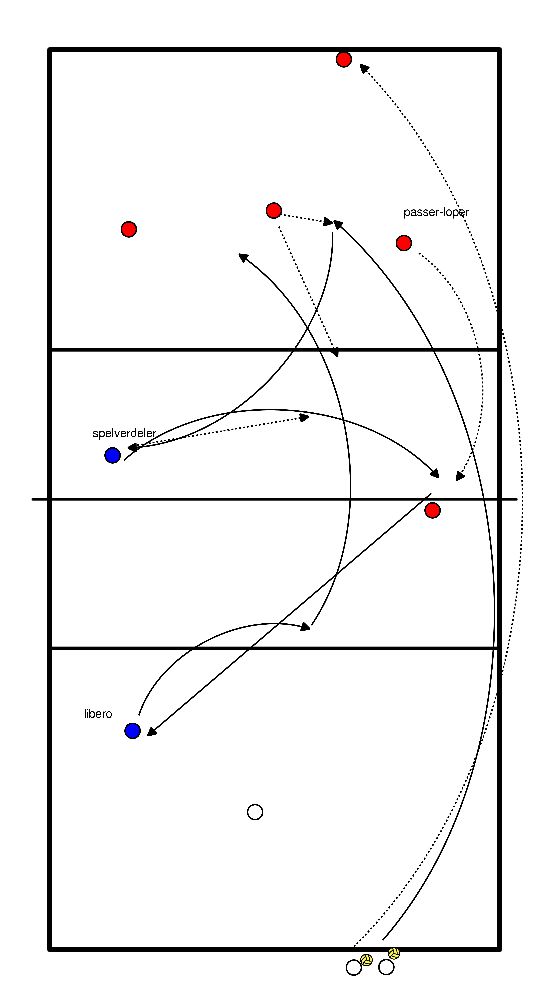
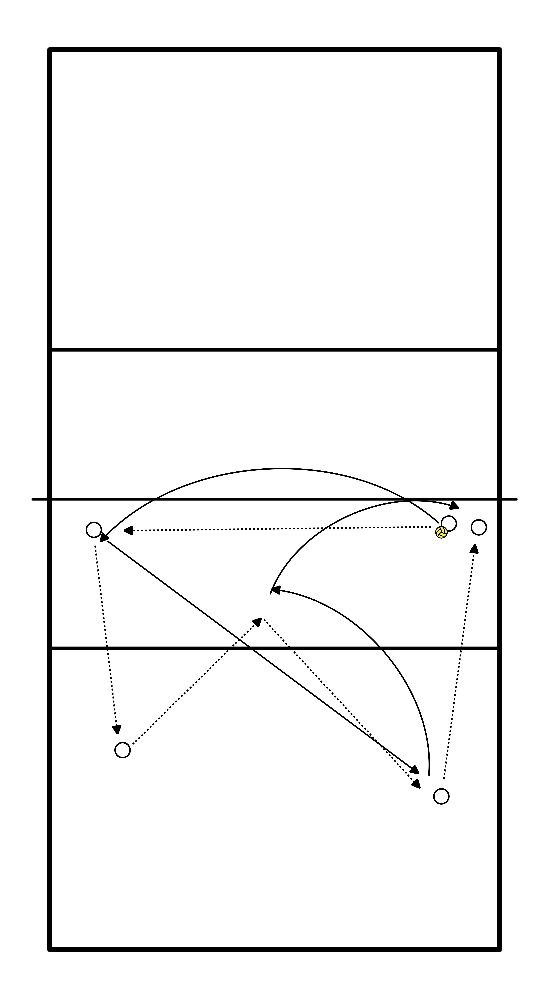
- Organization:
- Divide the group over the 2 fields.
- 2 players on pos 2 with 1 ball, 1 on 4, 1 on 5 and 1 on 1
- Execution:
Ball is played from p2 BH to 4.
On p4 the ball is hit technically to p1.
This one defends the ball on 3m p3 and at that moment the player on p5 comes to play the ball BH to p2.
And it starts all over again. - Running: from p2 to p4 to p5 to p1 and again to p2
- Organisation:
- Divide the group in 2x5 and each on a field half.
- 3 players with 1 ball on position 2 and 3 without ball on position 5.
- Execution:
- Start with throwing the ball over and running after it, then pass the ball over.
- Now play the ball from position 2 BH and from position 5 OH.
- Still run after the ball.
- Then from position 5 do a block jump on position 4.
- Then add a dive/roll from position 2 to position 1.
- Approx. 10 minutes and let the tempo increase gradually.