



Volleyballexercises for u20
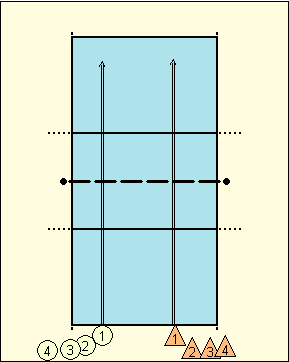
This exercise is fun to do and gives a lot of fun and competition! Relays in general already create competition.
What this exercise also wants to mimic is the stress factor that a serve brings.
The players are divided into equal teams and lined up on the serving area of the same court. The first player of a team serves and retrieves his ball. After the next player is tapped, this one serves, and so on.
It is important for a player to serve quickly, but it must also be flawless, otherwise the ball must be retrieved and served again!
If the teams are small, it is fun to let everyone serve two or three times.
Necessary:
- A minimum of 6 players
- As many balls as there are teams
Click here for the meaning of the symbols.
- The trainer stands on a box at the other side of the net, and the players must try to block the ball one by one.
- Step 1 is to explain when and why we block.
- Round 1:
- The trainer stands on the SV spot and the lln stand in a row in the middle. The ball is thrown to the trainer and the ball must be played to the trainer.
- Round 2:
- The trainer stands on the SV spot and the children stand in line in the middle. The ball is thrown to the trainer and the ball must be played to the trainer. The trainer gives a set-up and the ball is hit by the attacker outside. Good pass is to move to the attack. Bad pass is joining the back of the line after the ball is passed.
- Round 3:
- The trainer stands at the other side of the net, throws the ball to the attacker. Pass, set-up and attack. Good pass, set-up, bad pass is staying in the back of the line.
- Round 4:
- The trainer stands at the other side of the net, throws the ball on. Pass, set-up and attack. Good, move through, stay on the wrong side and the pass connects at the back. Only now the SV can choose left or right set-up. The one who attacked must then fetch the ball and close behind.
Tapped out? Get changed and see you next week!
- If volleyball players feel they are starting the attacking pass too early,
- or the coach feels the attackers are coming too early, this is a good drill.
- The playmaker is put down with a ball carrier.
- He gets the assignment to play 5 or less times for himself.
- The attackers do not know how many times this will happen, so they can only leave when the set-up is given, not before.
- The attackers will have to come in more aggressively and will build up more speed and thus more height, provided they have a good brake pass.
- If this goes well, the trainer can decide to move the playmaker closer to the attackers, so that the distance the set-upper has to travel is shortened.
- This should make the attackers even more alert.
- A big mistake during blocking is that players mostly look at the ball.
- From the moment the ball leaves the distributor until it is hit by the attacker, they look at the ball.
- However, most of the information can be obtained from the attacker.
- Where is the ball going to be hit, how are the shoulders positioned?
- The task is to teach the players to look at the attacker after they have seen which attacker is being served by the distributor.
In this exercise
- The trainer stands behind the pair who are blocking.
- The trainer throws the ball over the net and the attackers hit the ball.
- This way the blocking players cannot follow the ball and have to look at the attacker.
- Of course, the trainer can make further technical improvements here, such as
- Position of the hands,
- what to do after the block landing
- and the way to land.
- If the trainer wants to keep his or her hands free so that they can make technical improvements as the drill continues, either an attacker can throw the ball on one at a time, or the playmakers.
Variations are:
- only an outside block
- with a mid block
- also place attackers at the midposition
The important thing is that the players focuson the attacker.
To make the abdominal exercises more fun, I sometimes do the following exercise.
- Have two players sit on the ground at about 2 meters from each other and let them pass the ball overhead.
- Every time they play the ball they have to move their backs back towards the ground and come back up with their abdominal muscles when the ball is played to them again.
- This will not always be a perfect game, but that is a good thing
- If they have to play the ball next to them, they will also immediately use the oblique abdominal muscles
- Make sure that you have some balls in your hand to give to them immediately when the ball rolls away, otherwise the intensity is too low.
- 2 groups 1 ball :
- 3 meter attack with defense
- 1 serve, pass to SV
- SV set-up at 3 meter on one of the passers
- idem other side
- rally
- serve from the side where the ball hit the ground
- Team set-up
- Coach serves ball.
- Team defends, sets up and attacks.
- Then the trainer throws another ball into the field.
- Players must be ready quickly
In today's exercise, the following techniques will be used: serving, attacking, passing and distributing. However, the emphasis is on the pass and the distribution. The players have to watch, think well and react adequately during this exercise.
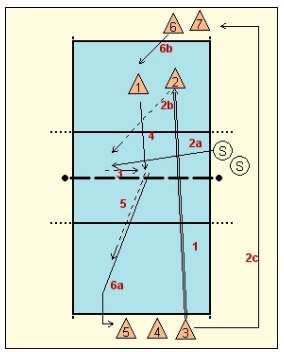 The diagram looks more complicated than the exercise is. The exercise goes as follows (I keep the numbering of the red numbers):
- 1 player 3 serves
- 2a one of the two playmakers runs to the position at the right front (the playmakers take turns)
- 2b one of the two passers (in this case player 2) passes the ball to the right front side
- 2c player 3 (who has just served) runs to the backline of the other half of the game
- 3 the server gives a setup to the player who did NOT pass. A setup to the centre if player 1 has passed and a setup to the outside if player 2 has passed.
- 4+5 the player who did not pass attacks (in this case player 1)
- 6a the attacker retrieves his own batted ball and joins the back of the line of serves.
- 6b the place where the attacker stood is taken by the first player in the row behind the court.
As soon as the ball is hit the next service is played.
Requirements
- A minimum of 9 players;
- pair of balls;
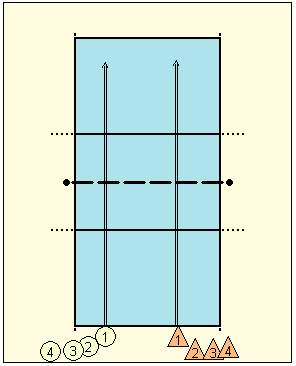 This exercise is fun to do and gives a lot of fun and competition! Relays in general already create competition.
What this exercise also wants to mimic is the stress factor that a serve brings.
The players are divided into equal teams and lined up on the serving area of the same court. The first player of a team serves and retrieves his ball. After the next player is tapped, this one serves, and so on.
It is important for a player to serve quickly, but it must also be flawless, otherwise the ball must be retrieved and served again!
If the teams are small, it is fun to have everyone serve two or three times.
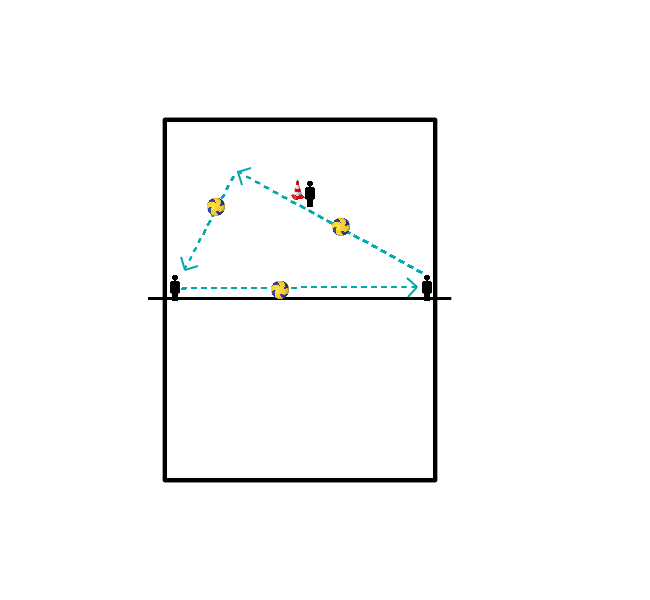 Round 1: Normal passing to each other.
Round 2: Pass the ball short or deep in the back.