

Volleyballexercises for u20
In pairs
Long pass (10x):
- 2nd player on the 3-meter line
- Player at the net hitting the ball
- 2nd player shuffles backwards (7 meters)
- Hit by player at the net
- 2nd player passes
Short pass (10x)
- 2nd player at 7 meters
- Player at the net hitting the ball
- 2nd player sprints forward
- tip-ball by player at the net
- 2nd player passes
- Holding a plate with your hands at the 9 and 3 positions, this exercise builds the core and also develops upper body strength.
- Specific to volleyball, it helps the shoulder stay healthy and aids in the transfer of power from the core to the upper body.
- This exercise, done with 2 dumbbells, is good for glute strength, hamstrings and improving an athlete's vertical jump.
- Doing exercises like colored cones circles helps improve foot speed that’s incredibly important for a volleyball player.
- First of all, you should prepare randomly colored cones.
- You should also ask a coach (or friend) to assist you with this exercise.
- At the next stage, you need to place colored cones in the circle.
- Your goal is to create a circle that is 20 feet wide.
- Now, you need to stand in the center of the circle.
- The job of a coach (or friend) is to pick one of colored cones for you.
- So, you will need to approach to the appropriate cone as soon as possible and then return back to the circle’s center using a crossover step.
- It’s fair to say that volleyball is a very fast game.
- That means that a volleyball player should be able to move quickly to do great job on the court.
- Volleyball players should focus on increasing foot speed as well as core rotational speed.
- Now, it’s time for you to get familiar with some of the best volleyball exercises for explosive speed.
- Volleyball players should do high knee skips for a number of reasons.
- It’s important to know that doing this type of exercise has a positive impact on a volleyball player’s calves, hamstrings and hip flexors.
- If you do this type of exercise regularly then you will be able to improve your vertical jump, endurance and coordination over time.
- Oftentimes, a volleyball player needs to jump off one leg during the game.
- It’s worth noting that this type of jumping is done by both attackers and defensive volleyball players.
- That’s the reason why athletes should do single leg bound exercise regularly.
- Actually, this volleyball exercise has many great benefits.
- First and foremost, doing single leg bound helps volleyball players succeed in jumping off one leg.
- On the other hand, this exercise helps a volleyball player gain the confidence that he/she needs to do this type of jumping.
- The exercise also positively affects a volleyball player’s hip as well as hip flexor and quads.
- It’s crucial for volleyball players to do single leg bound exercise the right way.
- When jumping off one leg you should try to keep your opposite knee up as high as it’s possible.
- Doing squat jumps helps volleyball players strengthen calves, glutes, hips as well as quads.
- When squatting down volleyball players should try to keep hips parallel.
- Make sure that your knees are bent at 90 degrees.
- Doing tuck jump has a profound positive impact on a volleyball player’s glutes, hips and quads.
- When doing this type of volleyball exercise you should keep your knees as high as possible.
- Plus, you need to spend as little time on the ground.
- Frog hops is the right type of volleyball exercise for developing explosive jumping power.
- If you do this volleyball exercise on a regular basis you’ll be able to strengthen the quadriceps and hamstrings over the time.
- As a result, you’ll be able to jump higher!
A game of 1 against 1 on a six meter long field
- Basisoefening:
- Player A tries to score a point against player B
- Everything is allowed, the ball has to be touched at least 2x before playing.
- Variation 1:
- The ball being played is, from now on, a hard overarm contact.
- Variation 2:
- The second contact is a soccer contact (head, knee, shoulder, breast, foot).
- Variation 3:
- Build up has to be done in 3 times.
- Ball 1 = Underhand
- Ball 2 = overarm
- Ball 3 = Attack or tip
- Build up has to be done in 3 times.
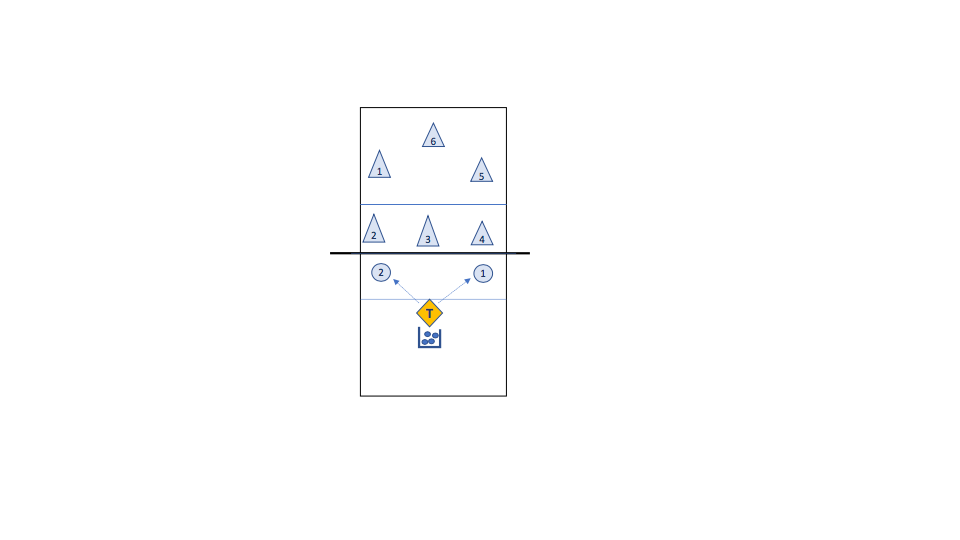
- The trainer randomly plays 1 or 2.
- From there, a set up to the other (1 or 2) is given for attacking.
- Depending on where the attack happens, 6 players on the other side of the net take the correct positions.
- Blocking, defending, and play over the net to me.
- High tempo.
- If the ball is not defended, throw it to my side of the net so that we can continue.